News
2025 Autumn Foliage Peak Viewing Forecast (as of November 6) Peak Viewing Expected to Be Delayed Across Japan; Eastern and Western Japan Likely to Reach Peak in Late November
2025.10.07
As temperatures are expected to remain above average in eastern and western Japan, where the foliage has yet to reach its peak, the leaf coloring is likely to be later than usual. In late November, the leaf coloring is expected to progress from the Kanto region through Kyushu, and it will likely be the time when many people can enjoy the autumn leaves.
The fall foliage season is not only a major seasonal highlight for domestic travelers but also a key attraction for international visitors to Japan. During this period, travel activity is expected to increase, bringing vibrancy to tourism and local economies.
PLEASE REFRAIN FROM USING THIS INFORMATION FOR CORPORATE PURPOSES WITHOUT PERMISSION (QUOTATIONS IN PRESS RELEASES OR USE FOR PROMOTIONAL PURPOSES AMONG OTHERS ARE PROHIBITIED).
For corporate use, including product PR, please visit: Contact Us
Autumn Foliage Peak Forecast for Various Regions Across Japan
This year, the peak viewing period for fall foliage is expected to be later than usual in many regions nationwide.
The timing of peak fall foliage depends on fall (September–November) temperatures: cooler weather accelerates leaf coloring, while warmer weather delays it. From September through mid-October, temperatures were higher than average nationwide. However, from late October onward, temperatures fell below average, mainly in northern and eastern Japan.
In November, northern Japan is expected to be occasionally affected by cold air, whereas in eastern and western Japan, cold air will have little influence, and temperatures are likely to remain above average. As a result, the peak viewing period in eastern and western Japan—where foliage has yet to reach its peak—is expected to be later than usual in many areas.
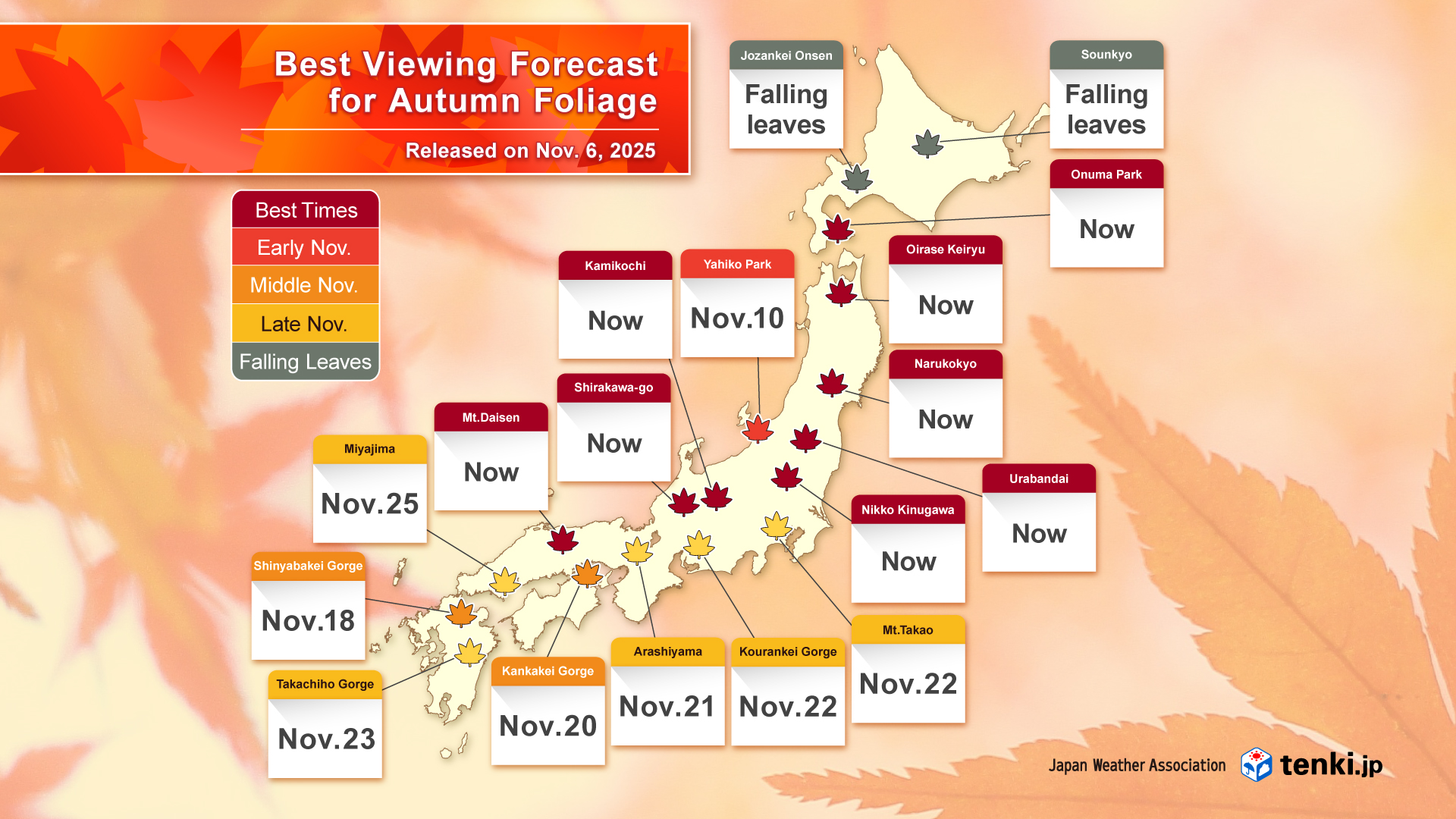
Regional Autumn Foliage Peak Forecast
Northern Japan (Hokkaido and Tohoku)
The peak viewing period for fall foliage is expected to be later than usual in many areas.
In northern Japan, temperatures remained above average until around mid-October. As a result, in Hokkaido, many locations experienced later peaks than usual.
In the Tohoku region, leaf coloring had been later than usual, but the cold spell in late October accelerated the coloring process, and many spots have reached their peak viewing. Throughout November, there will still be days affected by cold air, and in spots yet to reach their peak, many are expected to reach peak foliage around mid-November.
Eastern Japan (Kanto-Koshin, Hokuriku, Tokai)
The peak viewing period for fall foliage is expected to be later than usual in many areas.
Temperatures remained generally above average from September through mid-October, but have been below average since late October. As a result, in higher-altitude foliage spots, coloring has progressed, and many locations have already reached their peak. As November temperatures are expected to be above average, the peak viewing period in lowland areas is likely to be later than usual in many spots.
Western Japan (Kinki, Chugoku, Shikoku, Kyushu)
The peak viewing period for fall foliage is expected to be later than usual in many areas.
Temperatures remained generally above average from September through mid-October, but have mostly returned to seasonal norms since late October. However, as November temperatures are expected to be above average, the peak viewing period is likely to be later than usual in many foliage spots across western Japan.
Japan Weather Association’s Autumn Foliage Forecast
In every year, Japan Weather Association (JWA) announces forecasts for the best time for fall foliage and its viewing spots throughout Japan from September to November.
(Only available in Japanese)
- For details of the 2025 “Autumn Foliage Peak Viewing Forecast” along with information on foliage spots nationwide beyond the major locations listed above, click here: [tenki.jp] 2025 Autumn Foliage Forecast
- For color change updates for various regions:
For PC, click here: [tenki.jp] 2025 Autumn Foliage Forecast & Weather Information
For tablets and smartphones, click here: [tenki.jp] 2025 Autumn Foliage Forecast & Weather Information
What is Autumn Foliage?
Autumn foliage (Kōyō in Japanese) is a phenomenon in which the leaves of trees change color to red or yellow in fall. In Japan, the change starts around September in Hokkaido and the high-altitude areas of Honshu. Autumn foliage makes its way from north to south and can be enjoyed until December in areas between Kanto and Kyushu. The maples turn red, and the ginkgoes turn yellow.
Data Used in the Forecast
The following types of data are used to forecast the best times for foliage viewing:
- Past autumn foliage and temperature data observed by Japan Meteorological Agency (JMA)
- Past foliage data at target spots by cooperative organizations
- Temperature data of each spot forecast by JWA
In this year, the forecast will be released two more times through November. Updates will be posted on this page.
Other JWA Services to Use with Our Autumn Foliage Forecast
In addition to the autumn foliage forecast, weather forecast data can provide valuable insights for predicting the flow of people and for enabling travelers to better plan their visits.
In Japan, where weather patterns are highly volatile, the accuracy of forecasts is a critical factor influencing the quality of decisions in both travel and business. Leveraging high-precision forecasts and up-to-date meteorological data is essential for risk reduction and successful planning.
- Weather Data API
JWA’s weather API is designed to allow developers to access highly accurate weather information for any location. Data such as temperature, humidity, precipitation, snowfall, wind direction and speed, and general weather conditions can be retrieved in a single request through a user-friendly API.
For the overview, please see: Weather API Overview - Product Demand Forecasting
Analyze product sales and weather data to forecast product demand and customer traffic to adjust production volume and optimize inventory management. - 2-Year Long-Term Weather Forecasts
JWA has developed the industry’s first forecasting method that offers higher accuracy and longer forecast periods than conventional approaches. This service provides numerical forecasts for monthly temperature, precipitation/snowfall, and sunshine duration, as well as information on the rainy season and typhoon activity. For more details, please see:
What are Long-Term Forecasts? JWA’s Proprietary “2-Year Long-Term Weather Forecast” and Its Business Applications Part 1 / Part 2
For details on Japan’s fall and winter weather, please click: Fall and Winter Weather in Japan: What Global Companies Need to Know (Beyond Travel Tips)
For information on the 2025/26 winter weather outlook and its business impacts in Japan, please click: Winter 2025 Arrives Early: Be Alert for Severe Cold and Heavy Snow from December – What Are the Impacts on Business?
Please tell us about your challenges. For inquiries, please visit: Contact Us