News
Summer 2026 Weather Forecast for Japan: Temperatures May Be Above Normal
2026.03.26
According to the Japan Meteorological Agency’s warm-season forecast for summer 2026 (June–August), a nationwide trend toward above-normal temperatures is expected. The Pacific High is forecast to extend strongly toward Honshu, raising concerns that extreme heat may persist this summer.
This article explains the forecast for summer 2026 (June–August) and discusses the potential impacts of the anticipated extreme heat on daily life and various industries.
Key Points of the Summer 2026 Weather Forecast
- Temperatures across Japan are expected to be above normal in summer 2026 (June–August).
- The number of extremely hot days* may increase, particularly after the end of the rainy season.
- Total precipitation is expected to be near normal, but caution is advised for localized heavy rainfall during the rainy season.
- There are concerns about increased risks of heatstroke and rising electricity demand.
* In this article, an “extremely hot day” refers to a day when the maximum temperature reaches 35°C (95°F) or higher, which the Japan Meteorological Agency defines as “moushobi”.
Table of Contents
- [Conclusion] Will Summer 2026 Be Hotter Than Usual?
- Summer 2026 Temperature Forecast | Will It Be a Summer of Extreme Heat?
- Basis for the Summer 2026 Weather Forecast (El Niño and Global Warming)
- Outlook for Precipitation in Summer 2026
- Impacts of the Summer 2026 Heat on Daily Life and Preparations
- Japan Weather Association’s Meteorological Data Services
- Summary
- FAQ
[Conclusion] Will Summer 2026 Be Hotter Than Usual?
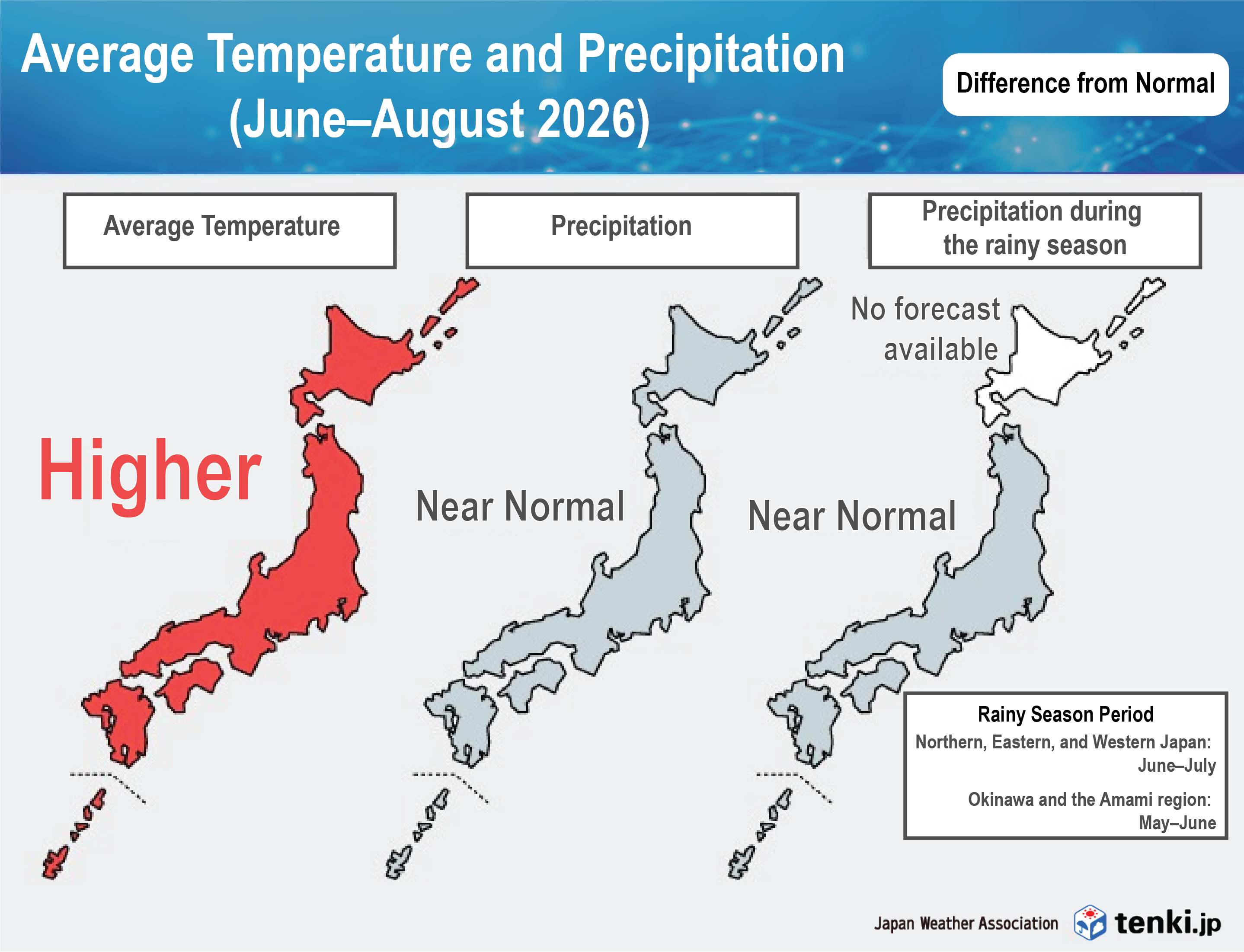
According to the warm-season forecast for June–August 2026, temperatures are expected to be higher than normal across a wide area of Japan.
As the Pacific High is expected to extend strongly over Honshu, the rainy season is likely to end earlier than usual, resulting in above-normal temperatures nationwide.
A Warm Tendency Expected to Continue from Spring
The three-month forecast for March–May 2026 also indicates that temperatures nationwide are expected to be near normal or higher.
Upper-level westerlies are forecast to flow north of normal, mainly from around Japan to the waters east of Japan, making it easier for warm air to cover the country.
Although a temporary return of colder weather is expected in March, temperatures are likely to rise more rapidly from April onward, and warmth reminiscent of early summer may arrive earlier than usual. As temperatures rise, caution is advised regarding heatstroke. Heatstroke is a general term for various symptoms that occur when the human body cannot properly adapt to hot and humid environments. For more information, please refer to the Japan Weather Association’s “Heatstroke Zero” project.
Above-Normal Temperatures Expected Nationwide in Summer 2026 (June–August)
According to the warm-season forecast, the Pacific High is expected to extend more strongly toward the vicinity of Honshu during June–August 2026, and average temperatures nationwide are likely to remain above normal.
Particularly after the end of the rainy season, the Pacific High is likely to extend toward the vicinity of Japan, and warm air is expected to dominate the upper atmosphere, which may increase the number of extremely hot days nationwide.
In recent years, summers in Japan have been characterized by significantly above-normal temperatures nationwide, increasing risks such as heatstroke.
In summer 2026 as well, global atmospheric temperatures are expected to remain high, and sea surface temperatures around Japan are also elevated, meaning there is a possibility that temperatures comparable to the extreme heat seen in recent years may occur.
In addition, the Pacific High may weaken somewhat during the latter half of summer, which could make typhoons more likely to approach Japan.
Could Summer 2026 Bring Record-Breaking Heat?
At present, it is suggested that temperatures are likely to be above normal. Long-term forecasts are probabilistic outlooks and do not guarantee that record-breaking heat will necessarily occur.
However, global temperatures are expected to remain elevated in 2026. In addition, sea surface temperatures around Japan are also expected to stay high.
Under these conditions, if multiple factors align—such as the position and meandering of the westerlies, as well as the extension of the Pacific High and the upper-level high-pressure system (the Tibetan High)—there is a possibility that heat comparable to the severe summers of recent years could occur.
Summer 2026 Temperature Forecast | Will It Be a Summer of Extreme Heat?
Regional Temperature Trends
In summer 2026 (June–August), temperatures are expected to be higher than normal nationwide.
Extremely hot days may persist after the end of the rainy season, particularly in western and eastern Japan. In northern Japan, temperatures may also be higher than normal. In Okinawa and the Amami region, the summer is expected to be hot and humid, with conditions likely to be affected by typhoons and moist air.
Across all regions, it will be necessary to prepare for increased heatstroke risks, impacts on electricity supply and demand, and effects on agriculture, tourism, and other industries.
Characteristics of the High-Temperature Trend Based on the Three-Month Average
Based on the three-month average temperature for summer 2026 (June–August), above-normal temperatures are expected nationwide.
This is because, in addition to elevated global temperatures, the westerlies are expected to flow north of normal around Japan, and the Pacific High is forecast to extend more strongly toward the vicinity of Honshu.
How Summer 2026 Compares with Recent Summers
In recent years, summers in Japan have continued to be marked by a trend of record-breaking heat.
In particular, from 2023 to 2025, the nationwide average temperature for summer (June–August) was significantly above normal. The summer of 2025 was 2.36°C above normal, marking the highest value since records began in 1898.
This is thought to be due to the long-term warming trend associated with global warming, together with the combined influence of large-scale atmospheric circulation patterns, such as the extension of the Pacific High and the position of the upper-level westerlies (the jet stream).
For summer 2026, the latest seasonal forecast also indicates the possibility of above-normal temperatures. If heat comparable to that of recent years occurs, the number of extremely hot days may increase.
Basis for the Summer 2026 Weather Forecast (El Niño and Global Warming)
From a La Niña–like Tendency Toward El Niño
Toward summer 2026, the distribution of sea surface temperatures in the tropical Pacific is expected to shift from La Niña–like conditions toward El Niño–like conditions.
Although El Niño is often perceived as bringing unsettled summer weather in Japan, its influence does not necessarily appear immediately.
Across the Asian region, the influence of La Niña–like conditions is expected to persist until summer 2026, and convective activity, including cumulonimbus cloud formation, is forecast to intensify over the ocean east of the Philippines.
As a result, the Pacific High is likely to extend toward Japan, creating conditions that favor higher temperatures.
The Impact of Global Warming
In recent years, Japan’s summers have been marked by record-breaking heat.
This is thought to reflect not only short-term weather variability, but also the upward shift in baseline temperatures associated with global warming.
In summer 2026, if multiple factors overlap—such as the meandering of the westerlies and the extension of the Pacific High and the upper-level high-pressure system (the Tibetan High)—there is a possibility that extreme heat comparable to that of recent years could occur.
Outlook for Precipitation in Summer 2026
Summer (June–August) Precipitation Expected to Be Near Normal Nationwide
According to the warm-season forecast for summer 2026 (June–August), precipitation is expected to be near normal nationwide.
However, toward the end of the rainy season, and from late summer into autumn, precipitation may increase due to influences such as typhoons approaching Japan.
Precipitation Trends During the Rainy Season
During the June–July rainy season, precipitation in northern, eastern, and western Japan is expected to be generally near normal.
However, instead of prolonged rainfall over wide areas, localized heavy rain may occur more frequently, potentially increasing regional variation in precipitation, with some areas receiving more rain and others less.
Impacts of the Summer 2026 Heat on Daily Life and Preparations
Points to Watch for This Summer
Temperatures in summer 2026 are expected to be higher than normal nationwide.
If this above-normal heat continues, the risk of heatstroke may increase.
One important measure is heat acclimatization, which refers to the body gradually adapting to heat.
Without proper heat acclimatization, the body cannot effectively regulate or release heat, increasing the risk of heatstroke.
Such high-temperature trends may also affect business activities.
Because temperature trends can shift the timing of demand and peak sales periods, businesses may need to adjust inventory distribution and advance promotional campaigns.
In addition, above-normal temperatures will inevitably increase demand for air conditioning.
In particular, as the number of extremely hot days increases, air conditioners will run for longer periods, which may result in higher electricity consumption for both households and businesses.
Japan Weather Association’s Meteorological Data Services
Weather Data API
JWA’s weather API is designed to provide developers with access to highly accurate weather information for any location. Developers can retrieve data such as temperature, humidity, precipitation, snowfall, wind direction and speed, and weather conditions in a single request through a user-friendly API.
For the overview, please see: Weather API Overview
2-Year Long-Term Weather Forecast (Only Available in Japanese)
JWA has developed the industry’s first forecasting method that offers higher accuracy and longer forecast periods than the conventional approach. This service provides numerical forecasts for monthly temperature, precipitation/snowfall amounts, and sunshine duration, as well as information on the rainy season and typhoon activity.
In addition to data provision, we also offer consulting services to help clients effectively utilize long-term forecasts.
The 2-Year Long-Term Weather Forecast (Only Available in Japanese) provides insights into seasonal and monthly weather trends, as well as two-year-ahead demand forecasts for specific products, along with recommendations on inventory planning and promotional timing. We also offer weather trend forecasting and consulting services for the fall and winter seasons of 2026.
For more details on 2-Year Long-Term Weather Forecasts, please click: What are Long-Term Forecasts? JWA’s Proprietary “2-Year Long-Term Weather Forecast” and Its Business Applications Part 1 / Part 2
Product Demand Forecasting
By analyzing weather conditions and product sales data, this service forecasts product demand and customer traffic, helping businesses adjust production volumes and optimize inventory management.
Logistics-oriented GoStop Management System
This web service provides weather-related transportation risk information, supporting decision-making that helps protect both lives and cargo in logistics operations.
The service provides transport impact risk forecasts up to six days in advance of severe weather, displayed through maps and tables, covering expressways, national highways, railways, and maritime transport (ports and shipping routes) across Japan.
Summary
According to the Japan Meteorological Agency’s warm-season forecast, temperatures in summer 2026 (June to August) are expected to be above normal nationwide.
With above-normal temperatures expected from spring and the Pacific High likely to strengthen after the end of the rainy season, many regions may experience severe heat.
Given the trend of record-breaking heat in recent years, it will again be important to prepare for the risk of extreme heat this summer.
On the other hand, precipitation nationwide is expected to be generally near normal.
However, even if precipitation is described as near normal, periods influenced by fronts or approaching typhoons may bring heavy rainfall, and precipitation may increase from late summer into autumn. It is therefore important to pay attention not only to total precipitation but also to rainfall patterns.
Several factors are considered to be behind the forecast of above-normal temperatures:
- The Pacific High tends to extend toward Japan
- The position of the westerlies tends to be north of normal
- The influence of atmospheric circulation, including ocean conditions such as El Niño and La Niña
- The upward shift in baseline temperatures associated with global warming
Together, these factors reflect the combined influence of the atmosphere and oceans, contributing to above-normal temperatures across Japan.
Extreme heat can have wide-ranging impacts on daily life and business, including increased heatstroke risk, higher electricity demand, effects on crop growth and price fluctuations, and changes in demand for summer-related products.
With a high likelihood of above-normal temperatures in summer 2026, it will be important to take early heat-preparedness measures and review demand and supply planning.
FAQ
Q1. Will the summer of 2026 in Japan be hot?
A. Yes. According to the Japan Meteorological Agency’s warm-season forecast (June–August), temperatures in Japan during summer 2026 are expected to be higher than normal nationwide. Above-normal temperatures are expected across wide areas as the Pacific High is likely to extend toward Japan.
Q2. Will temperatures in Japan be above normal in summer 2026?
A. Forecasts indicate that above-normal temperatures are most likely nationwide.
Q3. Will summer 2026 be extremely hot in Japan?
A. Current outlooks indicate a high likelihood of an extremely hot summer. However, long-term forecasts are probabilistic and do not guarantee record-breaking heat. Nevertheless, as recent years have seen persistent record-high temperatures, it is important to prepare for the possibility of severe heat again this year.
Q4. When will the heat begin in Japan in summer 2026?
A. Temperatures are expected to be above normal from spring (March–May), and the heat may intensify after the rainy season ends. If the rainy season ends earlier than usual, the start of midsummer-like heat may also come earlier.
Q5. What will the rainy season in Japan be like in 2026?
A. At present, the amount of precipitation during the rainy season is expected to be near normal in northern, eastern, and western Japan. According to the Japan Weather Association’s independent long-term weather forecast, the start and end of the rainy season may also occur earlier than usual.
Q6. Will precipitation increase in Japan during summer 2026?
A. Total precipitation from June to August is expected to be near normal nationwide. However, when fronts or typhoons affect the country, short periods of heavy rainfall may occur. It is important to pay attention not only to total rainfall but also to rainfall patterns.
Q7. Should people watch out for heatstroke in Japan during summer 2026?
A. Yes. Because high temperatures are expected nationwide, the risk of heatstroke is likely to increase. The risk is particularly high immediately after the end of the rainy season, when the body has not yet acclimatized to the heat. Drinking water regularly, heat acclimatization, and using the WBGT (Wet-Bulb Globe Temperature) heat index are important preventive measures.