News
Part 2: Product Demand Forecasting Using Weather Data
2025.12.08
Product demand forecasting that incorporates weather data is an essential approach for optimizing inventory management, improving sales planning, and maximizing revenue. At Japan Weather Association (JWA), we leverage proprietary weather data together with product sales data to deliver highly accurate demand forecasts. With JWA’s demand forecasting, companies can both maximize sales opportunities and reduce inventory-related costs.
This article introduces the effects of demand forecasting, industry-specific use cases, and efforts to improve accuracy. In Part1, the mechanism behind JWA’s high-precision product demand forecasting using weather data is explained.
For Part1, please click: Part 1: Product Demand Forecasting Using Weather Data
Key Points of This Article
-
How to apply high-accuracy industry-specific product demand forecasting
Achieves outcomes such as maximizing sales opportunities (average customer-traffic forecasting accuracy of 93.3%) and reducing costs (final inventory reduced by 54%).
-
Continuous improvement of forecasting accuracy through dedicated efforts
High-accuracy demand forecasting is supported by the use of AI and proprietary indicators, segment optimization by area and category, data quality management, and a structured cycle of verification.
Key Points of This Article
- How to apply high-accuracy industry-specific product demand forecasting
Achieves outcomes such as maximizing sales opportunities (average customer-traffic forecasting accuracy of 93.3%) and reducing costs (final inventory reduced by 54%).
-
Continuous improvement of forecasting accuracy through dedicated efforts
High-accuracy demand forecasting is supported by the use of AI and proprietary indicators, segment optimization by area and category, data quality management, and a structured cycle of verification.
Table of Contents
Case Examples on the Impact of Using Weather Forecasts for Demand Prediction
-
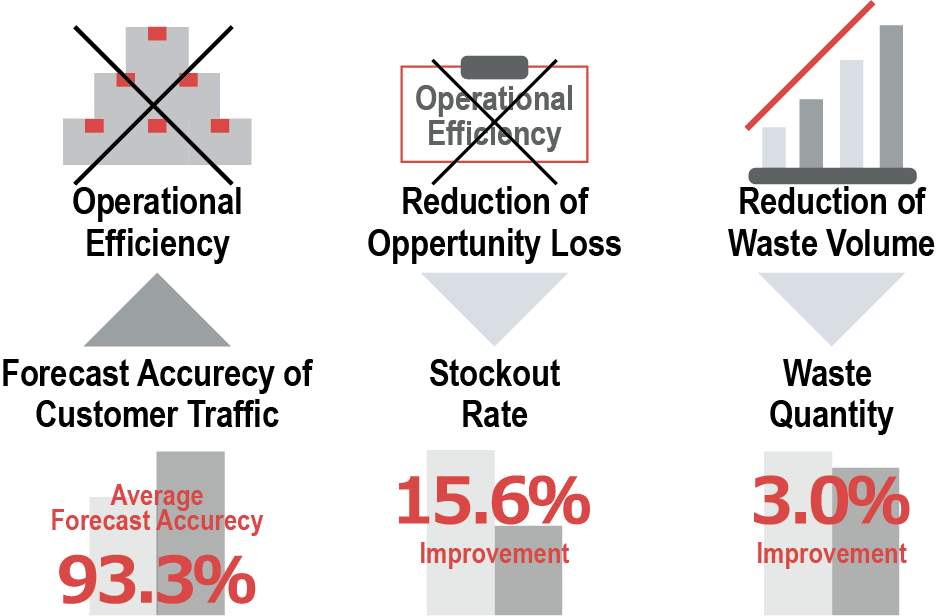
Effects of using short-term forecasting: Accurately predicts customer traffic and reduces both stockout and waste rates
- Average accuracy of customer traffic forecasting: 93.3%
- Stockout rate: 15.6% reduction
- Waste volume: 3.0% reduction
-
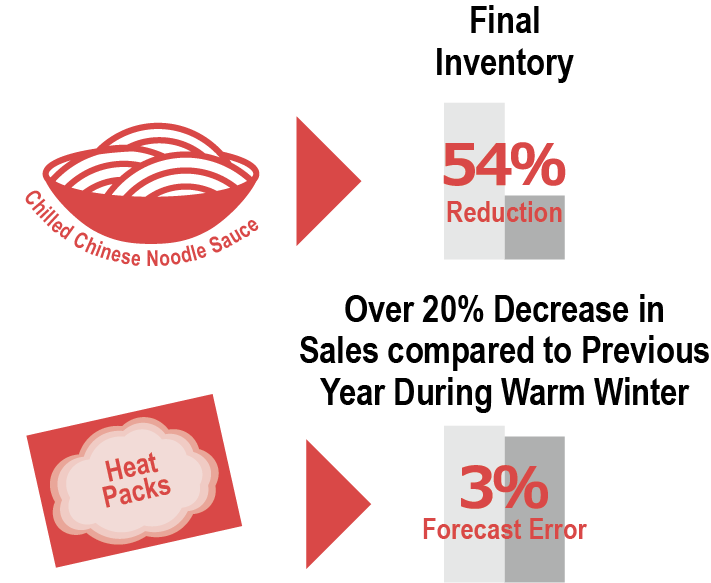
Effects of Using Medium-Term Forecasts: reduced leftover inventory of seasonal products and accurate prediction of year-to-year trends
- Final inventory of chilled Chinese noodle sauces: 54% reduction
- Sales forecast for disposable heat packs: During a warm winter, a 20% year-on-year decrease was forecast with only a 3% error margin.
-
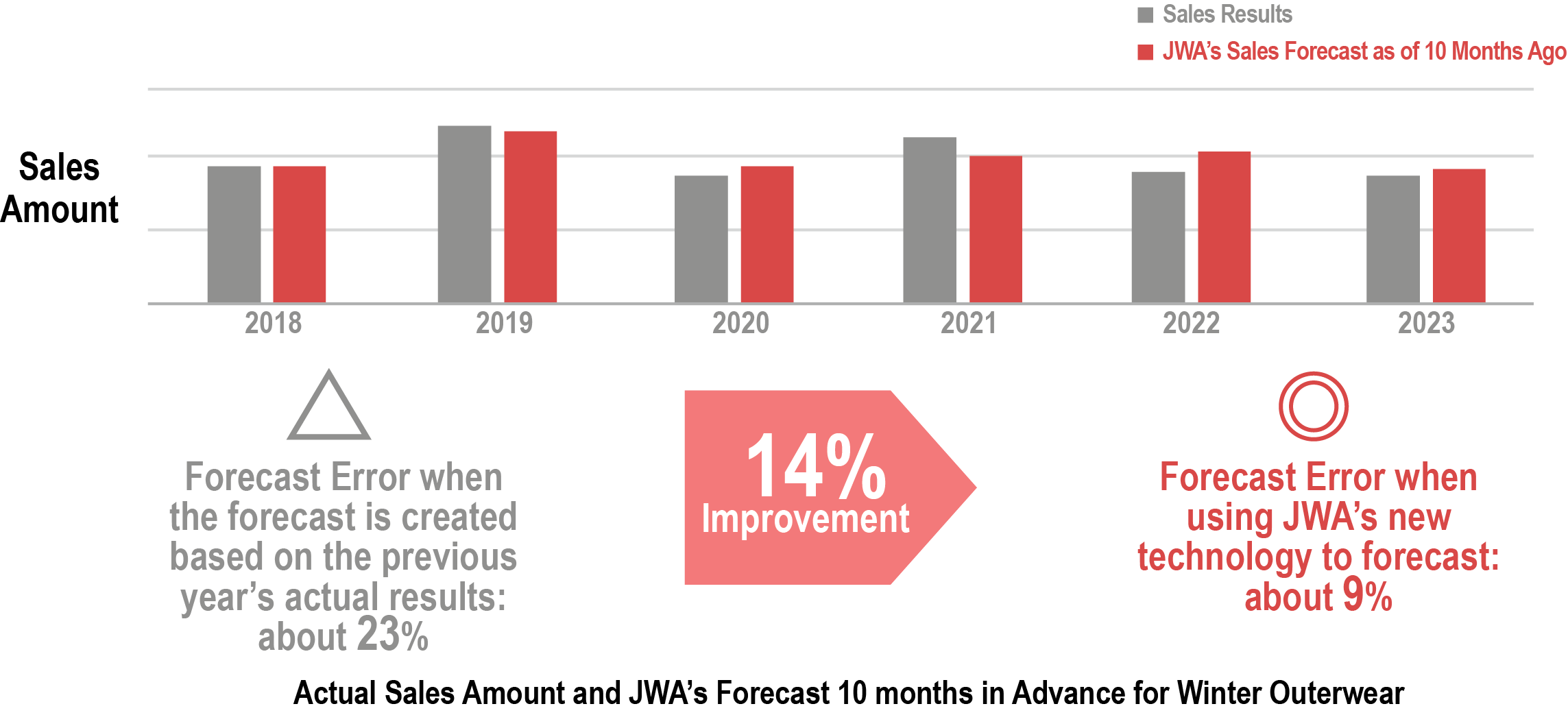
Effects of Using Long-Term Forecasts: Improved forecast accuracy by 14% compared with forecasts based on the previous year’s results
- For seasonal sales of winter outerwear, demand forecasts based on the previous year’s results had an error of about 23%, whereas forecasts using JWA’s new technology reduced the error to about 9%, improving accuracy by 14 %.
Industry-Specific Use Cases
- Apparel
Analyzes product and weather data to understand factors such as the timing of sales for each item and its relationship with temperature.
- Manufacturing
Analyzes product data (shipment volumes and POS data) together with weather data to support production, shipping, and sales of the right quantities at the right time.
- Retail
Builds highly accurate, user-friendly forecasting models that account for weather fluctuations. Supports retailers—whose operations are sensitive to weather factors such as rain and temperature—by improving efficiency in daily ordering operations.
- Energy
- Power generation companies: Optimizes generation plans in advance(reducing surpluses and shortages), cost minimization through improved accuracy in fuel procurement, plan for new development and maintenance of power plants, and maximize revenue through optimized electricity sales including bilateral transactions.
- Electricity retail companies: Strengthen medium‐ to long‐term procurement strategies (reducing price volatility risk) and hedge risks through the use of electricity futures markets.
-
Use Cases
- Mizkan Co., Ltd. (Only Available in Japanese): Leveraging demand forecasting for seasonal products such as chilled Chinese noodle sauce and hot pot soup base, forecasting demand in the late season and adjusting production to avoid surpluses and shortages.
- Morinaga&Co., Ltd. (Only Available in Japanese): Leveraging demand forecasting data for its ice cream and jelly drink business, adjusting shipment volumes based on regional variations in heat and demand, reducing inventory imbalances and improving operational efficiency.
For other use cases, please click: Cases (Only Available in Japanese)
Efforts to Improve Forecast Accuracy
-
Model Enhancement Using AI and Proprietary Indicators
Multiple techniques—including machine learning and statistical models—are combined to select the optimal model for each item and industry. In addition to temperature and precipitation, proprietary weather indicators with a strong relationship to human behavior—such as a “perceived temperature index” derived from social media— are incorporated as features. This allows JWA to capture demand fluctuations that closely reflect actual consumer needs.
-
Segment-Specific Forecast Optimization
Rather than applying a uniform nationwide model, JWA builds and fine-tunes demand forecasting models by segment—such as product category, area, and store format (urban / suburban). This approach reflects differences such as “even under the same weather conditions, sales patterns vary by area and type of business,” resulting in high-accuracy forecasts that are practical for on-site use.
-
Data Quality Management and a Continuous Verification and Improvement Cycle
Missing or abnormal values in sales and weather data are automatically detected and corrected. Meta-information such as sales promotions, campaigns, and price revisions is also incorporated to more accurately extract the impact of weather. After implementation, JWA continuously analyzes forecasting errors by comparing forecasted and actual values, conducting post-season reviews, PoC activities, and A/B tests. By continually refining the model structure, features, and parameters based on these analyses, JWA can adapt to changes in climate and consumer behavior over time.
Conclusion
JWA’s product demand forecasting is a weather-data-driven service that supports inventory optimization, maximization of sales opportunities, and cost reduction.
For more details on product demand forecasting, please click: Product Demand Forecasting
For Part 1, please click: Part 1: Product Demand Forecasting Using Weather Data
Please tell us about your challenges. For inquiries, please visit: Contact Us