News
Japan’s 2025–2026 Winter Snow Risks: Business Impacts and Solutions for Logistics, Energy, and Retail
2025.12.23
During Japan’s 2025–2026 winter, winter-type pressure patterns are expected to occur frequently. In particular, when the southward movement of cold air intensifies, there is an increased risk of heavy snowfall.
Snow and low temperatures can disrupt business operations across many industries. This winter, in particular, snow and cold-related risks are expected to occur earlier than usual, raising concerns about potential business impacts. Companies are therefore urged to recognize these risks early and prepare accordingly.
This article introduces weather APIs and services that can be used for winter risk management.
For an introduction to Japan’s snow and business impacts, please click: Snow in Japan Explained
Table of Contents
How Will Snow and Cold Affect Businesses in Japan?
Overall impact on business operations
Snow and low temperatures can disrupt operations across many industries. This winter, in particular, snow and cold-related risks are expected to occur earlier than usual, raising concerns about impacts on the following sectors.
Logistics and transportation
When cold air masses move southward, heavy snowfall may occur, particularly along the Sea of Japan coast—potentially affecting transport and delivery operations.
- For deliveries to snow-prone regions, early shipments and ample lead time are essential.
- Advance preparation for alternative routes and transfers between hubs is necessary.
- Vehicles should be equipped early with winter tires, tire chains, spare fuel, and other winter gear.
- Additional time for loading and unloading should be expected during heavy snowfall.
- From about one week in advance, when snowfall forecast accuracy improves, frequent plan reviews based on the latest forecasts are effective.
For snow and cold-weather countermeasures in the logistics and transportation sectors, we also recommend using GoStop Management System which enables companies to identify transport impact risks up to six days in advance.
*GoStop Management System is only available in Japan.
Energy, power, and gas utilities
As temperatures drop, electricity and gas demand may rise earlier than usual.
- Early-season snowfall may affect equipment maintenance and fuel procurement plans.
- Power generation plans should account for the risk of reduced output caused by snow accumulation on PV panels.
- Supply plans should be reviewed to prepare for demand peaks driven by cold weather.
ENeAPI, an API Service for the Energy Industry, supports improved planning accuracy by offering not only solar power generation and electricity demand forecasts but also risk information such as snow accumulation and snowfall amounts.
Retail, manufacturing, and supply chains
Cold weather may cause fluctuations in product demand and vegetable prices. In addition, localized heavy snowfall may affect logistics and supply chains.
- Sudden increases in demand for winter-related products.
- Delivery delays due to snow accumulation may lead to stockout risks.
- Sudden cold spells and fluctuating demand may cause price volatility, such as in vegetables.
*Product Demand Forecasting: Demand is predicted by analyzing product data and weather data.
*Vegetable market price forecasting (Only Available in Japanese): Predicts trading prices and volumes based on weather conditions in production areas and demand trends.
What Weather Data Solutions Can Businesses Use?
Weather Data API: “Snow Accumulation Information”
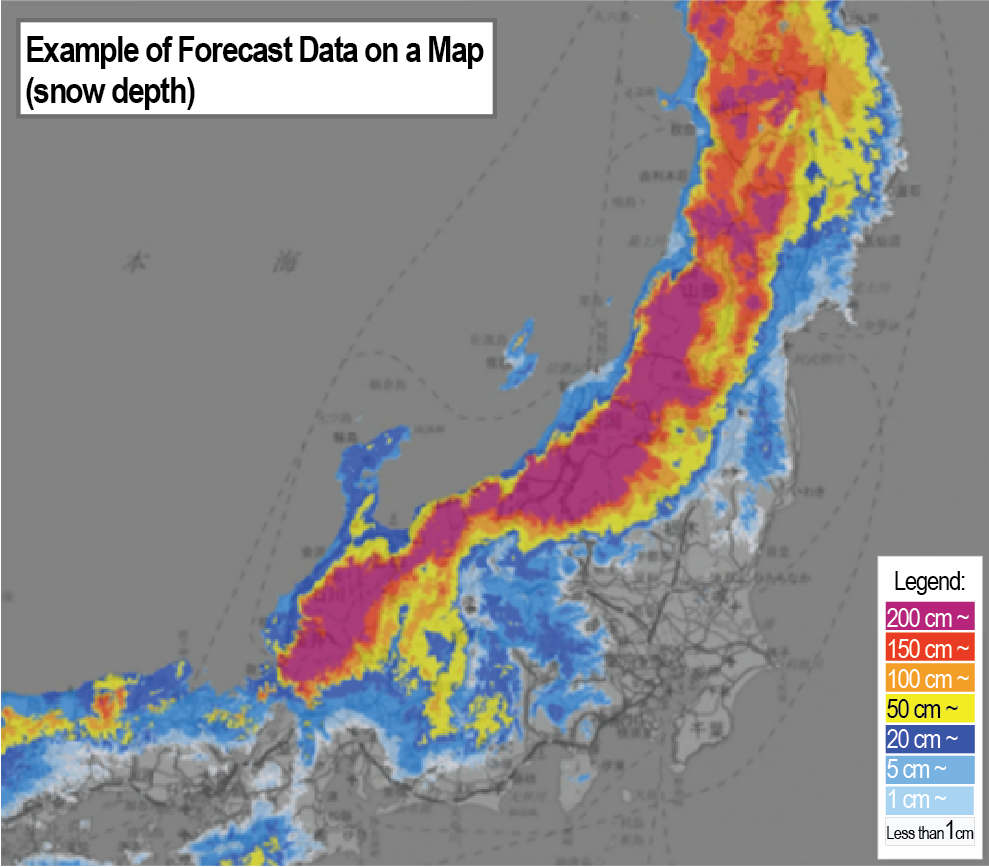
The high-resolution snow information service developed by Japan Weather Association—“JWA Snow Accumulation Information (Snow Accumulation Information API)”—enables precise snow accumulation monitoring for industries affected by snowfall, including logistics, construction, and energy.
Overview of the Main Features of “Snow Accumulation Information”
- Provides high-resolution snow accumulation data at 1 km mesh.
- Forecasts changes in snow accumulation and snow quality up to 96 hours (four days) ahead.
- Supports multiple parameters, including snow depth, snow density, snow water equivalent, and water amount reaching the ground surface.
- Available in various formats, including Web API, map visualization, and area-based distribution.
Use Cases
- Logistics: Identify peak snow accumulation periods to inform departure scheduling and route decisions.
- Construction: Support site operation decisions and safety management.
- Energy: Monitor snow accretion on transmission and power generation facilities and identify related risks.
- Retail and manufacturing: Enable advance adjustments to avoid stockouts and transportation disruptions.
ENeAPI: Snowfall amount and snow depth forecast API
ENeAPI, an API Service for the Energy Industry, provides estimated snow-depth values and snowfall amount forecasts up to two weeks in advance. These datasets help assess conditions of snow accumulation on equipment and support understanding longer-term snow-related risks.
In addition to snow-related information, the service provides numerous APIs that support a wide range of energy-sector use cases, including solar and wind power generation, retail electricity, grid-scale battery, energy management, and Operations and Maintenance (O&M).
Main Items Provided
- Analyzed snow depth
- Snowfall amount forecasts (up to two weeks ahead)
- Solar radiation and photovoltaic output estimates/forecasts
- Regional electricity demand forecasts
- Electricity market price forecasts and more.
Use Cases
- Operation control of snow-melting equipment
- Formulating equipment maintenance plans
- Early detection of snow accumulation-related impacts
- Improving the accuracy of supply-demand and power generation planning
For more details, please click: ENeAPI
For inquiries, Contact Us
For information on this winter’s electricity supply and demand, please click: 2025 Winter Weather and Power Supply–Demand Outlook: Cold Wave Risks and Preparedness for Supply–Demand Shortages (Only Available in Japanese)
Web Service Optimized for Transport Decision-Making: GoStop Management System
GoStop Management System is a web service that provides transport-impact risk information specifically for the logistics industry.
Features
- Allows users to identify transport impacts from heavy snow, typhoons, and other events up to six days in advance.
- Consolidates impact information across highways, national routes, railways, marine transport (ports and sea routes), and aviation.
- Can be used as objective documentation when explaining conditions to shippers.
For more details, please click:GoStop Management System
For inquiries, Contact Us
How Should Businesses Prepare for Japan’s 2025–2026 Winter?
With cold weather arriving earlier and snow impacts expected to occur sooner this winter, it is essential to establish a workflow that enables decision-making before snow begins to fall.
By utilizing JWA’s Snow Accumulation Information API, ENeAPI, and GoStop Management System, businesses in logistics, energy, retail, and other snow-impacted sectors can begin preparations early.
Feel free to Contact Us for consultations regarding the implementation of snow accumulation and snowfall APIs, web services, or data delivery solutions.
For more information on the weather complexities in other seasons in Japan, please click:
Why Is Japan’s Weather So Difficult to Forecast?
For year-end and New Year weather information, please click:
2025–2026 Year-End and New Year Weather Forecast: Rain or Snow at Year-End, and a Possible Heavy Snow Event on the Sea of Japan Side During the New Year Cold Wave” (Only Available in Japanese)
FAQ
Q1. How far in advance can snow accumulation be forecast?
A. The snow accumulation information provided through Weather Data API offers forecasts up to 96 hours ahead, while ENeAPI provides snowfall amount forecasts up to two weeks in advance. Support for other weather elements and delivery formats is also available. Please feel free to Contact Us.
Q2. What kinds of systems can the APIs integrate with?
A. Weather Data API and ENeAPI are provided in JSON and CSV formats. They can be integrated with a wide range of systems, including operational and transport management systems, equipment control, BI tools, and internal applications, and more. Please Contact Us for details.
Q3. Is there information specifically useful for logistics operations?
A. Yes. The GoStop Management System allows users to monitor transport impact risks across highways, national routes, railways, marine transport, and aviation—all in a single web service. It helps reduce information-gathering time and enhances safety.
*GoStop Management System is only available in Japan.
Q4. How can the JWA Snow Accumulation Information (Snow Accumulation Information API) be utilized in business operations?
A. JWA Snow Accumulation Information (Snow Accumulation Information API) can be used in operations where accurate snow monitoring is required, such as delivery planning, construction-site operation decisions, equipment maintenance, and retail inventory adjustments. We can also provide guidance on how to apply the data. Please feel free to Contact Us .