News
How Do Extreme Heat and Summer Weather Affect Electricity Supply-Demand Balance and Spot Market Prices? Understanding Summer-Specific Characteristics Through Temperature, Solar Radiation, and Weather Conditions
2026.08.05
Electricity supply and demand—particularly demand—and spot market prices in summer exhibit seasonal patterns because they are affected by weather conditions and the resulting changes in human activity.
Various seasonal patterns can be observed in both actual electricity supply-demand conditions and the spot market prices on the Japan Electric Power Exchange (JEPX), where retail electricity providers procure electricity. Understanding the patterns specific to summer is therefore useful for efficient electricity supply-demand management.
What You Will Learn from This Article
- How temperatures and other weather conditions affect electricity demand in summer
- How hot days and changes in solar radiation affect spot market prices
- How to use weather data in electricity demand and market price forecasting
This article explains how electric utilities, retail electricity providers, and professionals responsible for supply-demand management and market trading, can use changes in summer weather to support supply-demand management and procurement decisions.
Table of Contents
What Is the Relationship Between Electricity Demand and Weather? Why Weather Variables Matter
Electricity demand fluctuates in response to various factors that affect our daily behavior.
These factors include both social and weather-related factors. Among them, temperature is one of the factors with a particularly large impact.
| Social Factors | Weather Factors |
|---|---|
|
|
Seasonal Changes in Electricity Demand
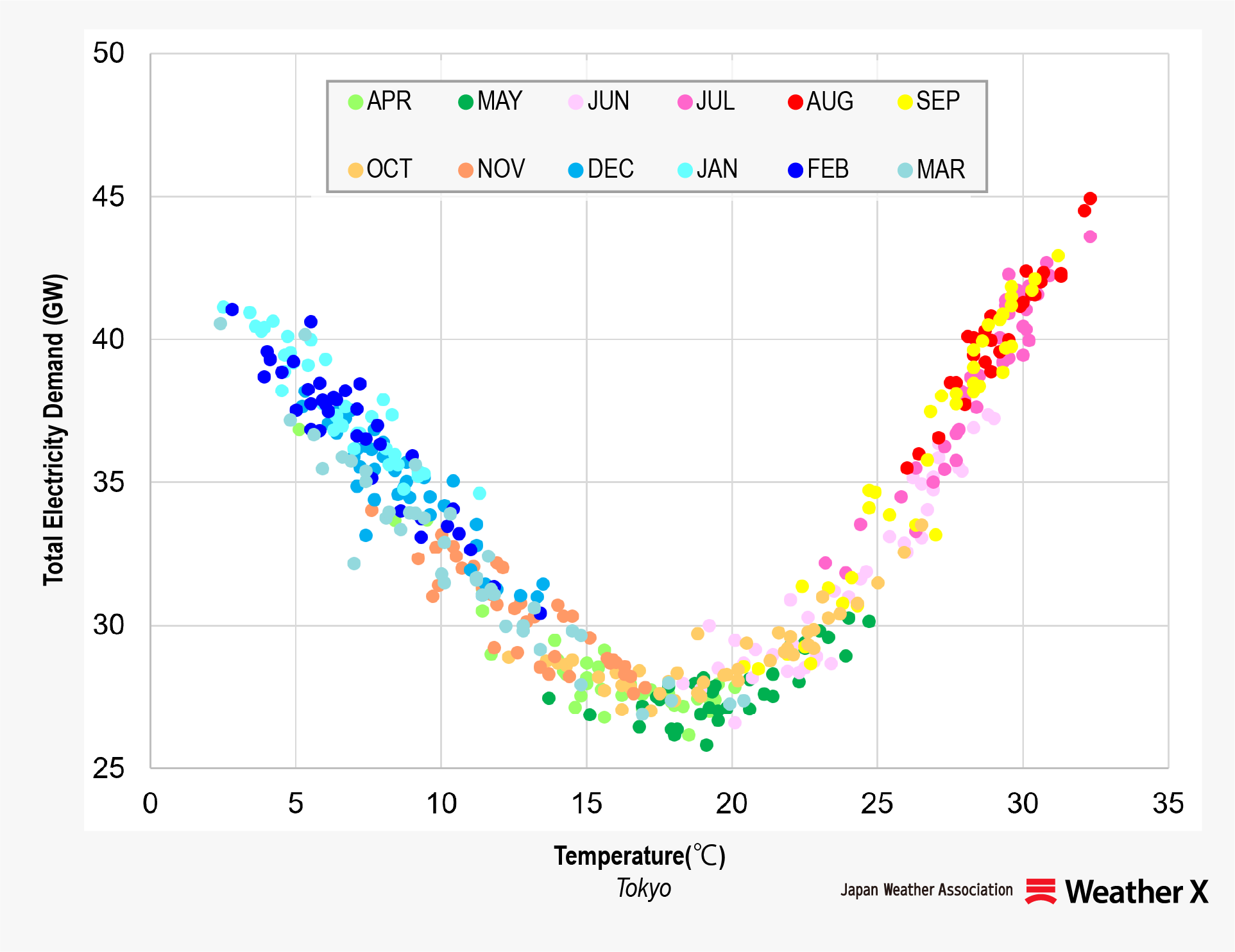
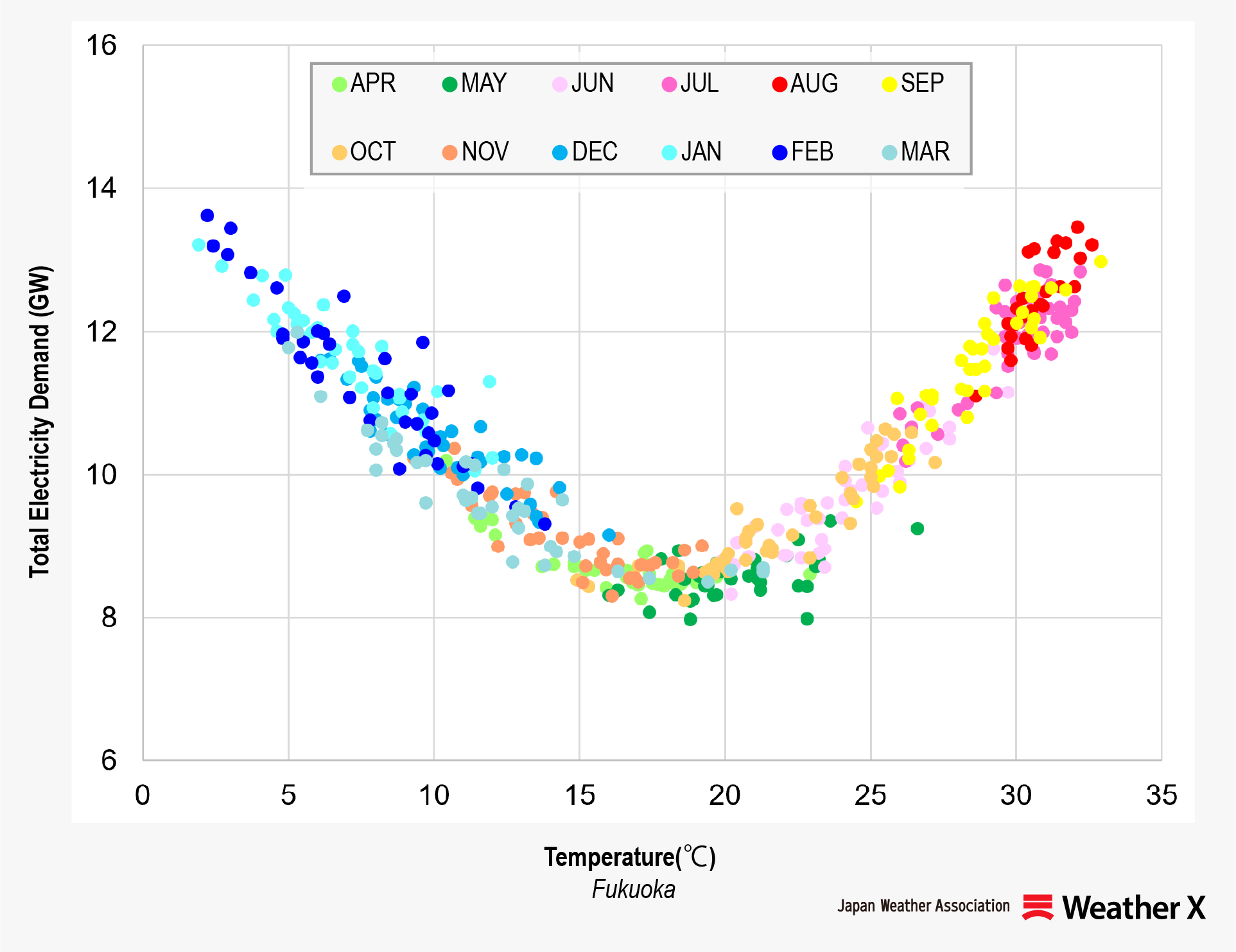
Looking at demand by season, fluctuations are relatively moderate in spring and autumn.
By contrast, in summer and winter, temperature has a strong influence and demand fluctuates more widely. In summer in particular, demand tends to increase as temperatures rise.
Demand is also affected by regional characteristics. Urban areas tend to see concentrated cooling demand because of their large populations, while differences in population composition and industrial structure also have an impact. It is therefore important to understand weather information appropriate to the area concerned.
| Tokyo Area | Kyushu Area |
|---|---|
|
|
Figure 1. Relationship Between Total Electricity Demand and Temperature in the Tokyo and Kyushu Areas (FY2024–FY2025, Weekdays)
Summer Electricity Demand: Weather Forecast Accuracy Has a Major Impact
Characteristics of Electricity Demand
Although regional differences exist, summer electricity demand increases markedly during periods of high temperatures.
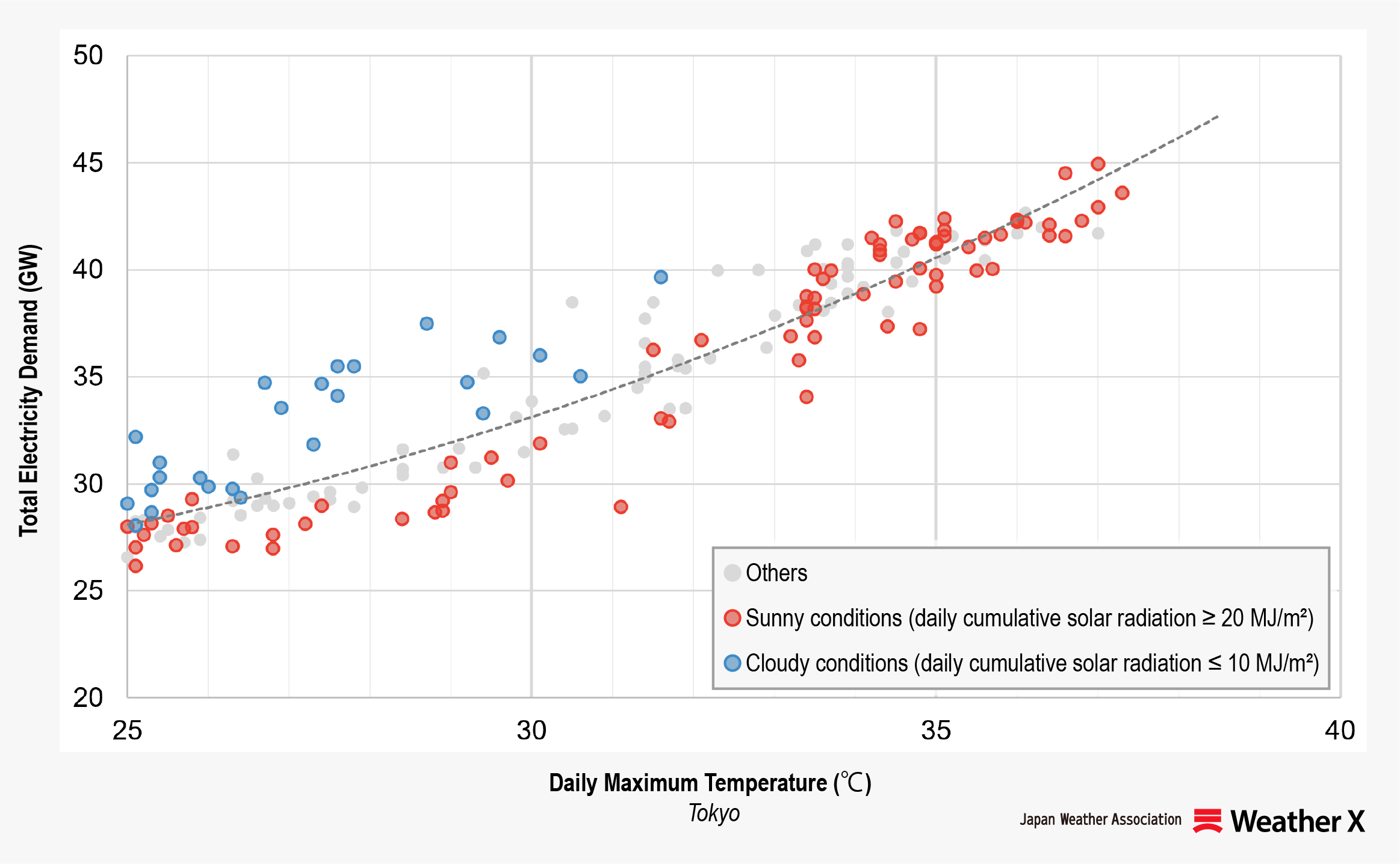
Cooling demand rises as temperatures increase, raising total demand across the area. In the Tokyo area, the amount by which demand increases for each 1°C rise in temperature (temperature sensitivity) becomes greater at higher temperatures. This means that the need for highly accurate weather data becomes even greater during periods of extreme heat.
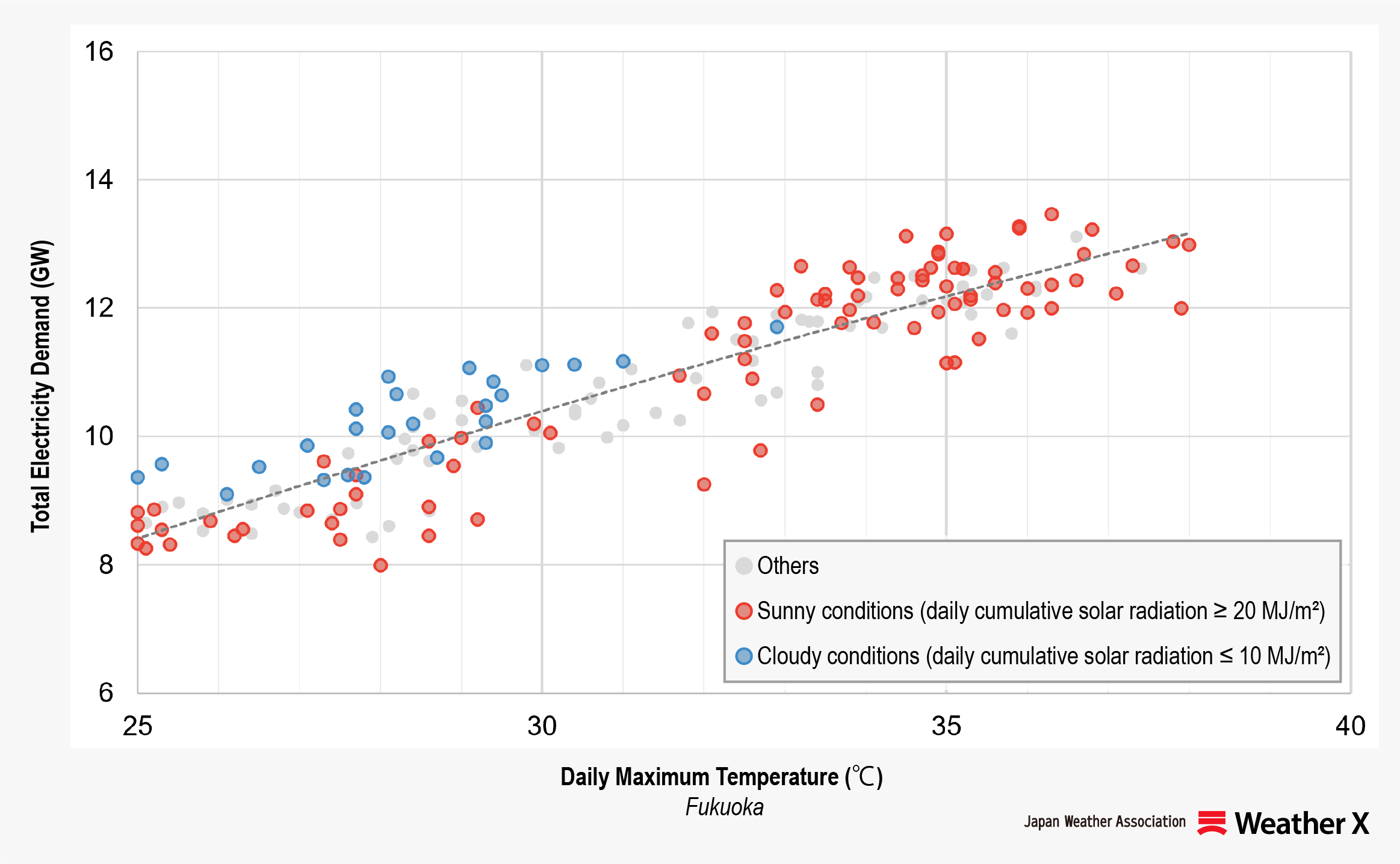
Moreover, demand varies with weather conditions even at the same temperature. Figure 2 shows that, within temperature ranges up to around 30°C, electricity demand tends to be relatively lower under sunny conditions and higher under cloudy conditions, even within the same temperature range.
This may be due mainly to factors such as:
- Differences in the amount of self-consumed solar power depending on weather conditions
- Changes in lighting demand depending on weather conditions
- Increased thermal discomfort due to higher humidity under cloudy conditions
These points indicate that multiple weather factors, rather than temperature alone, need to be considered together.
| Tokyo Area |
|
|---|---|
| Kyushu Area |
|
Figure 2. Relationship Between Total Electricity Demand and Daily Maximum Temperature in the Tokyo and Kyushu Areas (FY2024–FY2025, Weekdays)
Business Challenges
In summer, weather conditions and temperature have a strong impact on electricity demand, making the following challenges more likely:
- Even slight changes in weather or temperature can reduce the accuracy of electricity demand forecasts, resulting in discrepancies between planned and actual values.
- Larger demand fluctuations make balancing supply-demand more difficult and increase the likelihood of imbalances.
These issues affect not only short-term supply-demand operations but also market trading.
Use of Weather Data
Under these conditions, the use of weather data is important. It is necessary to understand multiple factors, including not only temperature but also solar radiation and cloud cover. Using weather information suited to the area concerned can improve demand forecast accuracy and, as a result, help stabilize supply-demand operations.
Impact on Spot Market Prices
Spot market prices are the transaction prices for electricity delivered the following day on the spot market of the Japan Electric Power Exchange (JEPX). Prices are determined in 30-minute intervals and published as area prices for each area. A system price is also published as an indicator calculated by aggregating bidding results nationwide.
Characteristics of Spot Market Prices
Fluctuations in electricity demand also affect spot market prices. In summer, price levels tend to rise due to increased demand and tighter supply-demand conditions. Another characteristic is that the range of price fluctuations also tends to widen.
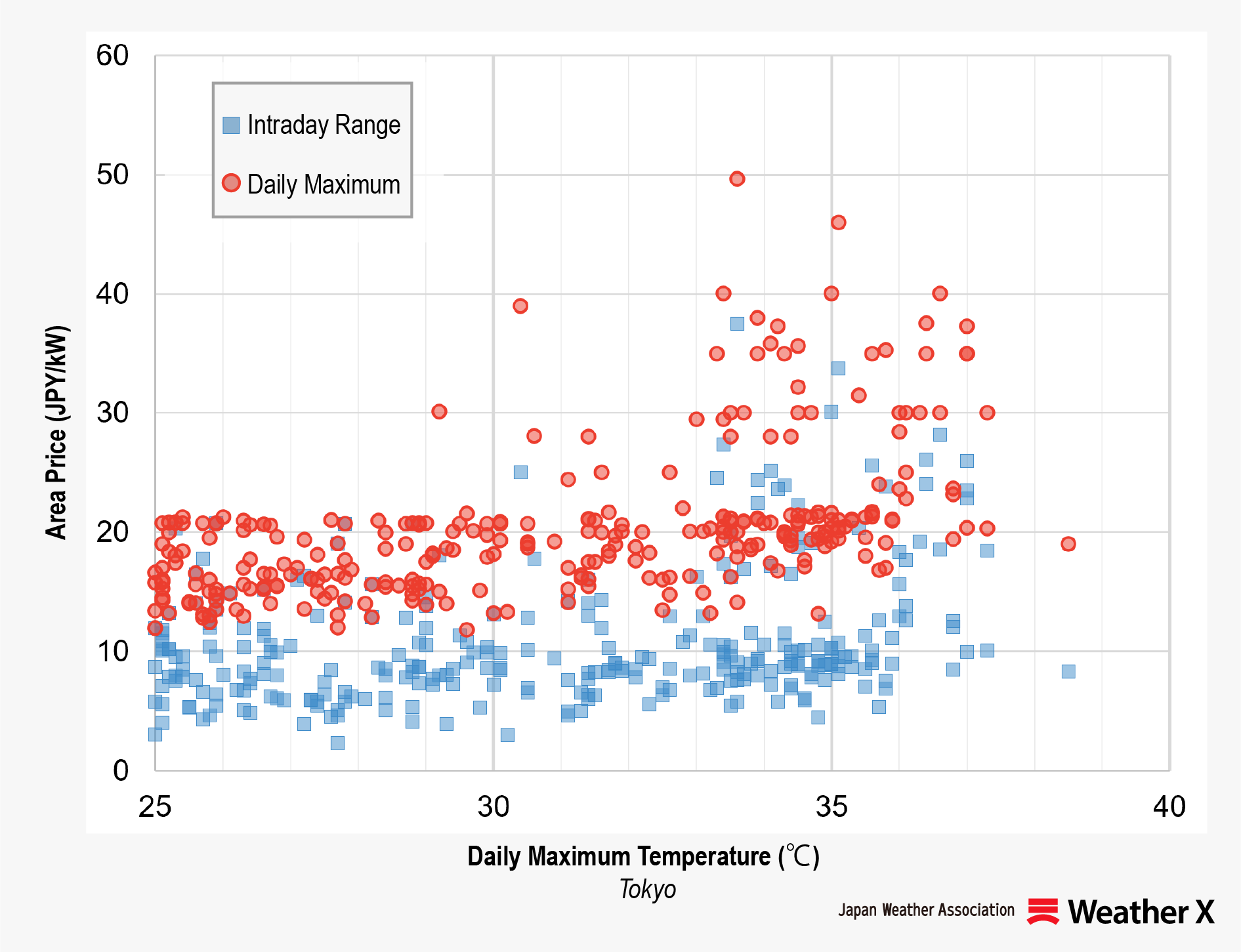
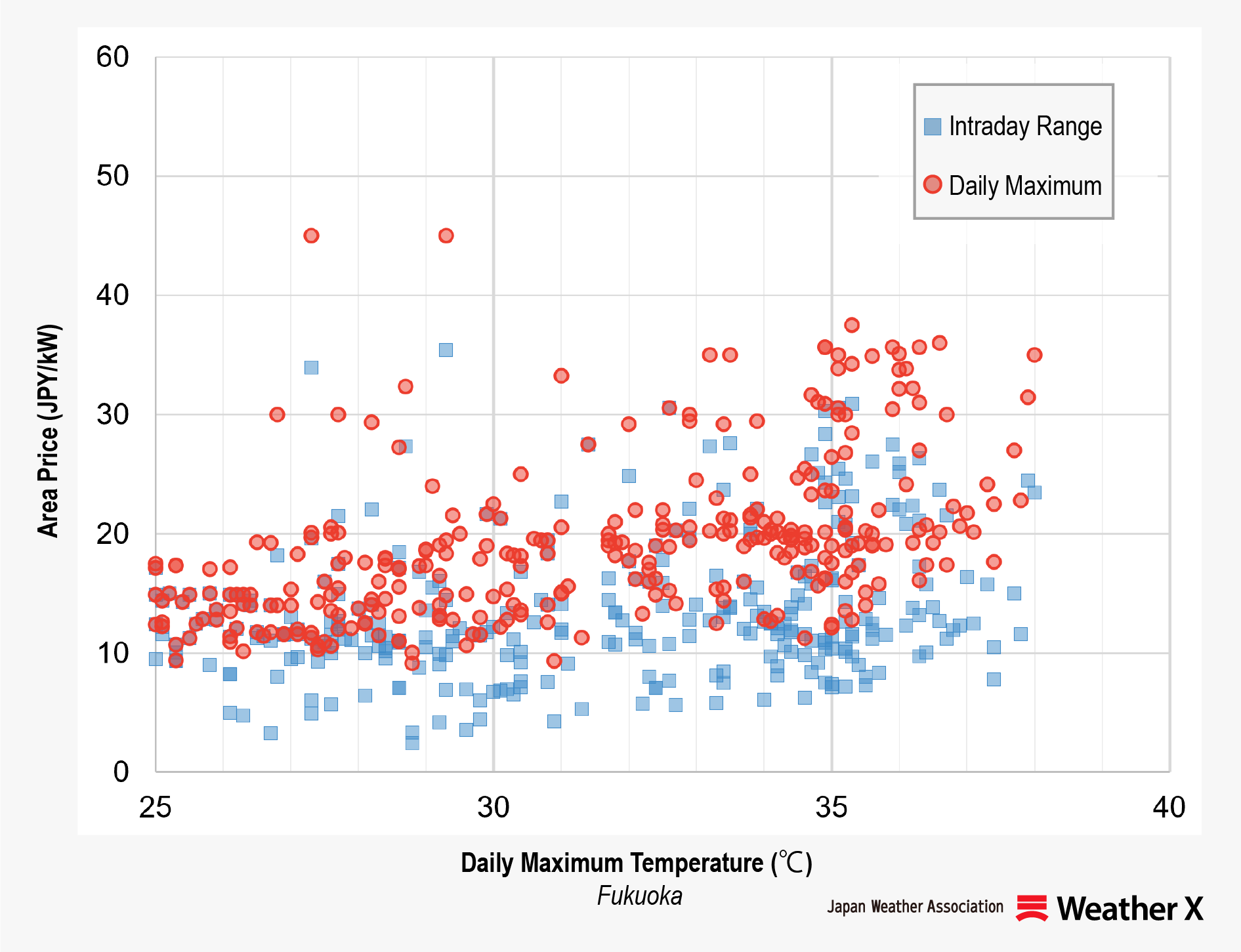
Figure 3 shows the daily maximum spot market area price and the intraday range (the maximum minus the minimum among 48 half-hourly periods) in the Tokyo and Kyushu areas. In both areas, days with noticeably higher daily maxima and intraday ranges become more common once the daily maximum temperature reaches around 30°C.
On hot days, demand increases and prices tend to rise from the evening onward. During the daytime, however, higher solar power output may lower prices. As a result, the price difference between daytime and evening tends to widen.
| Tokyo Area | Kyushu Area |
|---|---|
|
|
Figure 3. Relationship Between Daily Maximum Temperature and Daily Maximum Area Prices and Intraday Price Ranges in the Tokyo and Kyushu Areas (FY2024–FY2025, All Days)
Business Challenges
Such price fluctuations create operational challenges.
- Market price outlooks tend to become less stable
- Procurement costs tend to fluctuate from day to day
- Trading and procurement strategies must account for time-of-day price differences
How to Use Weather Data for Electricity Demand and Market Price Forecasting
Electricity supply-demand and market prices are strongly affected by weather conditions. In summer in particular, fluctuations in temperature and solar radiation are large, making supply-demand conditions and prices more likely to fluctuate. It is therefore important to incorporate weather forecasts into supply-demand and market analysis.
Japan Weather Association provides electricity demand and price forecasting services that use weather information. These services are useful on their own, but they can support a broader range of applications when combined with power generation forecasts and other data.
ENeAPI, an API Service for the Energy Industry
ENeAPI provides weather information for energy businesses in Web API format.
In addition to weather information essential for advanced energy management, ENeAPI provides a range of data to support strategic electricity trading, including electricity demand forecasts, market price forecasts, and solar power output forecasts.
Price Forecasting (Electricity Market Price Forecasting)
Price Forecasting (Electricity Market Price Forecasting) is a service that forecasts spot market trading prices (system price and area prices) on the Japan Electric Power Exchange (JEPX), as well as supply-demand adjustment market prices on the Electric Power Reserve Exchange (EPRX), and provides the forecast results online.
Highly accurate electricity market price forecasts enable strategic power generation, procurement, and charging and discharging plans, helping energy businesses maximize revenue and maintain stable operations.
Electric Power Demand Forecasting
Electricity demand is greatly affected by various weather factors, including temperature, humidity, solar radiation, rain, and snow.
By combining the expertise of weather forecasters with analytical technologies using artificial intelligence (AI) and machine learning, we provide highly accurate electricity demand forecasting services.
Two-Year Long-Term Weather Forecasting (only available in Japanese)
Japan Weather Association has developed an industry-first forecasting method that offers higher accuracy and a longer forecast period than the conventional method. By understanding long-term trends in temperature, precipitation, snowfall, and other factors up to two years ahead, businesses can optimize the costs of supply planning and fuel procurement planning.
Related Articles
-
Combine PV power generation forecasts with electricity demand forecasts to support the control of grid-scale battery storage
“Battery Control Support Service for Grid-Scale Battery Storage Operators” (only available in Japanese) -
Combine with supply-demand adjustment market price forecasts to support “electricity trading strategies and revenue maximization”
“Supply–Demand Adjustment Market Price Forecasting”
Conclusion
- Actual electricity supply-demand conditions and the spot market prices on the Japan Electric Power Exchange (JEPX), where retail electricity providers procure electricity, exhibit summer-specific characteristics, several of which can be explained by their relationship with weather conditions.
- Using highly accurate forecast data is effective for efficient electricity supply-demand operations.
- Japan Weather Association’s weather data, electricity demand forecasts, and electricity price forecasts can be used to inform decisions concerning efficient supply-demand management, market trading, procurement planning, and battery charging and discharging plans.
FAQ
Q. How should weather data be used to forecast electricity supply-demand and market prices?
A. Weather data is used for a wide range of purposes, including power generation forecasting, supply-demand management, market response, and business planning. Selecting and using the appropriate data for each purpose can improve decision-making accuracy, from operational activities to management levels. Contact us to discuss how weather data can be used to address your company’s specific challenges.
Q. How does weather affect electricity demand forecasting?
A. Electricity demand is strongly affected by weather factors such as temperature, humidity, solar radiation, rain, and snow. Temperature has a particularly strong effect on electricity demand and, in combination with fluctuations in renewable energy generation, affects the supply-demand balance. Accurately capturing changes in weather conditions helps improve demand forecast accuracy.
Please see Electricity Demand Forecasting for details about Japan Weather Association’s electricity demand forecasting service.
Q. Why does electricity demand tend to increase in summer?
A. As temperatures rise in summer, cooling demand increases, making total electricity demand across an area more likely to rise. At higher temperatures, the increase in demand for each 1°C rise tends to be larger. This tendency is particularly pronounced in urban areas and elsewhere, making demand forecasts that account for temperature, humidity, solar radiation, and other factors important.
Q. What weather factors affect summer spot market prices?
A. Summer spot market prices are affected by increased demand due to rising temperatures and by fluctuations in solar power generation associated with changes in solar radiation and cloud cover.
For those considering the use of ENeAPI, an API Service for the Energy Industry, Electric Power Demand Forecasting, or Price Forecasting (Electricity Market Price Forecasting), please see the relevant service pages.