News
2026 Autumn Foliage Peak Viewing Forecast ~Peak Viewing Expected Around the Usual Time or Later Nationwide; Some Mountainous Areas in Northern Japan May Peak Earlier Than Usual~
2026.10.02
Japan Weather Association (JWA) released its 2026 “Autumn Foliage Peak Viewing Forecast” on October 1, 2026. The forecast will also be updated through November on “tenki.jp,” JWA’s weather forecasting media platform.
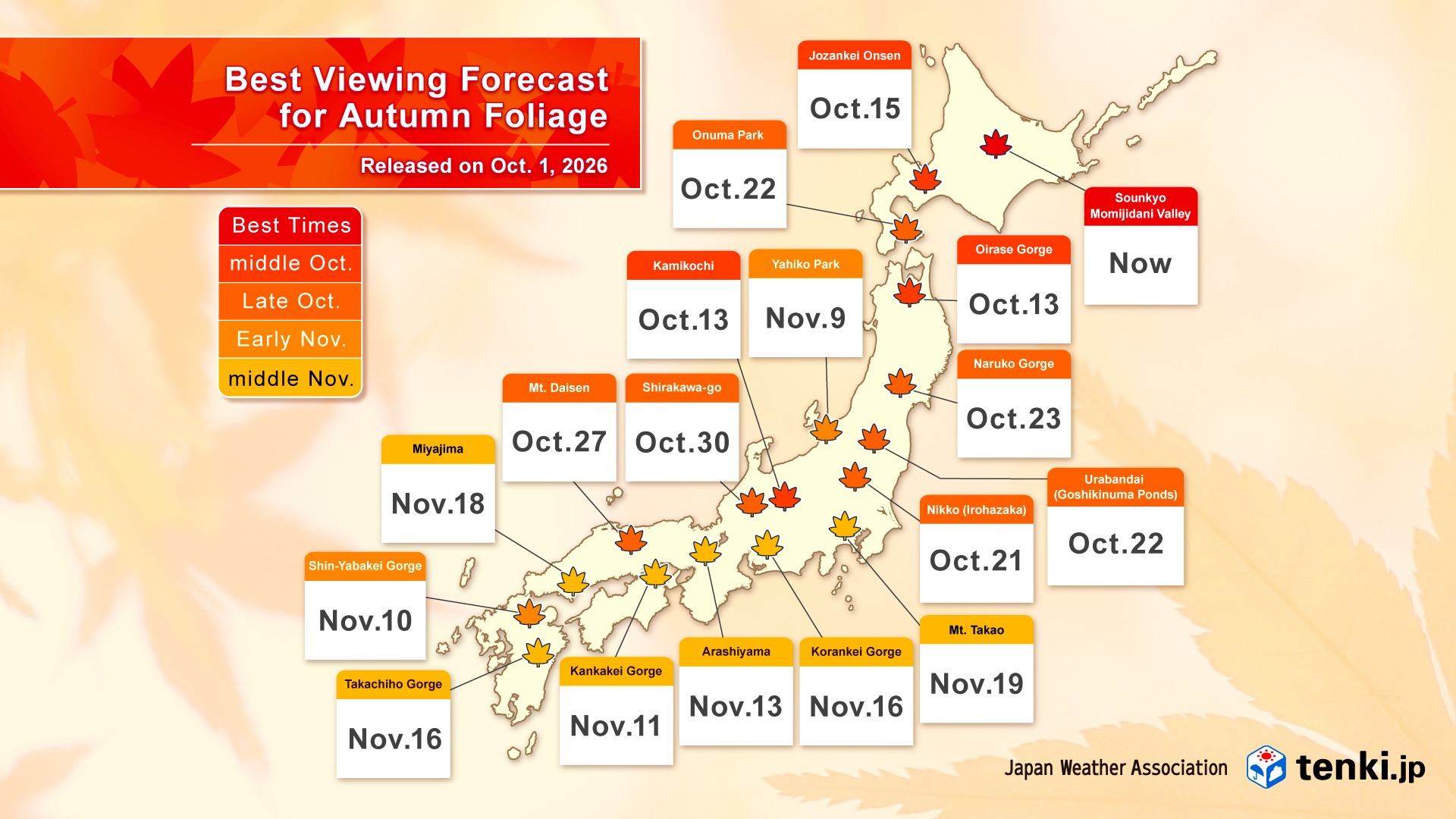
* Please refrain from unauthorized corporate use of this information for purposes other than news reporting.
For corporate use, including the promotion or marketing of products or services, please contact us.
Table of Contents
Autumn Foliage Peak Forecast for Various Regions Across Japan
This year, the peak viewing period for autumn foliage is expected to be around the usual time or later nationwide.
The peak viewing period of autumn foliage is influenced by temperatures in autumn, from September through November. Cooler autumn temperatures typically lead to an earlier peak, while warmer temperatures delay it.
During the first half of September, temperatures periodically fell below average nationwide. As a result, in some mountainous areas of Hokkaido, Tohoku, and Hokuriku, where foliage usually reaches its peak between September and early October, leaf coloring progressed earlier than usual.
However, since the latter half of September, temperatures have generally remained above average nationwide, and warmer-than-normal conditions are expected to continue from October through November.
Therefore, the peak viewing period is expected to be generally around the usual time nationwide. However, some locations in eastern and western Japan, particularly in lowland areas, are expected to reach their peak later than usual.
Regional Autumn Foliage Peak Forecast
Northern Japan (Hokkaido and Tohoku)
The peak viewing period for autumn foliage is expected to be generally around the usual time.
Because temperatures were below average at times during the first half of September, leaf coloring has progressed earlier than usual at Sounkyo Momijidani Valley in Hokkaido and Oirase Gorge in Aomori Prefecture, where foliage normally peaks early. In addition, a temporary spell of cooler weather is also expected in early October. In Hokkaido and Tohoku, this is expected to advance leaf coloring mainly in mountainous areas and in some lowland areas, with some locations reaching peak viewing earlier than usual.
Thereafter, however, temperatures are expected to remain above average through November. As a result, many autumn foliage spots are expected to reach their peak around the usual time, although some locations in southern Tohoku may peak later than usual.
Eastern Japan (Kanto-Koshin, Hokuriku, Tokai)
The peak viewing period for autumn foliage is expected to be around the usual time or later.
Because temperatures were below average at times during the first half of September, leaf coloring progressed earlier than usual in a very limited number of high-elevation areas. In addition, a temporary spell of cooler weather is expected in early October, which should further advance leaf coloring in areas along the mountains.
However, temperatures are expected to remain above average thereafter through November. As a result, the peak viewing period at many foliage spots is expected to be around the usual time or later.
Western Japan (Kinki, Chugoku, Shikoku, Kyushu)
The peak viewing period for autumn foliage is expected to be around the usual time or later.
In western Japan as well, temperatures are expected to remain above average through November. Consequently, leaf coloring is likely to progress somewhat later, and many locations are expected to reach their peak around the usual time or later.
Autumn Foliage Information on tenki.jp
Details of the 2026 “Autumn Foliage Peak Viewing Forecast,” along with information on foliage spots nationwide beyond the major locations listed above, are published and updated on “tenki.jp” through its Autumn Foliage Peak Viewing Information and Meteorologists’ Commentary.
*The pages can be viewed in your preferred language using your browser’s translation feature.
JWA’s Autumn Foliage Forecast
In every year, JWA announces forecasts for the best time for fall foliage and its viewing spots throughout Japan from September to November.
What is Autumn Foliage?
Autumn foliage (Kōyō in Japanese) is a phenomenon in which the leaves of trees change color to red or yellow in fall.
In Japan, the change starts around September in Hokkaido and the high-altitude areas of Honshu. Autumn foliage makes its way from north to south and can be enjoyed until December in areas between Kanto and Kyushu. The maples turn red, and the ginkgoes turn yellow.
Data Used in the Forecast
The following types of data are used to forecast the best times for foliage viewing:
- Past autumn foliage and temperature data observed by Japan Meteorological Agency (JMA)
- Past foliage data at target spots by cooperative organizations
- Temperature data of each spot forecast by JWA
Other JWA Services to Use with Our Autumn Foliage Forecast
JWA can provide support tailored to each company’s needs, from the provision of weather data to its use in demand forecasting and risk-based decision-making.
In Japan, where weather patterns are highly volatile, the accuracy of forecasts is a critical factor influencing the quality of decisions in both travel and business. Leveraging high-precision forecasts and up-to-date meteorological data is essential for risk reduction and successful planning.
- Weather Data API
JWA’s weather API is designed to allow developers to access highly accurate weather information for any location. Data such as temperature, humidity, precipitation, snowfall, wind direction and speed, and general weather conditions can be retrieved in a single request through a user-friendly API.
For the overview, please see: Weather API Overview - Product Demand Forecasting
Analyze product sales and weather data to forecast product demand and customer traffic to adjust production volume and optimize inventory management. - 2-Year Long-Term Weather Forecasts
JWA has developed the industry’s first forecasting method that offers higher accuracy and longer forecast periods than conventional approaches. This service provides numerical forecasts for monthly temperature, precipitation/snowfall, and sunshine duration, as well as information on the rainy season and typhoon activity. For more details, please see:
What are Long-Term Forecasts? JWA’s Proprietary “2-Year Long-Term Weather Forecast” and Its Business Applications Part 1 / Part 2
For more information on the winter weather outlook, please see:
[2026–2027 Winter Weather Forecast] Stay Alert for Cold Waves and Heavy Snow Even During a Warmer-than-Normal Winter
Frequently Asked Questions about the 2026 Autumn Foliage Peak Viewing Forecast
JWA has compiled answers to frequently asked questions regarding its Autumn Foliage Peak Viewing Forecast.
Q1: What is the update schedule for the Autumn Foliage Peak Viewing Forecast?
A1: In 2026, the forecast is scheduled to be updated a total of three to four times through November on the Autumn Foliage Peak Viewing Information page on “tenki.jp.” Daily information will also be provided through its Meteorologists’ Commentary.
Autumn Foliage Peak Viewing Information
Meteorologists’ Commentary
Q2: How does temperature affect the timing of peak viewing for autumn foliage?
A2: The peak viewing period of autumn foliage is influenced by temperatures in autumn, from September through November. Cooler autumn temperatures typically lead to an earlier peak, while warmer temperatures delay it.
Q3: How does Japan Weather Association (JWA) forecast autumn foliage peak viewing?
A3: JWA examines the correlation between historical maple leaf coloring dates observed by the Japan Meteorological Agency and temperature data for each area, and uses this analysis to develop its own forecasting formula. Based on this formula, the 2026 forecast is calculated using observed temperature data and JWA’s forecast data of upcoming temperatures for each area.
Q4: What is the criterion for determining the peak viewing time of autumn foliage?
A4: It is defined as the stage when the majority of the leaves on maple trees have turned red.
Q5: How does the timing differ in high-elevation areas?
A5: In high-elevation locations, autumn foliage is expected to reach its peak earlier than the forecast peak-viewing period for that region.
Q6: Can the Autumn Foliage Peak Viewing Forecast be used outside Japan?
A6: Autumn foliage is a seasonal phenomenon in Japan that we hope people around the world can enjoy.
For inquiries regarding corporate use outside Japan, please contact us.