News
How Can Medium- to Long-Term Electricity Demand Be Forecast? Using the “2-Year Area Electricity Demand Forecast” to Incorporate Future Weather Outlooks into Demand Estimates and Power Procurement Planning
2026.11.13
On Friday, September 25, 2026, Japan Weather Association (JWA) began offering its “2-Year Area Electricity Demand Forecast” service. The service forecasts electricity demand across Japan’s 10 regional service areas at 30-minute intervals up to two years (24 months) ahead.
The “2-Year Area Electricity Demand Forecast” combines weather forecasts extending up to two years ahead with electricity demand forecasting technology. It provides information to support decisions on medium- to long-term demand estimates, the required supply capacity and procurement volumes, and power procurement plans.
When electricity businesses develop demand estimates and power procurement plans for the following fiscal year and beyond, a key assumption is the level of future electricity demand.
However, electricity demand also fluctuates with weather conditions such as temperature. The challenge, therefore, is not only to consider historical demand data but also to determine how to incorporate demand fluctuations arising from future weather conditions.
Key Points of the “2-Year Area Electricity Demand Forecast”
- Forecasts electricity demand across Japan’s 10 regional service areas at 30-minute intervals up to two years ahead.
- Combines the weather industry’s first “2-Year Long-Term Weather Forecast” with highly accurate electricity demand forecasting technology to identify medium- to long-term fluctuations in electricity demand based on weather forecasts extending up to two years ahead.
- Can be combined with a company’s historical demand data and contract outlook to support the assessments of medium- to long-term supply capacity and procurement volumes, as well as the development and revision of power procurement plans.
- In a verification study covering summer 2026, the error rate for cumulative electricity consumption over the period across Japan’s 10 regional service areas improved from 3.94% to 3.18%, an improvement of approximately 20%.
This article is intended for professionals responsible for supply–demand management, electricity trading, corporate planning, and business planning at retail electricity businesses and companies engaged in power generation and procurement. It explains how the “2-Year Area Electricity Demand Forecast” works and how it can be used for medium- to long-term demand estimation and power procurement planning.
Table of Contents
What Is the “2-Year Area Electricity Demand Forecast”?
The “2-Year Area Electricity Demand Forecast” is a service that forecasts electricity demand across Japan’s 10 regional service areas by inputting weather data from JWA’s “2-Year Long-Term Weather Forecast” into its proprietary regional electricity demand forecasting model. The forecasts account for future weather conditions, seasonal patterns, day-of-week characteristics, and other factors.
By combining the forecast results with their own historical demand data, customer composition, contract outlook, and other information, companies can develop their own medium- to long-term demand estimates and begin assessing the necessary supply capacity and procurement volumes at an early stage.
The service can also support medium- to long-term power procurement planning, including efforts to comply with the medium- to long-term power supply procurement obligation.
In June 2024, JWA began offering the weather industry’s first “2-Year Long-Term Weather Forecast.”
JWA has also provided electricity demand forecasts to more than 30 companies in Japan and overseas. It has built up extensive expertise in weather-based electricity demand forecasting and currently produces daily forecasts covering more than 30% of the electricity sold by retail electricity businesses nationwide.
Learn more about the 2-Year Long-Term Weather Forecast here.
Future Demand Forecasts Are Important for Meeting the Medium- to Long-Term Power Supply Procurement Obligation
When electricity businesses develop corporate plans and medium- to long-term demand estimates and procurement plans, it is important to estimate the supply capacity required to meet future demand and determine, at an early stage, how much power must be secured and when it should be procured.
In particular, retail electricity businesses are required to comply with the medium- to long-term power supply procurement obligation (Note 1). To assess the supply capacity and procurement volumes at an early stage, they need a forecast of electricity demand several years ahead as the basis for those assessments.
Note 1: Medium- to Long-Term Power Supply Procurement Obligation
A system that requires retail electricity businesses to secure future electricity volumes (kWh) in advance, several years ahead, through contracts or other arrangements.
The “2-Year Area Electricity Demand Forecast” provides regional demand forecasts that reflect future weather conditions. By combining these forecasts with their own historical demand data and contract outlook, companies can develop their own demand estimates and use the results as information to support decisions on supply capacity and procurement volumes.
Electricity Demand Also Fluctuates with Weather Conditions Such as Temperature
Electricity demand is strongly influenced by temperature. For example, a 1°C rise in summer temperatures is estimated to increase electricity demand by approximately 5% due to air conditioning and other factors (Note 2). If summer electricity demand in the Tokyo Electric Power Company service area is assumed to be 50,000 MW, this increase would amount to 2,500 MW, equivalent to the output of two typical large thermal power plants.
When developing medium- to long-term demand estimates, it is important to consider how much demand could fluctuate based on future weather conditions.
Historical Data Alone Makes It Difficult to Reflect Future Weather Variability
Historical electricity demand and weather data are important baseline data for developing medium- to long-term demand estimates. However, future weather conditions will not necessarily mirror those observed in the past. Rather than relying solely on climatological normals or historical data, incorporating weather forecasts extending up to two years ahead into demand estimates makes it possible to quantitatively identify, at an early stage, medium- to long-term demand fluctuations and peak demand caused by weather conditions that are difficult to capture using historical data alone.
What Can the “2-Year Area Electricity Demand Forecast” Tell Us?
The “2-Year Area Electricity Demand Forecast” makes it possible to examine medium- to long-term demand fluctuations, seasonal and time-of-day demand patterns, and peak demand across Japan’s 10 regional service areas.
Furthermore, by combining the forecast results with their own historical demand data, customer composition, contract outlook, and other information, companies can estimate their own demand while accounting for fluctuations in regional electricity demand caused by weather conditions and seasonal patterns.
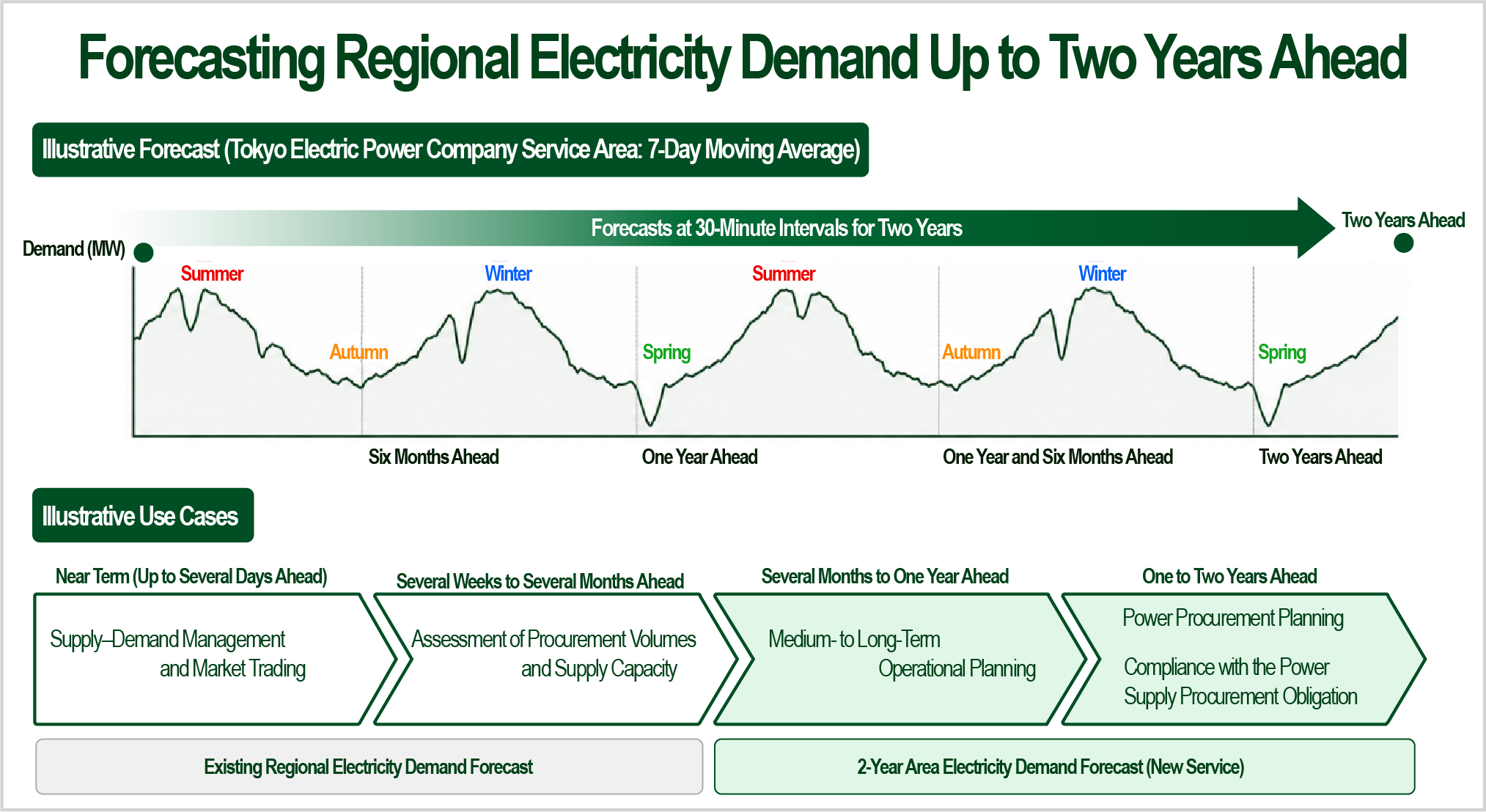
Electricity Demand Across Japan’s 10 Regional Service Areas Up to Two Years Ahead
The “2-Year Area Electricity Demand Forecast” is calculated by inputting data from JWA’s proprietary “2-Year Long-Term Weather Forecast” into its proprietary regional electricity demand forecasting model.
In addition to future weather conditions, the model takes into account seasonal patterns, day-of-week characteristics, and other factors to forecast electricity demand across Japan’s 10 regional service areas at 30-minute intervals up to two years ahead.
In addition to annual and monthly demand levels, seasonal and time-of-day demand patterns and peak demand can be quantitatively examined using forecasts at 30-minute intervals.
Applying Regional Demand Forecasts to a Company’s Own Demand Estimates
The “2-Year Area Electricity Demand Forecast” forecasts electricity demand in each regional service area.
By combining the forecast results with a company’s own historical electricity demand data, customer composition, contract outlook, and other information, the company can develop its own medium- to long-term demand estimates that take weather conditions and seasonal patterns into account.
This makes it easier to estimate the required supply capacity and procurement volumes and develop power procurement plans that account for increases or decreases in demand.
Monthly Updates Also Support Plan Revisions
The “2-Year Area Electricity Demand Forecast” is updated monthly. This allows companies to obtain the latest weather outlook and demand estimates that reflect it, enabling them to continuously review their corporate plans and power procurement plans.
In addition, by combining this service with existing short-term (up to 78 hours ahead), medium-term (up to two weeks ahead), and long-term (up to six months ahead) regional electricity demand forecasts, companies can consider demand estimates and procurement plans across different time horizons, from medium- to long-term planning to operations closer to actual supply and demand.
Related Articles
- How Should Weather Data Be Used Differently? Differences Between Short-, Medium-, Long-, and Extended-Long-Range Forecasts and Their Business Applications
- What Is Weather Risk in Renewable Energy Businesses? Data Utilization and Decision-Making by Time Scale
Service Specifications and Update Frequency
The service specifications are as follows.
| Item | Specification |
|---|---|
| Forecast target | Regional electricity demand [Unit: MW] |
| Forecast period | Up to two years ahead (104 weeks ahead) |
| Time resolution | 30-minute intervals |
| Target areas | Japan’s 10 regional service areas |
| Forecast release frequency | Once a month (released at 17:00 on the second Friday of each month) |
| Delivery method | Delivered Online by email |
| File format | CSV format (separate files for each regional service area) |
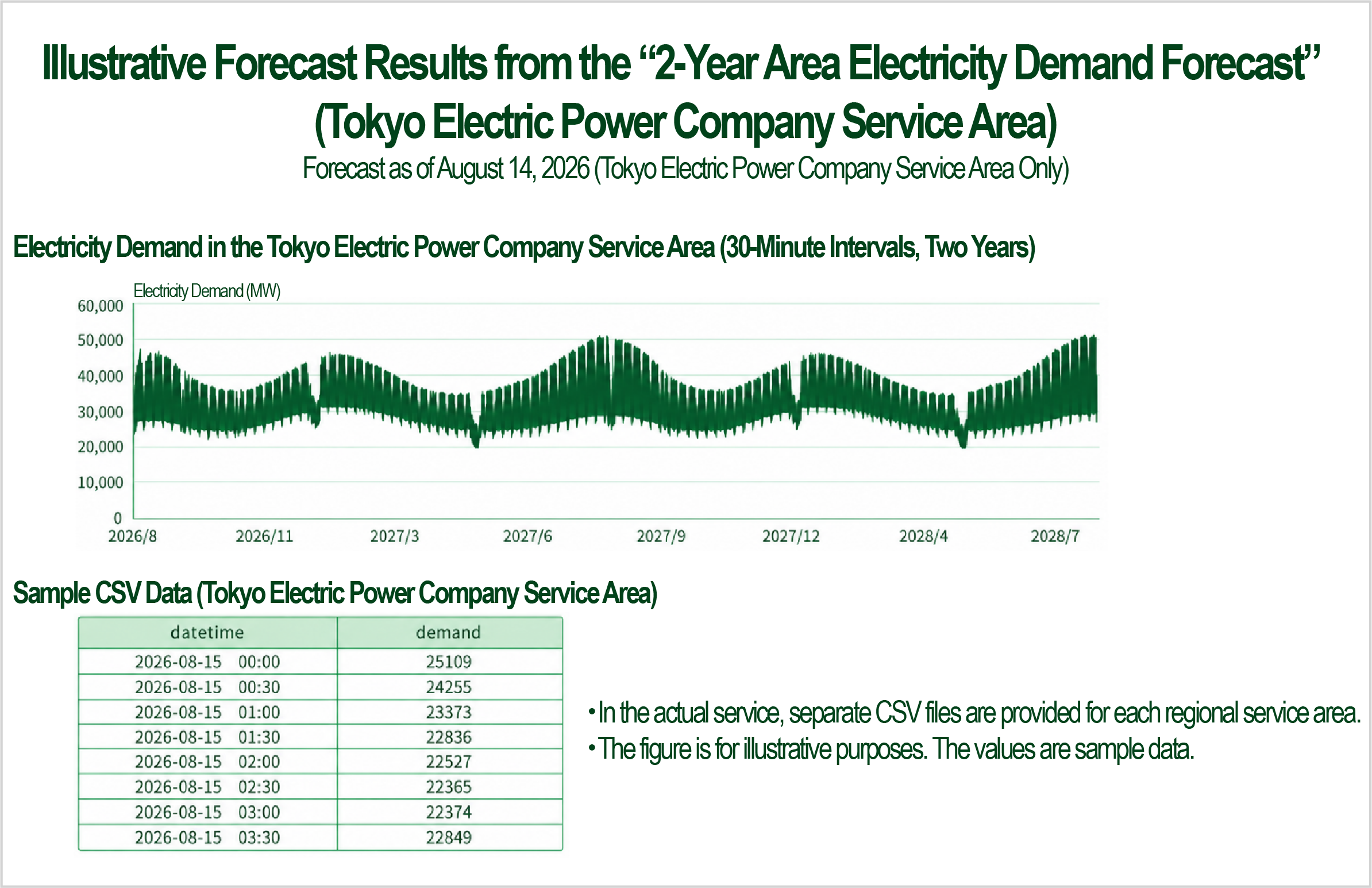
How to Use the “2-Year Area Electricity Demand Forecast” in Business Operations
When using the “2-Year Area Electricity Demand Forecast” in their own operations, companies combine regional demand forecasts with their own historical demand data, customer composition, contract outlook, and other information to develop more specific demand estimates and use them to support management and procurement decisions.
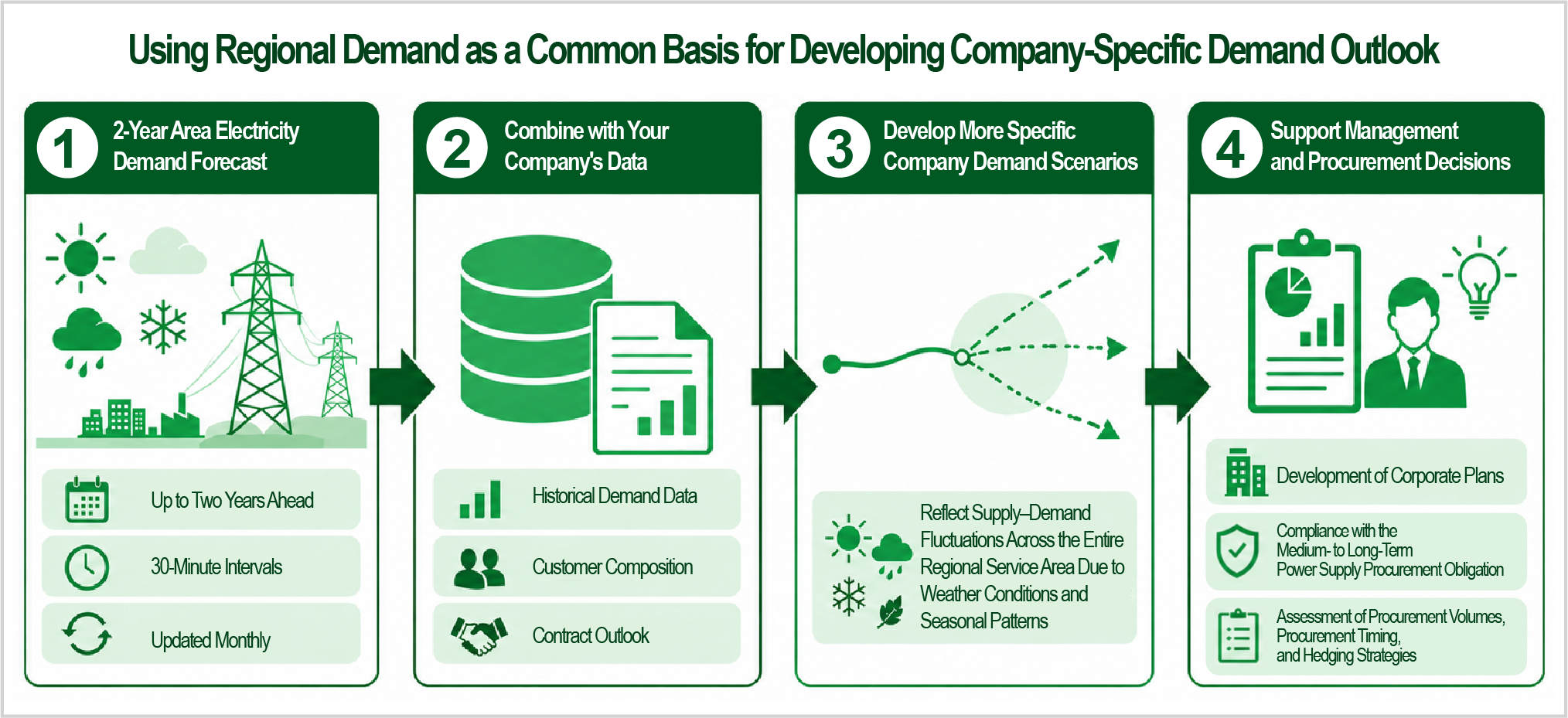
Using Medium- to Long-Term Demand Estimates in Corporate Planning
When developing corporate plans, estimates of expected demand in the following fiscal year and beyond form the basis for supply capacity and procurement decisions. Companies can use their own medium- to long-term demand estimates, developed taking weather conditions and seasonal patterns into account, in corporate planning.
Assessing the Necessary Supply Capacity and Procurement Volumes to Meet the Medium- to Long-Term Power Supply Procurement Obligation
To comply with the medium- to long-term power supply procurement obligation, it is important to begin assessing the supply capacity and procurement volumes required to meet future demand at an early stage.
The “2-Year Area Electricity Demand Forecast” can be used as baseline information when developing a company’s own demand estimates.
By assessing required supply capacity, procurement volumes, and procurement timing based on demand forecasts, the service supports decisions on securing power supplies over the medium to long term.
Using Demand Forecasts to Assess Procurement Volumes, Product Mix, Costs, and Risks
Based on future demand forecasts, companies can assess procurement volumes and combinations of procurement products for each fiscal year and season.
The forecasts can also be used as information to support decisions when simulating procurement costs and risks based on weather scenarios.
This enables companies to estimate the required supply capacity and procurement volumes at an earlier stage. The forecasts can also be used to develop and revise medium- to long-term power procurement plans, including compliance with the medium- to long-term power supply procurement obligation, bilateral contracts (Note 3), and futures and forward markets (Note 4).
Note 3: Bilateral Contracts
A type of transaction in which electricity sellers and buyers trade directly without using the Japan Electric Power Exchange (JEPX).
Note 4: Futures and Forward Markets
Markets in which electricity for future delivery is traded at prices and on terms agreed in advance.
In addition, the forecasts can be used to review corporate plans and power procurement plans in line with monthly forecast updates.
Verification of the 2-Year Area Electricity Demand Forecast for Summer 2026
JWA conducted an accuracy verification of the “2-Year Area Electricity Demand Forecast” covering summer 2026 (June–August).
The verification compared demand estimates based on actual electricity demand in summer 2024 with an estimate based on the “2-Year Area Electricity Demand Forecast” as of October 2024. The results showed that the error rate for cumulative electricity consumption across Japan’s 10 regional service areas decreased from 3.94% to 3.18%, equivalent to an improvement of approximately 20%.
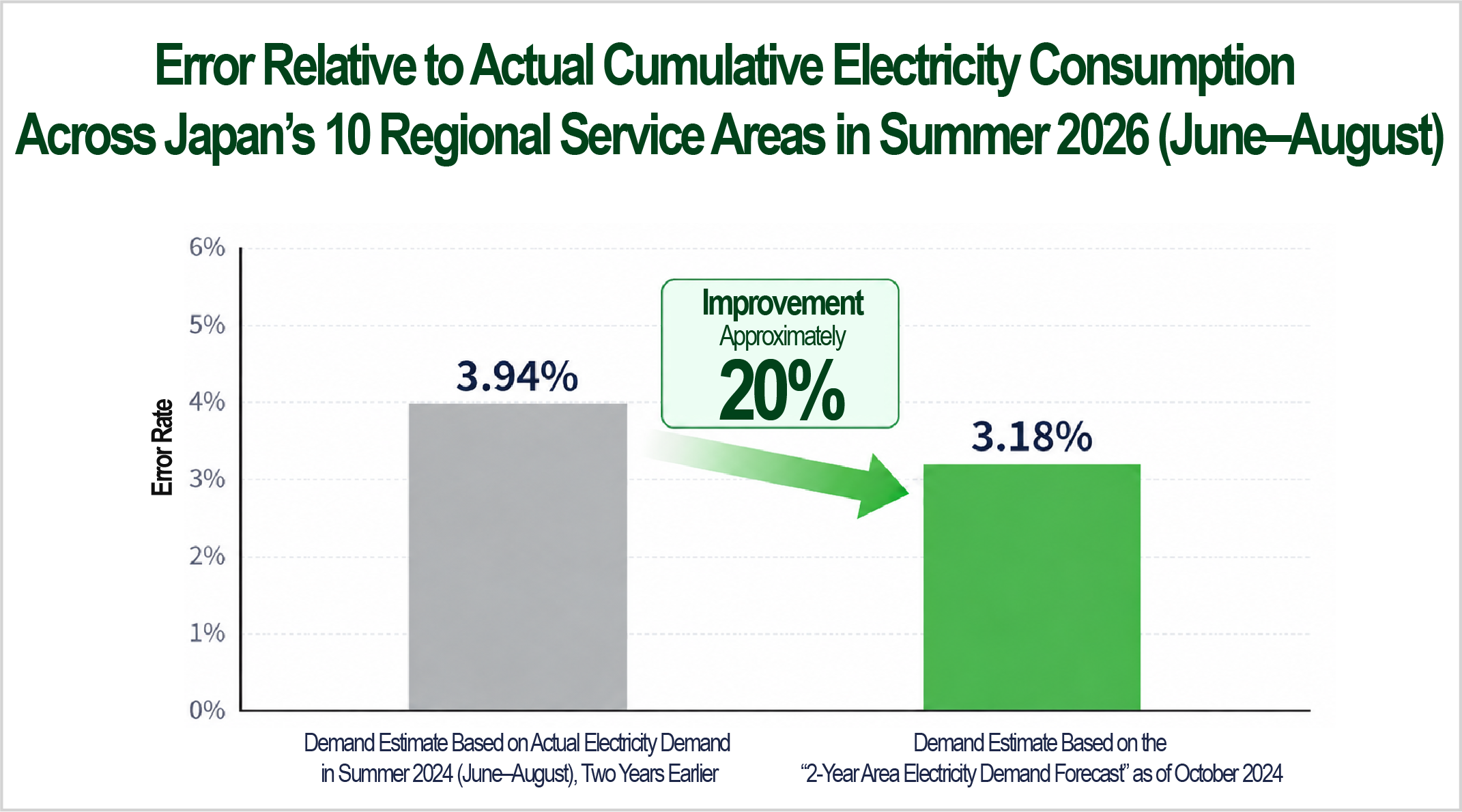
Using numerical data from long-term weather forecasts extending up to two years ahead as input data for electricity demand forecasting makes it possible to identify at an early stage, demand fluctuations that cannot be anticipated through simulations based on historical weather and demand data alone. This is expected to improve accuracy of corporate planning and medium- to long-term power procurement planning, while helping to reduce supply–demand fluctuation risks and optimize procurement costs.
Conclusion
- When forecasting medium- to long-term electricity demand, it is important to use historical demand data while also incorporating demand fluctuations caused by future weather conditions, such as temperature, into demand estimates.
Given requirements such as the medium- to long-term power supply procurement obligation, it is becoming increasingly important to assess demand several years ahead and determine the required supply capacity and procurement volumes. - The “2-Year Area Electricity Demand Forecast” combines weather forecasts extending up to two years ahead with regional electricity demand forecasting technology to forecast demand across Japan’s 10 regional service areas at 30-minute intervals up to two years ahead. Seasonal and time-of-day demand patterns and peak demand can also be examined.
- By combining regional demand forecasts with their own historical demand data, customer composition, contract outlook, and other information, companies can develop more specific medium- to long-term demand estimates. These estimates can be used to assess and review supply capacity, procurement volumes, procurement timing, corporate plans, and power procurement plans.
If you are considering using the “2-Year Area Electricity Demand Forecast” and weather information to develop medium- to long-term demand estimates or assess supply capacity and power procurement plans, please contact us.
FAQ
Q. Why are weather forecasts necessary for medium- to long-term electricity demand forecasting?
A. Because electricity demand fluctuates with weather conditions such as temperature. Historical weather and demand data are important baseline data, but future weather conditions will not necessarily be the same as those in the past. By incorporating future weather conditions into demand estimates, companies can use the results to support decisions when developing and revising medium- to long-term corporate plans and power procurement plans.
Q. Is it not possible to forecast electricity demand for the following fiscal year and beyond using only the previous year’s or historical electricity demand data?
A. Historical electricity demand data are important baseline data for estimating demand for the following fiscal year and beyond. However, electricity demand also fluctuates with weather conditions such as temperature, and future weather conditions will not necessarily be the same as those in the past. Therefore, it is important to consider future weather conditions as well as historical data when estimating demand.
Q. How is electricity demand two years ahead forecast?
A. Data from JWA’s proprietary “2-Year Long-Term Weather Forecast” are fed into JWA’s independently developed regional electricity demand forecasting model. The forecasts take into account future weather conditions, seasonal patterns, day-of-week characteristics, and other factors. Electricity demand is forecast across Japan’s 10 regional service areas at 30-minute intervals up to two years ahead.
Q. How can regional electricity demand forecasts be used to develop a company’s own demand estimates?
A. Rather than using regional demand forecasts directly as estimates of a company’s own demand, they are combined with the company’s historical electricity demand data, customer composition, contract outlook, and other information. This enables the company to estimate its own demand while taking into account regional demand fluctuations caused by weather conditions and seasonal patterns, and to use those estimates to assess the necessary supply capacity, procurement volumes, and procurement timing.
Q. How should two-year-ahead demand forecasts be used differently from power procurement planning and short-term supply–demand operations?
A. Two-year-ahead forecasts are used to consider medium- to long-term demand estimates and power procurement plans. Meanwhile, JWA also provides short-term (up to 78 hours ahead), medium-term (up to two weeks ahead), and long-term (up to six months ahead) regional electricity demand forecasts. By combining these services, companies can develop demand estimates and procurement plans according to different time horizons, from medium- to long-term planning to near-term supply–demand operations.