News
Power Supply-Demand Optimization and Decarbonization Enabled by the 2-Year Long-Term Weather Forecast
2025.12.10
In the electric power industry, weather conditions have a significant impact on the balance of supply and demand as well as on market prices.
In recent years, the increasing frequency of extreme weather events and the growing adoption of renewable energy have made improving the accuracy of long-term supply and demand forecasts an urgent issue.
Weather is the only natural phenomenon that can be scientifically predicted.
By leveraging long-term weather forecasts, it becomes possible to project electricity supply and demand more than one year ahead with smaller error—something that was difficult to achieve in the past. For power generation and electricity retail companies, incorporating these forecasts to their operation and procurement planning can lead to greater efficiency and cost reductions.
At Japan Weather Association, through our industry-first “2-Year Long-Term Weather Forecast,” which provides forecasts up to two years into the future, we aim to improve supply-demand balance, reduce the risk of power shortages, and contribute to both the stable supply of electricity and decarbonization.
For more information on our industry-first “2-Year Long-Term Weather Forecast,” please click: 2-Year Long-Term Weather Forecast” (Only Available in Japanese)
What are Long-Term Forecasts? JWA’s Proprietary “2-Year Long-Term Weather Forecast” and Its Business Applications Part 1 / Part 2
Why is Power Supply-Demand Optimization Necessary?
Under Japan’s energy policy, efforts are underway to secure the amount of power generation capacity required for a stable electricity supply while promoting a transition to power sources with low CO₂ emissions—such as expanding the use of renewable energy and replacing oil- and coal-fired power plants with high-efficiency LNG-fired plants.
However, recent extreme weather events, the expanded deployment of renewable energy, changing social conditions, and growing geopolitical risks have raised concerns about the stability of supply-demand balance.
In particular, extreme weather has a significant impact on supply–demand outlooks, and Japan’s power supply–demand situation remains uncertain.
As extreme weather events and other factors make it increasingly difficult to estimate electricity demand, projections based solely on past experience and historical data tend to fall short. Therefore, technologies capable of providing more accurate long-term forecasts of electricity supply and demand are needed.
Enhancing the Accuracy of Power Supply-Demand Forecasts Using the “2-Year Long-Term Weather Forecast”
To improve the accuracy of long-term forecasts across various business fields, JWA, with the advice and cooperation of Professor Hiroaki Ueda of the University of Tsukuba, has developed a new weather forecasting model capable of providing long-term forecasts up to two years in advance—the longest range in the meteorological industry (Patent No. 7569539).
By utilizing the highly accurate “2-Year Long-Term Weather Forecast,” which achieves smaller error than the conventional method, it is now possible to generate more precise forecasts of electricity supply and demand.
Service Overview of the 2-Year Long-Term Weather Forecast
| Data Version | Report Version | |
|---|---|---|
| Content Provided | Various types of monthly quantitative data up to 2 years ahead | Monthly forecast information, rainy season and typhoon forecasts up to 1.5 years ahead |
| Delivery Method | Data files sent via email, or data integration | Report sent via email |
For pricing, please contact us for details.
Application Examples for Power Generation and Retail Electricity Companies
Power generation and retail electricity companies can use the 2-Year Long-Term Weather Forecast data as input values for their existing long-term electricity demand forecasting and power procurement planning.
By replacing past temperature and other historical records used as input values in conventional methods with physically predicted future weather data, more accurate forecasts with smaller errors can be achieved.
By utilizing the “2-Year Long-Term Weather Forecast,” it becomes possible to enhance supply–demand projections through advanced use of meteorological forecast data, enabling the formulation of an optimal power supply mix while reducing the risk of supply–demand tightness.
This, in turn, makes it possible to achieve more efficient power procurement and stable supply–demand operations.
Benefits of the “2-Year Long-Term Weather Forecast”
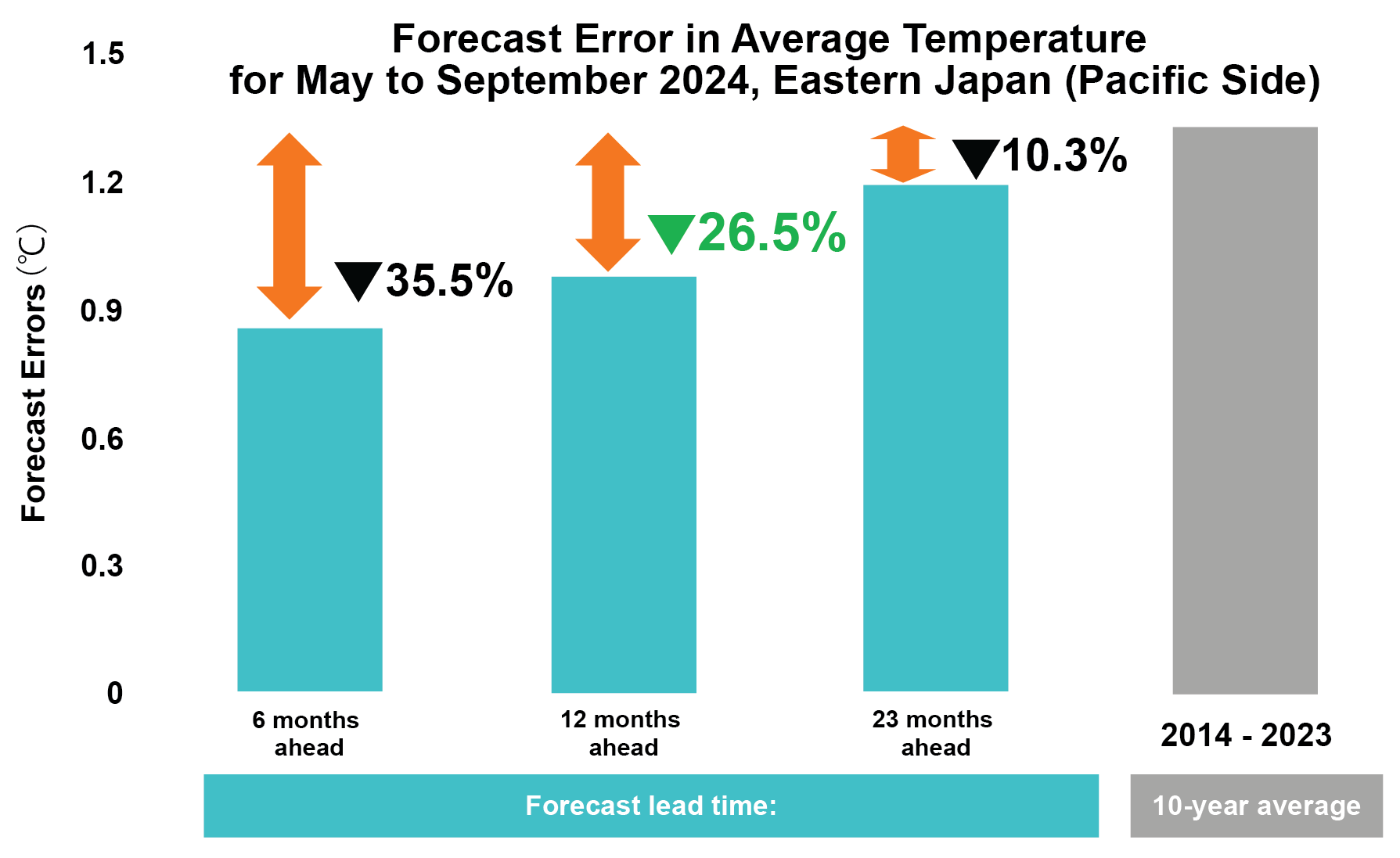
Using the “2-Year Long-Term Weather Forecast” to predict monthly average temperatures in eastern Japan (Pacific side) for May to September 2024 demonstrated a significant improvement in forecast accuracy—forecast errors were reduced by 25%*1 compared with the “latest 10-year average temperature” commonly used for power supply–demand outlooks for the following year.
- *1 Based on evaluation results using temperature forecast data from 12 months in advance.
Expected Benefits for Power Generation Companies:
- Advance optimization of generation plans (Reducing surplus and shortages)
- Cost minimization through improved accuracy of fuel ordering.
- Planning for new power plant development and maintenance
- Maximizing revenue through optimization of electricity sales, including bilateral transactions
Expected Benefits for Retail Electricity Providers:
- Strengthening medium- to long-term procurement strategies (reducing price fluctuation risk)
- Risk hedging using the electricity futures market
The “2-Year Long-Term Weather Forecast” has already been adopted by major energy companies, with further expansion anticipated.
Features of the 2-Year Long-Term Weather Forecast
-
Longer lead time and higher accuracy compared to the conventional long-term forecast
With the advice and cooperation of Professor Hiroaki Ueda at the University of Tsukuba, JWA has developed a new seasonal forecasting method for Japan area using machine learning. This method incorporates indicators such as convective activity and sea surface temperatures in the tropical and subtropical regions, which have a high correlation with Japan’s weather (Patent No. 7569539).
As a result, forecasts beyond the previous maximum of six months are now possible.
Furthermore, compared to the conventional method (limited to six months ahead) that had difficulty predicting extreme high or low temperatures, forecast error at the six-month lead time has been improved by up to 40%.
Forecast Accuracy Details
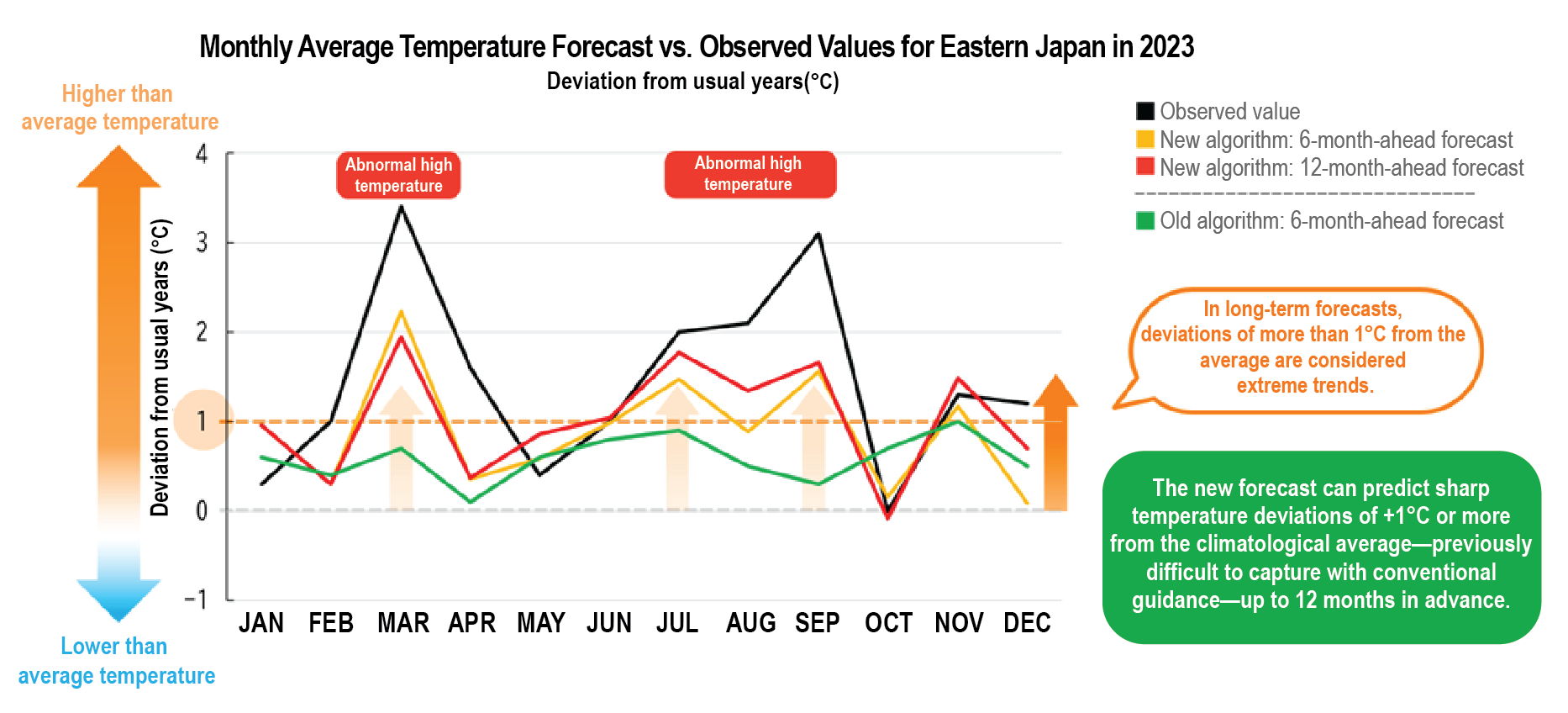
Monthly temperature forecasts for 2023 using the 2-Year Long-Term Weather Forecast were able to anticipate unusual weather events, such as extreme high temperatures in March and record-breaking heat from July to September—that the conventional method found difficult to predict, more than a year in advance.
-
Quantitative Forecasts for Multiple Weather Elements by Month and Region
The “2-Year Long-Term Weather Forecast” provides specific numerical predictions for monthly average temperature, sunshine duration, and precipitation which can be integrated into existing systems and tools.
In addition to nationwide averages, forecasts are available for individual regions, making them useful for area-specific power generation and procurement planning.
Unlike the conventional long-term forecast method which was limited to temperature alone, the “2-Year Long-Term Weather Forecast” also provides predictions for temperature, precipitation, snowfall, sunshine duration, the number of typhoon approaches, and the timing of the end of the rainy season. Information on the onset and end of the rainy season and typhoon activity, can help improve the accuracy of summer supply–demand projections.
-
Data and report-based information delivery
In addition to quantitative data, a report version including qualitative information is available, along with consulting services.
We not only provide the data but also offer guidance on how to utilize it and respond to questions or inquiries. Furthermore, forecasts can be customized by area, indicator, and/or other parameters.
If you are interested in adopting the “2-Year Long-Term Weather Forecast” service, please contact us.
After understanding your requirements, we will provide a proposal tailored to your specific needs.For more information on our industry-first “2-Year Long-Term Weather Forecast,” please click: 2-Year Long-Term Weather Forecast” (Only Available in Japanese)
What are Long-Term Forecasts? JWA’s Proprietary “2-Year Long-Term Weather Forecast” and Its Business Applications Part 1 / Part 2
JWA serves as a partner supporting the power businesses of many energy companies. Through the provision of its “2-Year Long-Term Weather Forecast,” JWA contributes to optimizing the supply–demand balance of electricity, expanding the use of renewable energy, and maximizing CO₂ reduction effects toward the realization of a decarbonized society in Japan.
This initiative received the Grand Prize at the “2024 NIKKEI Decarbonization Award,” hosted by Nikkei Inc., in recognition of its unique approach that leverages weather information to support and promote decarbonization.
[Nikkei Inc.] NIKKEI Decarbonization Award (Only Available in Japanese)
[Nikkei Digital Edition] NIKKEI Decarbonization Project Symposium (Only Available in Japanese)
Additionally, Kumi Okoshi of JWA and Professor Hiroaki Ueda of the University of Tsukuba, developers of the 2-Year Long-Term Weather Forecast, received the Minister of Education, Culture, Sports, Science and Technology Award (Science and Technology Promotion Category) for FY2025 for “Promoting the Social Implementation of Seasonal Forecast Technology.”
[JWA] Kumi Okoshi receives the FY2025 Commendation by the Minister of Education, Culture, Sports, Science and Technology (Science and Technology Promotion Category) for “Promoting Social Implementation Based on the Development of Seasonal Forecast Technology” (Only Available in Japanese)
Moving forward, Japan Weather Association will continue to listen to customer feedback, refine its technological capabilities and contribute to the realization of a decarbonized society.