News
What Is Japan’s Baiu, or Tsuyu, Rainy Season? Explaining the Mechanism of Baiu and “Onset of Baiu” / “End of Baiu”
2026.06.11
Baiu, also known as Tsuyu, is a seasonal phenomenon in which cloudy and rainy days become more frequent from late spring into summer.
On the other hand, the “onset of Baiu” and the “end of Baiu” are not specific meteorological phenomena. They also do not strictly mark the exact beginning or end of the Baiu season. Rather, they are seasonal indicators announced by the Japan Meteorological Agency based on the progression of weather conditions and future outlooks.
For weather-sensitive operations such as retail, logistics, electric power, and construction, Baiu needs to be understood as a weather-related business risk that can affect decision-making.
When using weather data for business decisions, it is important to consider not only the dates of the onset and end of Baiu, but also precipitation amounts, the duration and persistence of rainfall, the timing of heavy rainfall events, temperature, humidity, and sunshine duration in combination.
This article explains the mechanism of Baiu, the meanings of the “onset of Baiu” and the “end of Baiu,” and the impact of Baiu on corporate activities.
Forecast for the 2026 End of Baiu:
When Will the 2026 Baiu Rainy Season End? Latest Forecast and Impact on Companies (Only Available in Japanese)
What You Will Learn in This Article
- How Baiu works
- The meanings of the onset and end of Baiu
- Weather data that companies should check
Table of Contents
- What Is Baiu? Definition
- Characteristics of Baiu
- What Are the “Onset of Baiu” and the “End of Baiu”?
- Impact on Corporate Activities: Key Points for Business Decisions
- Using Weather Data Is Important for Decision-Making During Baiu
- Related Information: Forecast for the 2026 Onset of Baiu
- Conclusion
- FAQ
What Is Baiu? Definition
The Japan Meteorological Agency defines Baiu as “a phenomenon, or the period of such a phenomenon, in which rainy and cloudy days frequently occur from late spring to summer.”
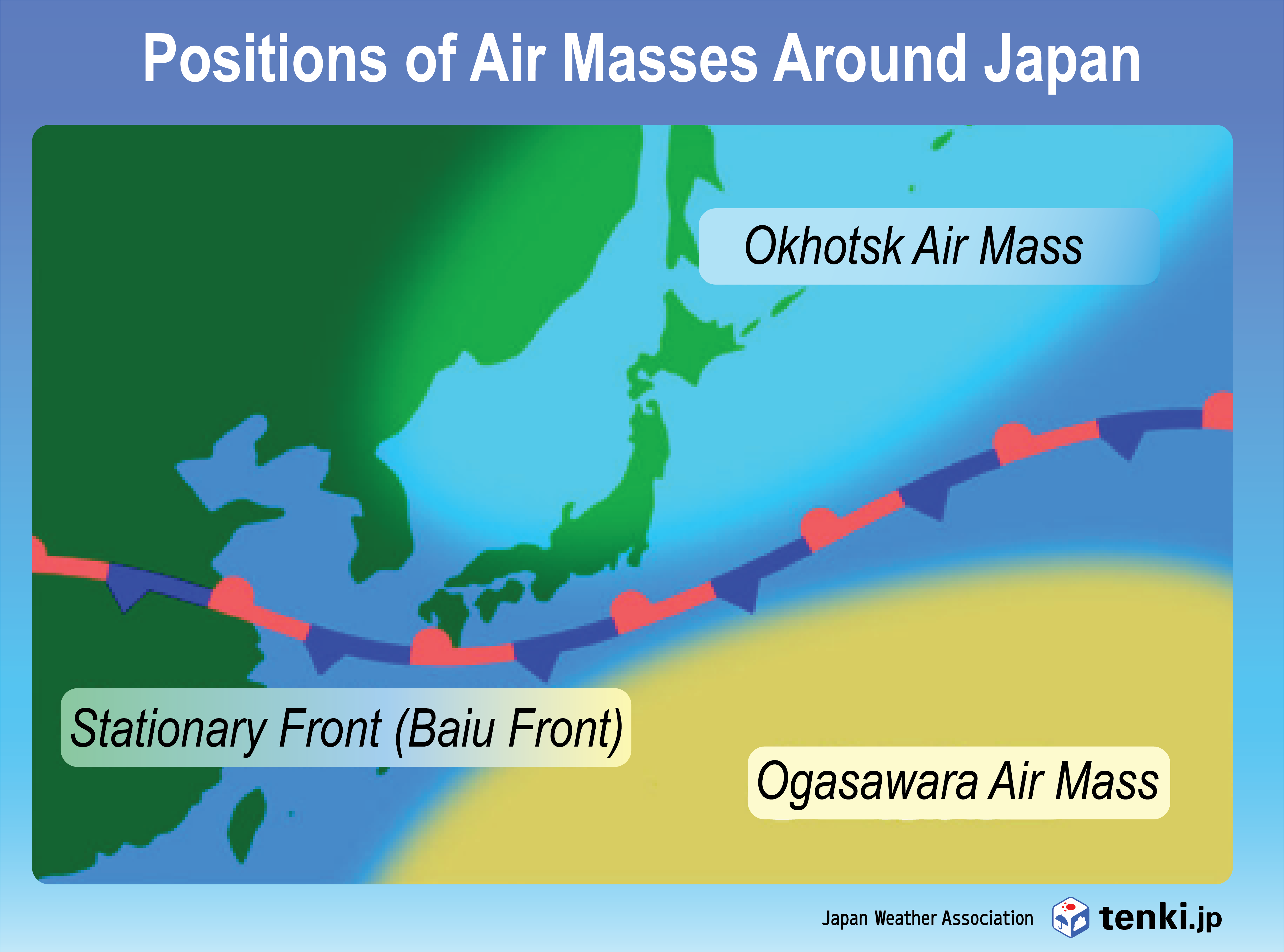
As summer approaches, the Pacific High, which brings warm and moist air from the south, expands its influence. When it collides with the Okhotsk High, which brings cold air from the north, and relatively cool, dry air from the continent, the Baiu front forms near Japan.
Near the Baiu front, clouds develop and rainy days become more frequent.
In general, the Baiu front gradually moves northward as the season progresses. As a result, the onset and end of Baiu typically occur from south to north.
How the Baiu Front Works
The Baiu front forms between the following two air masses with different characteristics.
- North side: relatively cold air (such as the Okhotsk High)
- South side: warm, moist air (Pacific High)
Because these two air masses have nearly equal strength, the front becomes a slow-moving “stationary front.”
Near the Baiu front, which is a type of stationary front, clouds extend in a long, belt-like shape from east to west. Rainy days become more frequent, and unsettled weather tends to continue.
In general, as the Baiu front gradually moves northward, the onset of Baiu is first observed in the Okinawa region from around May to June, and the Tohoku region is usually the last to enter Baiu.
The Baiu season, from the “onset of Baiu” to the “end of Baiu,” varies from year to year. In the Kanto-Koshin region, it lasts for approximately 40 days, as calculated from normal values.
After that, when the Pacific High to the south strengthens, the Baiu front is pushed northward, resulting in the end of Baiu. The end of Baiu begins in the Okinawa region from around June to July, and the Tohoku region is usually the last to see the end of Baiu. In Hokkaido, a period in which cloudy and rainy weather continues for several weeks, as seen in Honshu, is less clearly defined. For this reason, the Japan Meteorological Agency does not announce the onset or end of Baiu for Hokkaido.
Characteristics of Baiu
Baiu is not simply a period when rain continues. Depending on the year, there may be years with little precipitation, years in which rainy or cloudy days continue for a long time, and years in which heavy rain is concentrated over a short period.
The characteristics and progression of Baiu vary from year to year, and in some years the Japan Meteorological Agency is unable to determine the dates of the onset or end of Baiu.
During the Baiu season, the position and activity of the Baiu front change from day to day.
Because the Baiu front is a belt-shaped area where rain clouds can easily develop, even a slight change in its position can easily alter the areas where rain falls and the amount of rainfall.
For this reason, in corporate activities, it is important to check daily weather forecasts, meteorological information related to heavy rain, and precipitation outlooks by region.
Recent Trends
Even in the most recent years, 2025 and 2024, Baiu showed different tendencies.
In 2025, the onset and end of Baiu occurred considerably earlier than normal in many regions from western Japan to eastern Japan, and many regions recorded below-average precipitation during the Baiu season.
For the 2025 onset and end of Baiu, there were major revisions in the final values after the preliminary values were announced. Preliminary and final values are explained later.
In 2024, the onset of Baiu occurred considerably later than normal in many regions, but many regions recorded above-average precipitation the Baiu season.
As this shows, it is becoming difficult to understand the actual situation of Baiu based only on whether the onset or end of Baiu is “early” or “late.”
When using Baiu for business decision-making, it is important to check not only the dates of the onset and end of Baiu, but also precipitation amounts by region, the number of consecutive rainy days, and the timing of heavy rainfall occurrence.
Why Baiu Weather Changes Easily and Is Difficult to Forecast
Baiu weather changes easily because the position and activity of the Baiu front are affected by multiple factors, including the Pacific High, the westerlies, and the inflow of warm, moist air.
Even a slight northward or southward shift in the position of the Baiu front can change the areas where rain falls and the amount of rainfall, which makes forecast details during the Baiu season likely to change.
In addition, heavy rain during the Baiu season may occur locally due to rain clouds and precipitation bands that develop around the front.
In particular, when a linear precipitation band forms, extremely heavy rain continues to fall over the same area, which may lead to disasters. Localized heavy rain, such as that caused by linear precipitation bands, is a phenomenon for which it is difficult to accurately predict in advance where it will form and how long it will last.
For typhoons and heavy rain in Japan, please see:
Typhoons and Heavy Rain in Japan: Business Risks for Global Companies and the Use of Weather Data Part 1 / Part 2
Heavy Rain in the Middle to Later Stages of Baiu Is on an Increasing Trend and May Intensify Further
In the latter half of Baiu, warm and moist air flows toward the Baiu front, activating the front and sometimes causing heavy rain.
Recent studies and reports have shown that precipitation during the Baiu period has been increasing, and that precipitation associated with the Baiu front in early summer, especially in June, is expected to intensify in the future.
An analysis using observational data from 1901 to 2020 reported that total precipitation during the Baiu season has increased, particularly from late June to July, in the middle to later stages of Baiu, on the Sea of Japan side. It also found that extreme precipitation, such as heavy rain exceeding 100 mm per day and annual maximum daily precipitation amount during the Baiu season, has shown a stronger increasing trend during the Baiu season than during the Akisame autumn rainy season. (Endo, H. 2023, Long-Term Precipitation Changes in the Baiu and Akisame Seasons in Japan over the Past 120 Years (1901–2020))
According to the Japan Meteorological Agency’s “Climate Change in Japan 2025,” the frequency and intensity of extreme heavy rainfall in Japan have been increasing, and the nationwide average frequency of extreme heavy rainfall is projected to continue increasing in the future.
Furthermore, in connection with the increase in water vapor caused by rising temperatures, precipitation bands associated with the Baiu front in early summer, or June — so-called Baiu precipitation bands — are projected to intensify. (Japan Meteorological Agency, “Climate Change in Japan 2025”)
In light of these trends, business decisions during the Baiu season require attention to and countermeasures against the risk of heavy rain in the middle to later stages of Baiu. In particular, logistics, construction, electric power, and retail operations will need to continuously check precipitation outlooks by region and the possibility of warning-level weather conditions.
What Are the “Onset of Baiu” and the “End of Baiu”?
The onset and end of Baiu are not actual meteorological phenomena themselves. They are determined and announced by the Japan Meteorological Agency based on the progression of weather conditions.
Definition
The onset and end of Baiu are determined and announced by the Japan Meteorological Agency for each region based on the weather conditions up to that point and the outlook for weather conditions over the following week or so.
- Onset of Baiu: a state in which the region is considered to have entered the Baiu season
- End of Baiu: a state in which the Baiu season is considered to have ended
Baiu does not suddenly begin or end in a single day. In general, there is a transition period of several days before and after the onset or end of Baiu, during which the weather changes. The middle day of that transition period is announced as the date of the onset or end of Baiu. For this reason, the onset and end of Baiu are expressed as “around” a certain date.
After these dates are announced as preliminary information, they are reviewed in autumn based on the actual weather conditions, and the Japan Meteorological Agency finalizes the dates of the onset and end of Baiu.
Preliminary Values and Final Values
There are “preliminary values” and “final values” for the onset and end of Baiu.
| Category | Announcement Timing | Details |
|---|---|---|
| Preliminary values | Around May to July | Announced based on weather conditions up to that point and the forecast for about one week ahead or beyond |
| Final values | Around early September | Reviewed and published after the Baiu season has passed, based on the actual progression of weather conditions |
Because preliminary values include forecasts, they may be revised later.
When using this information for corporate activities, it is important to treat preliminary values as a “seasonal guide” and combine them with daily forecasts and precipitation information for actual operational decisions.
In Hokkaido, the Baiu front often becomes unclear, and differences from year to year are large. Therefore, it is considered that there is no clearly defined Baiu season in Hokkaido.
Points to Note for Business
The onset of Baiu does not mean that “rain will continue from that day,” and the end of Baiu does not mean that “heavy rain will no longer occur afterward.”
According to the Japan Meteorological Agency, even if no Baiu front is shown on the weather map, a period of continuing rain is treated as Baiu.
Depending on the progression of weather conditions, there are also years in which the onset or end of Baiu cannot be identified.
Therefore, in corporate activities, the dates of the onset and end of Baiu should not be used as standalone decision-making criteria. It will be important for demand forecasting, safety management, and other operations to check actual precipitation amounts, hourly rainfall amount, the number of consecutive rainy days, and the possibility of heavy rain.
Impact on Corporate Activities: Key Points for Business Decisions
Baiu is a period when disasters caused by heavy rain are likely to occur.
In corporate activities as well, the increase in rainfall during Baiu is related to sales, logistics, supply and demand, process management, and safety management.
Main Examples of Impact
Retail and Food Service
In retail and food service, an increase in rainy and cloudy days may affect customer visits and product demand. Even immediately after the onset of Baiu, there may be sunny days, and even after the end of Baiu, heavy rain may occur.
Logistics
In logistics, road flooding, rising river levels, landslides, and other effects caused by heavy rain may affect delivery plans and delivery schedules. The risks during the Baiu season are not limited to short periods of intense rain.
Several days of rain may also increase the risk of landslides and rising river levels. It is important to check hourly rainfall amount, daily precipitation amount, and cumulative precipitation together.
Electric Power and Energy
In the electric power and energy sectors, temperature, humidity, solar radiation, and precipitation are related to electricity demand and solar power generation.
During Baiu, rainy and cloudy days are frequent and sunshine duration decreases, making solar power generation more likely to decline.
Construction
In the construction sector, rain may cause work interruptions, schedule delays, and challenges for on-site safety management.
Decision-Making Indicators to Check During Baiu
For business decisions during the Baiu season, it is effective to check the following indicators in combination.
| Indicator | Situations Where It Is Used for Decision-Making |
|---|---|
| Daily precipitation | Total daily precipitation; impacts on operations, deliveries, and customer visits |
| Hourly precipitation | Short-duration heavy rain; understanding peak time periods |
| 3-hour precipitation | Understanding linear precipitation bands and significant heavy rain |
| Number of consecutive rainy days | Impacts of prolonged rain on demand, processes, and inventory |
| Temperature and humidity | Demand, air conditioning, perceived temperature, and work environment management |
| Sunshine duration | Electricity supply and demand, solar power generation, and changes in behavior |
To understand the impact of Baiu on operations, it is necessary to monitor weather conditions by region, day or time period.
Using Weather Data Is Important for Decision-Making During Baiu
For operational decision-making during the Baiu season, it is important to use weather data by region and time period, rather than relying solely on the onset and end of Baiu as seasonal markers.
Japan Weather Association provides the following services to help companies use weather data for business decisions.
| Issue | Solution |
|---|---|
| Understanding changes in demand caused by weather | Product Demand Forecasting
For more information on product demand forecasting, please see: Product Demand Forecasting Using Weather Data Part 1 / Part 2 |
| Using seasonal outlooks for business planning | Weather Data API 2-Year Long-Term Weather Forecast (Only Available in Japanese) For more information on the 2-Year Long-Term Weather Forecast, please see: What are Long-Term Forecasts? JWA’s Proprietary “2-Year Long-Term Weather Forecast” and Its Business Applications Part 1 / Part 2 |
| Understanding heavy rain and severe weather risks | Weather Data API GoStop Management System |
| Using weather data in the energy sector | ENeAPI, an API Service for the Energy Industry |
| Using weather data in your company’s own systems | Weather Data API |
| Starting to use weather data | Contact Us |
Baiu does not progress in the same way every year.
That is precisely why combining forecasts for the onset and end of Baiu with the latest weather data, and making decisions tailored to each operation, can help support risk countermeasures and improve operational efficiency.
Related Information: Forecast for the 2026 End of Baiu
The latest forecast for the end of Baiu and the impact of the timing of Baiu on corporate activities are explained in the following article.
When Will the 2026 Baiu Rainy Season End? Latest Forecast and Impact on Companies (Only Available in Japanese)
Conclusion
Baiu is a seasonal phenomenon in which rainy and cloudy days become more frequent from late spring into summer.
The onset and end of Baiu are announced by region based on the progression of weather conditions and future outlooks, and they cannot be clearly separated on a day-by-day basis.
During the Baiu season, disasters caused by heavy rain are also more likely to occur. In particular, during the latter half of Baiu, attention should be paid to short-duration heavy rain and linear precipitation bands.
For corporate activities, it is important to make decisions by combining not only the dates of the onset and end of Baiu, but also precipitation amounts, hourly precipitation, the number of consecutive rainy days, the timing of heavy rainfall occurrence, temperature, humidity, and sunshine duration.
See this summer’s temperature forecast: Summer 2026 Weather Forecast for Japan: Temperatures May Be Above Normal
FAQ
Q. What is Baiu?
A. Baiu is a phenomenon, or the period of such a phenomenon, in which rainy and cloudy days frequently occur from late spring to summer. It is a seasonal phenomenon defined by the Japan Meteorological Agency.
Q. How is the onset of Baiu determined?
A. The onset of Baiu is determined as the beginning of a period in which rainy and cloudy days increase and sunshine duration decreases. Preliminary dates are announced based on the weather conditions up to that point and the future outlook.
Q. When is the end of Baiu finalized?
A. The final date for the end of Baiu is determined by the Japan Meteorological Agency after the Baiu season has passed, based on the actual progression of weather conditions, and is published in early September. It may differ from the preliminary value.
Q. Can there be no rain even after the onset of Baiu?
A. Yes. This is because the onset and end of Baiu include an average transition period of about five days, making it difficult to clearly separate the period by a single specific day.
Q. What indicators are important for corporate decision-making during the Baiu season?
A. It is important to check not only the onset date of Baiu, but also daily precipitation, hourly precipitation, 3-hour precipitation, the number of consecutive rainy days, temperature, humidity, and sunshine duration. In particular, when there is a possibility of heavy rain or linear precipitation bands, it is necessary to check daily meteorological information, warnings, and advisories.
Q. What should companies keep in mind when using information on the onset and end of Baiu?
A. The onset and end of Baiu do not strictly indicate the beginning or end of rain. For operational decisions, it is important to also check precipitation amounts by region, hourly precipitation, the number of consecutive rainy days, and the timing of heavy rainfall occurrence.