News
Weather Risks in Japan from Summer to Autumn 2026: Impacts on Electricity Demand, Solar, and Wind Power Generation
2026.08.05
From summer to autumn 2026, cooling demand is likely to increase, particularly in July and August. From September onward, moist air, approaching typhoons, and unstable weather may affect power supply-demand management and power generation planning.
The key points for energy businesses from summer to autumn 2026 are the following three:
- Increase in electricity demand due to high temperatures, especially in July and August
- Impacts on wind power shutdowns and related facilities due to typhoons and lightning
- Fluctuations in solar power generation due to rainfall and unstable weather
This article outlines the key points for energy businesses based on the weather outlook from summer to autumn 2026, including changes in electricity demand caused by hot and humid conditions and impacts on solar and wind power generation.
Table of Contents
Weather Risks Likely to Affect Electricity Demand and Renewable Energy Operations from Summer to Autumn
Electricity Demand | High Summer Temperatures and Lingering Autumn Heat Are Likely to Increase Cooling Demand
In summer, electricity demand increases as cooling demand rises. In particular, from July to August, “extremely hot days,” when the daily maximum temperature reaches 35°C or higher, often occur over long periods and across wide areas. In recent years, “severely hot days,” when the daily maximum temperature reaches 40°C or higher, have also become increasingly common.
Summer is a period when severe heat increases electricity demand nationwide, placing greater pressure on supply-demand conditions. Another characteristic is that heat accumulated during the day can lead to high temperatures at night, resulting in high cooling demand both during the day and at night.
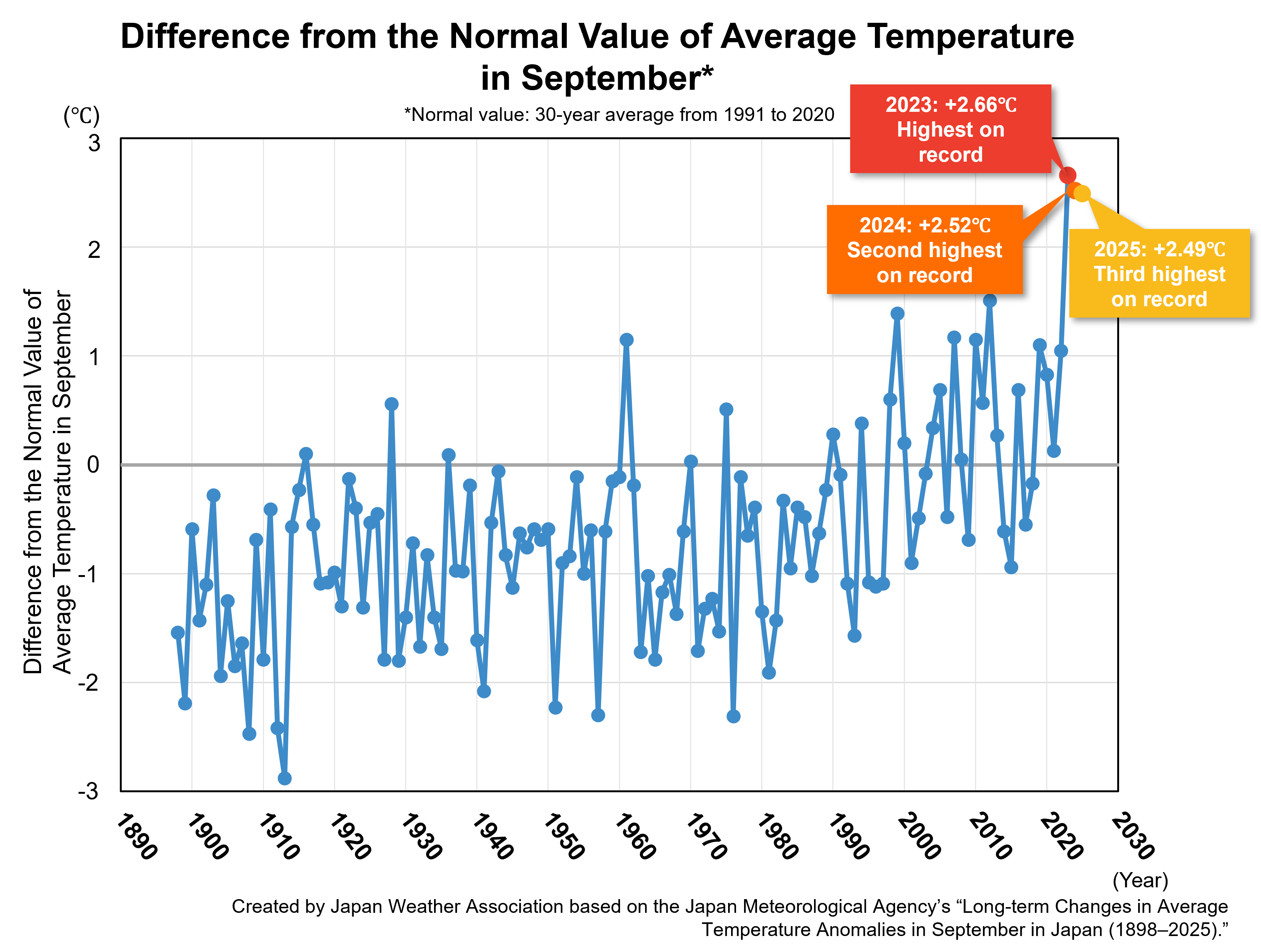
According to the Japan Meteorological Agency’s definition, autumn starts in September. In reality, however, September can still be as hot as midsummer, and high cooling demand may continue. In particular, from 2023 to 2025, intense heat did not subside easily, and compared with past statistics, the nationwide average temperature in September was extremely high.
In October, electricity demand decreases as temperatures fall.
During periods from around July to September when hot and humid conditions and high nighttime temperatures are expected, energy businesses should monitor outlooks for peak electricity demand, reserve capacity, and procurement volumes at an early stage.
Solar Power Generation | Solar Radiation Is Likely to Fluctuate Due to the Autumn Rain Front and Unstable Weather
In September, the Pacific High, which brings sunny summer weather, gradually weakens. This is also a period when a stationary autumn rain front can easily lead to prolonged rainfall, reducing solar radiation, while unstable weather can cause sudden changes in solar radiation.
During this period, power generation forecasts and supply-demand plans need to be reviewed in light of decreases and sudden fluctuations in solar radiation.
Wind Power Generation and Facility Management | Operational Risks from Typhoons, Lightning, and Gusts Require Attention
As the Pacific High weakens in September, the atmosphere becomes even more unstable. This period is also characterized by an increase in weather phenomena that can lead to facility failures, such as lightning and gusts including tornadoes.
In October, electricity demand decreases as temperatures fall, but caution is still advised for typhoons even after the intense heat subsides. The number of typhoons approaching Japan, based on normal values, peaks from August to September, and October is also the fourth-highest month of the year. Supply-demand operations need to take into account operational risks for wind power generation and power facilities, as well as outage risks.
Weather Points Requiring Particular Attention from Summer to Autumn 2026
From the perspective of energy businesses, the following three weather elements require particular attention from summer to autumn 2026:
- Temperature: a tendency toward high temperatures, mainly from July to August
- Typhoons: an increase in the number of approaching typhoons
- Solar radiation: fewer periods of stable sunny weather
Temperature | High Temperatures Expected in July and August; Increased Demand Due to Humid Heat Also Requires Attention in September
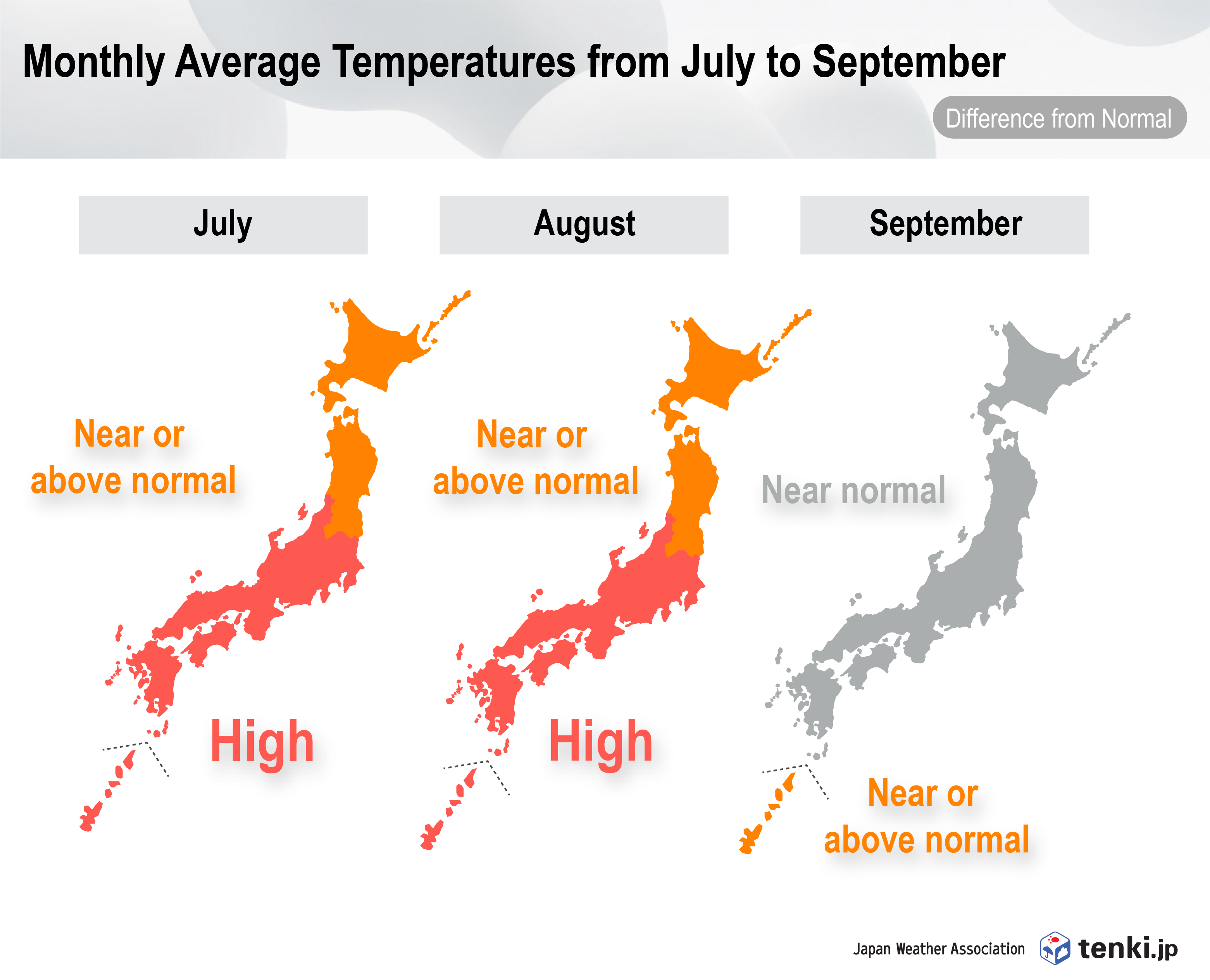
According to the Japan Meteorological Agency’s three-month forecast, released on June 23, 2026, temperatures in July and August are expected to be higher than normal nationwide, indicating a tendency toward “high temperatures.” Until August, the Pacific High, which brings intense heat, is expected to be somewhat strong, and continued attention will be needed this year as cooling demand is expected to remain high.
On the other hand, in September, temperatures are expected to settle around normal levels, mainly from western Japan to northern Japan. Unlike the past few years, there is now a possibility that midsummer-like heat may not continue into September. However, because Japan is likely to be affected by moist air, hot and humid conditions may become more noticeable, increasing the use of air conditioners and dehumidifiers and potentially causing electricity demand to be somewhat higher.
Number of Approaching Typhoons | Typhoons Are Likely to Approach Toward Autumn; Attention Needed for Facility Impacts from Strong Winds, Heavy Rain, and Lightning
In 2026, the number of typhoons approaching Japan is expected to increase from the latter half of summer through autumn. In addition, because typhoons may approach while still maintaining their strength, they may affect wind power generation facilities, power transmission and distribution facilities, and related infrastructure through strong winds and heavy rain.
In addition, when a typhoon approaches, moist air around the typhoon flows into the area near Japan, making lightning more likely several days before the typhoon makes its closest approach. Risks that could affect the power supply, such as facility failures caused by lightning or gusts, should also be considered.
For detailed typhoon trends in 2026, see: Japan’s 2026 Typhoon Outlook: Increased Risk of Typhoons Approaching Japan in August, with Potential Impacts from Stronger Typhoons in Autumn
Solar Radiation | Sunny Weather Is Less Likely to Continue, and Short-Term Fluctuations May Affect Power Generation Plans
From the latter half of summer, periods of sunny weather may become less persistent due to the weakening of the Pacific High and the approach of typhoons, and solar radiation may become unstable. Sudden cumulonimbus clouds are also likely to develop, causing solar radiation to fluctuate significantly over short periods and potentially affecting the formulation of power generation plans.
Japan Weather Association Services That Can Be Used to Reduce Supply-Demand Risks from Summer to Autumn
From summer to autumn, electricity demand is likely to increase due to the use of air conditioning, and the risk of failure or damage to power generation facilities also increases due to typhoons and lightning. To reduce power supply-demand risks, it is essential to have systems in place to anticipate changes in weather and incorporate them into supply-demand management and power generation planning.
Japan Weather Association provides energy management services that use highly accurate weather forecasting and analysis technologies tailored to each challenge.
| Challenge | Applicable Service |
|---|---|
| Understand in advance increases in electricity demand caused by changes in temperature and weather | Electric Power Demand Forecasting |
| Forecast the impact of changing weather conditions on electricity market prices | Price Forecasting (Electricity Market Price Forecasting) |
| Obtain solar power generation output, wind power generation output, lightning risk, and other information via API | ENeAPI |
| Obtain detailed information on typhoon tracks at an early stage | Probabilistic Scenario-Based Typhoon Forecasts (only available in Japanese) |
Electric Power Demand Forecasting
Power demand is greatly affected by various weather elements, including temperature, humidity, solar radiation, and precipitation.
Japan Weather Association analyzes the characteristics of past electricity demand based on variable factors such as weather conditions and social activity, combines this with advanced data analysis technologies including AI, and provides highly accurate electricity demand forecasts. In addition, consulting by weather experts including certified weather forecasters, supports day-to-day supply-demand operations. Electric power demand forecasts are also available through ENeAPI, in Web API format.
Price Forecasting (Electricity Market Price Forecasting)
Fluctuations in electricity demand and renewable energy generation caused by changes in weather conditions also lead to fluctuations in electricity trading prices. In the spot market in particular, trading prices for the following day must be determined on the previous day, making it important to accurately understand the weather conditions expected for that day.
Japan Weather Association provides highly accurate electricity trading price forecasts using weather big data and AI-based analysis technologies, forecasting electricity trading prices for delivery from the next day up to 31 days ahead. This enables strategic power generation, procurement, and charging/discharging plans, and supports energy businesses in maximizing profits and maintaining stable business operations.
ENeAPI, an API Service for the Energy Industry
ENeAPI provides weather information for energy businesses in Web API format.
The “Solar Power API” provides estimated and forecast information on solar radiation and solar power generation output. It supports the creation of accurate power generation sales plans and the formulation of maintenance and operation plans for solar power generation facilities.
The “Wind Power API” provides actual and estimated values for wind direction and wind speed, as well as forecast information for wind direction, wind speed, and wind power generation output. It supports the wind power generation business as a whole, including the planning and design of onshore and offshore wind power projects, as well as maintenance and management after installation.
The “Risk Information API” provides information that enables users to understand meteorological disaster risks, such as lightning activity levels and lightning strike locations. By obtaining this information quickly, users can identify facility failure risks in advance and determine whether maintenance and inspection work can be carried out safely.
Probabilistic Scenario-Based Typhoon Forecasts
Typhoon track forecasts inherently involve uncertainty. In particular, when a typhoon is expected to approach Japan, even a slight change in its track can alter the areas affected, the timing of impacts, and the expected intensity of rain and wind.
Unlike conventional typhoon forecasts, “Probabilistic Scenario-Based Typhoon Forecasts” provide multiple track scenarios together with the probability of each scenario. By understanding ahead of time the likelihood of a typhoon approaching Japan, something that can be difficult to determine from forecast circles alone—users can begin disaster preparedness measures at an early stage.
For details on service content and how to introduce these services, please feel free to contact us.
Conclusion
In summer 2026, from July to August, electricity demand is expected to increase due to “high temperatures.” In addition, throughout summer and autumn, attention is needed for the impact of typhoons on power facilities and fluctuations in solar radiation caused by unstable weather.
It is important to identify these risks in advance using a range of weather data and to conduct efficient supply-demand management and formulate power generation plans.
By using Japan Weather Association’s “Electric Power Demand Forecasting,” “Price Forecasting (Electricity Market Price Forecasting),” “ENeAPI, an API Service for the Energy Industry,” and “Probabilistic Scenario-Based Typhoon Forecasts”, energy businesses can enhance supply-demand management and renewable energy operations by taking into account weather changes.
FAQ
Q1. How does the weather from summer to autumn affect energy management?
A. In summer, electricity demand is expected to increase and remain high due to high temperatures. In addition, throughout summer and autumn, energy businesses are likely to be affected by typhoons, and operational risks for wind power generation and power facilities, as well as outage risks, may increase. Because sunny weather may not persist, attention should be paid to unstable solar radiation and facility failures caused by lightning and gusts.
Q2. What services are available to respond to energy supply-demand risks caused by changes in weather?
A. Japan Weather Association provides a wide range of services for energy businesses that use weather forecasts.
- Electric Power Demand Forecasting: This service combines the know-how of certified weather forecasters with artificial intelligence (AI) and machine learning analysis technologies to provide highly accurate electricity demand forecasts.
- Price Forecasting (Electricity Market Price Forecasting): This service combines proprietary weather forecast data with AI-based analysis technologies to provide electricity trading price forecasts from delivery on the next day through delivery up to 31 days ahead.
- ENeAPI, an API Service for the Energy Industry: This service provides weather information for energy businesses in Web API format. It offers a wide range of highly accurate weather information for energy businesses, including solar radiation and solar power generation output forecasts, wind direction, wind speed and wind power generation output forecasts, electricity demand forecasts, and electricity trading price forecasts.
- Probabilistic Scenario-Based Typhoon Forecasts: This service provides multiple typhoon forecast scenarios and the probability level of each scenario, which cannot be understood from conventional forecast circles alone.
Q3. To what extent do summer heat and lingering autumn heat affect electricity demand?
A. Summer heat and lingering autumn heat increase electricity demand by raising cooling demand. In particular, in July and August, “extremely hot days,” when the daily maximum temperature reaches 35°C or higher, may occur over long periods and across wide areas, making electricity demand likely to rise nationwide. If September is as hot as midsummer, high cooling demand may continue.
Q4. How do high nighttime temperatures affect electricity demand?
A. Heat accumulated during the day can also lead to high temperatures at night. When temperatures do not fall easily at night, cooling demand remains high both during the day and at night, making electricity demand less likely to decline.
Q5. When is power supply-demand likely to tighten from summer to autumn?
A. From summer to autumn, power supply-demand conditions are likely to tighten during periods when cooling demand increases due to high temperatures. In particular, July and August are periods when severe heat tends to raise electricity demand nationwide. In addition, facility impacts caused by typhoons and lightning, as well as fluctuations in solar radiation due to unstable weather, may affect supply-demand management and power generation plans.
Q6. How do typhoons affect solar power generation?
A. When a typhoon approaches, sunny weather may not persist due to the weakening of the Pacific High, rainfall, and unstable weather, and solar radiation may become unstable. Decreases in solar radiation and short-term fluctuations affect forecasts of solar power generation and power generation plans.
Q7. How do typhoons affect wind power generation?
A. Typhoons may affect wind power generation facilities, power transmission and distribution facilities, and related infrastructure through strong winds and heavy rain. In addition, when a typhoon approaches, there may be risks of facility failures caused by lightning and gusts. Therefore, supply-demand operations need to take into account operational risks for wind power generation and power facilities, as well as outage risks.