News
Electricity Demand and Market Prices in Winter 2026–2027
Electricity Supply–Demand Risks to Watch for Even in a Mild Winter
2026.11.02
The winter of 2026/27 (December 2026–February 2027) is expected to be mild across Japan. If the winter is as mild as forecast, heating demand is expected to be lower than usual.
On the other hand, even if the winter is mild overall, a strong cold air mass may temporarily move into Japan. Furthermore, even during a mild winter, low-pressure systems passing along the southern coast of Japan may bring lower temperatures and snowfall to the Pacific side of the country, where snowfall is typically limited in winter. In particular, if an increase in electricity demand due to low temperatures coincides with a decrease in solar power generation due to low solar radiation, electricity supply–demand conditions may change significantly over a short period.
Key Points of This Article
- With a mild winter forecast, heating demand may increase less than usual over the season as a whole, making it necessary to review demand and procurement plans to reflect the expected mild winter conditions.
- During temporary cold waves or periods of cloudy weather or snowfall when temperatures and solar radiation are both low, particular attention should be paid to the risk of higher-than-expected demand and reduced solar power generation.
- It is important to progressively update information, from seasonal forecasts to day-ahead and same-day forecasts, and reflect the resulting demand and power generation outlooks in procurement and electricity sales decisions.
This article briefly introduces the weather outlook for winter 2026/27 and explains considerations for electricity businesses in winter supply–demand operations and market trading, including demand projections during a mild winter, responses to temporary cold waves and snowfall on the Pacific side, and potential impacts on electricity market prices.
Table of Contents
- Weather Outlook for Winter 2026/27
- Three Key Points to Watch for in Electricity Supply and Demand During a Mild Winter
- How Does Winter Weather Affect Electricity Market Prices?
- Key Information to Check and Points to Monitor in Winter Supply–Demand Operations
- Using JWA Services for Winter Supply–Demand Operations
- Conclusion
- FAQ | Frequently Asked Questions
Weather Outlook for Winter 2026/27
The key points of this winter’s weather outlook are as follows:
- Mild winter conditions expected across Japan
- Typical winter pressure patterns are less likely to persist
- Low-pressure systems are likely to affect areas around Honshu, requiring attention to cloudy weather conditions and snowfall even on the Pacific side
- Temporary incursions of strong cold air and heavy snowfall on the Sea of Japan side remain possible even during a mild winter
El Niño is expected to continue during the winter of 2026/27. According to the “El Niño Monitoring Bulletin” released by the Japan Meteorological Agency (JMA) on September 9, 2026, El Niño is expected to continue into winter (100% probability).
In addition, the currently available forecasts indicate a clear tendency toward mild winter conditions across Japan in winter 2026/27.
Source: Japan Meteorological Agency, “El Niño Monitoring Bulletin” (No. 408, released September 9, 2026)
This winter, winter-type pressure patterns are less likely to persist, and areas around Honshu are expected to be more frequently affected by low-pressure systems. As a result, seasonal snowfall on the Sea of Japan side is expected to be near or below normal, while the Pacific side may experience more cloudy, rainy, or snowy days than in a normal winter.
However, a mild winter does not mean that conditions will remain warm throughout the season. Attention should also be paid to the possibility of temporary inflows of strong cold air, short periods of low temperatures, and heavy snow on the Sea of Japan side.
*For details of this winter’s forecast, see “【Japan Winter Weather Forecast for 2026-2027】Cold Waves and Heavy Snow Still Possible Even in a Mild Winter.”
Three Key Points to Watch for in Electricity Supply and Demand During a Mild Winter
With mild winter conditions expected this winter, it is important to distinguish between lower demand over the season as a whole and temporary increases in demand over short periods. In particular, when a drop in temperature coincides with reduced solar power generation output, it is important to assess supply–demand outlooks from both the demand and supply sides.
1. Heating Demand May Decrease, with Lower Morning and Evening Demand Peaks
Winter electricity demand is strongly correlated with temperature, with heating demand increasing as temperatures fall. Therefore, with a mild winter expected this year, heating demand over the season as a whole is expected to be lower than normal.
In particular, on days when early-morning temperatures are relatively mild, electricity demand may increase less than usual when households and businesses begin using heating. Similarly, if temperatures do not drop significantly in the evening, the evening demand peak typical of winter may be lower than usual.
For this reason, it is important to revise winter demand plans to reflect the expected mild winter conditions, rather than relying on demand estimates based on normal winter temperatures.
2. A Cold Wave Can Increase Demand over a Short Period
Even if the seasonal average indicates a mild winter, temperatures may fall sharply across Japan if strong cold air temporarily moves into the country.
In particular, if temperatures drop suddenly after a period of warmer-than-normal conditions, heating demand will rise over a short period. In such situations, rather than relying solely on the “mild winter” indication in seasonal forecasts, it is important to update demand outlooks regularly using weekly forecasts, two-week temperature forecasts, and other information.
3. Watch for Increased Demand and Reduced Solar Power Generation During Cloudy Weather and Snowfall on the Pacific Side
Even on the Pacific side, which usually experiences many sunny days in winter, cloudy weather, rain, or snow may occur when low-pressure systems pass along the southern coast of Japan.
If temperatures remain low and daytime temperatures struggle to rise, heating demand may increase while reduced solar radiation may cause solar power generation to decline. When a low-pressure system passes along Japan’s southern coast, it is important to check forecasts of temperature and solar radiation as well as the possibility of snowfall.
If rising demand coincides with falling solar power generation output and reduces the available supply margin, electricity supply–demand may become tight. This could lead to higher spot market prices and imbalances caused by forecasting errors in electricity demand and power generation.
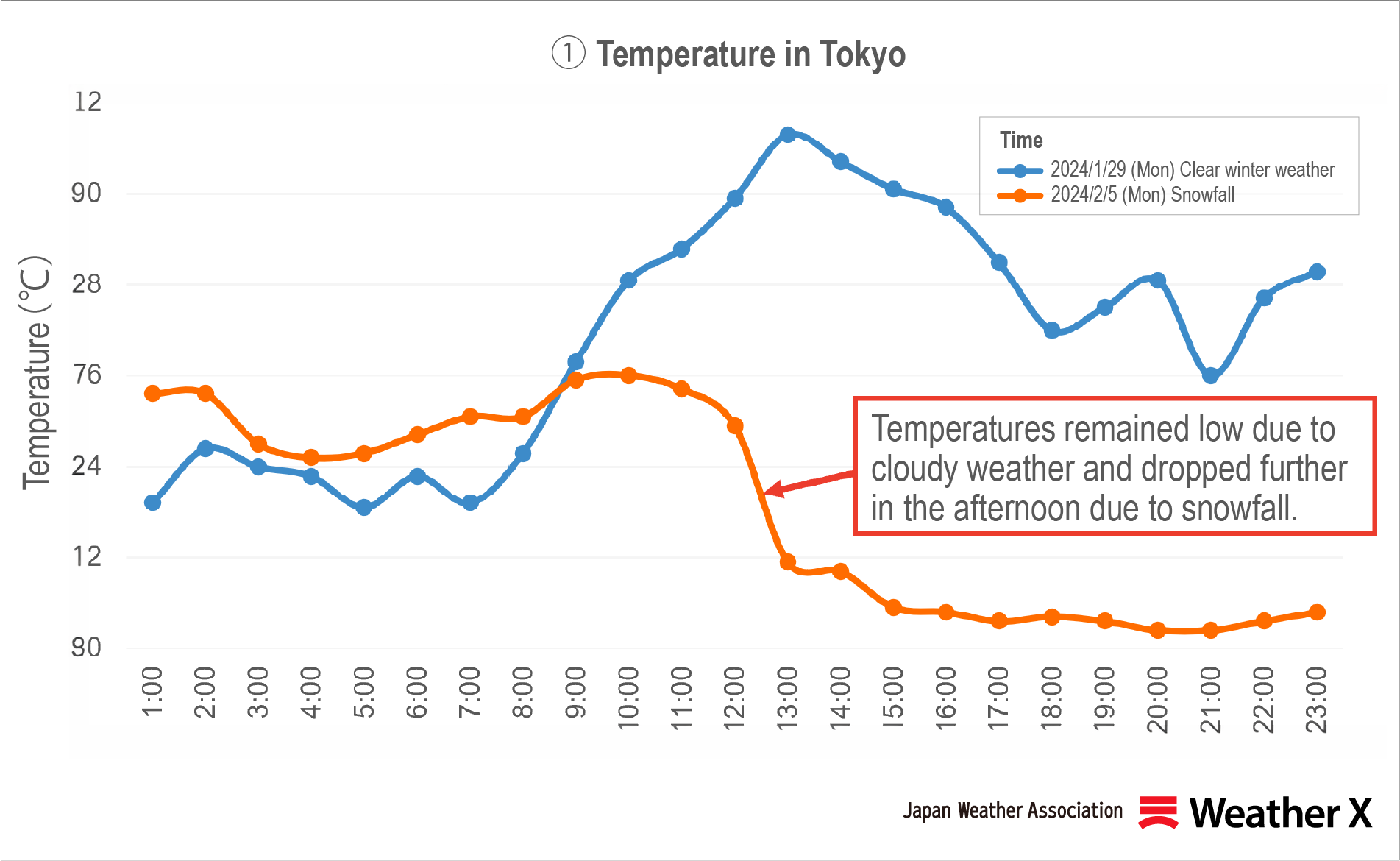
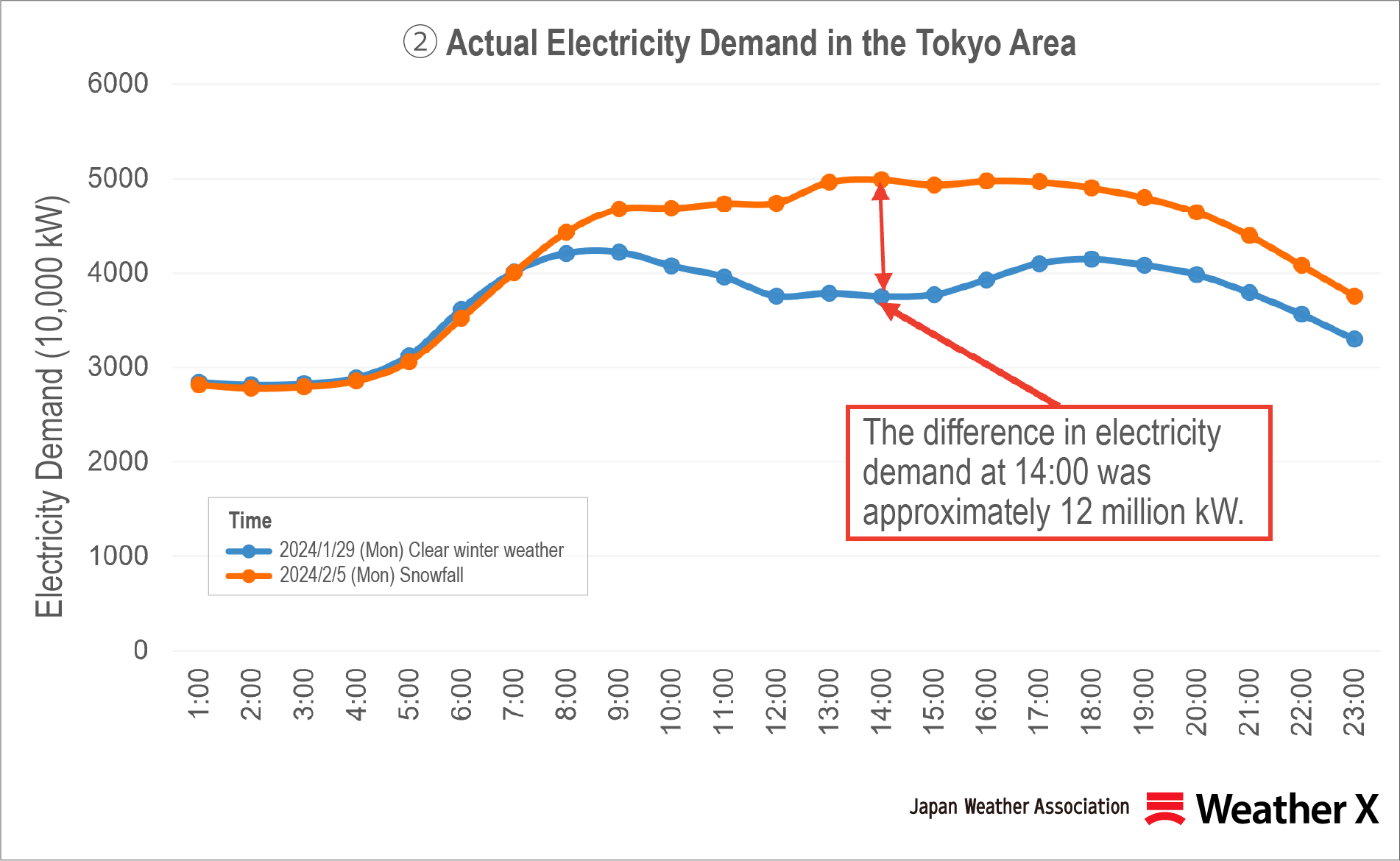
We compared a sunny winter day in Tokyo on Monday, January 29, 2024, with a snowy day on Monday, February 5, 2024.
On February 5, when it snowed, daytime temperatures did not rise as much as on the sunny winter day of January 29 (Figure 1), and electricity demand remained high (Figure 2).
At 2:00 p.m., the temperature was 10.7°C on January 29 (the sunny winter day) and 1.7°C on February 5 (the snowy day). Electricity demand at 2:00 p.m. was 37.53 million kW on January 29 and 49.90 million kW on February 5. Demand on the snowy day was 12.37 million kW higher than on the sunny winter day.
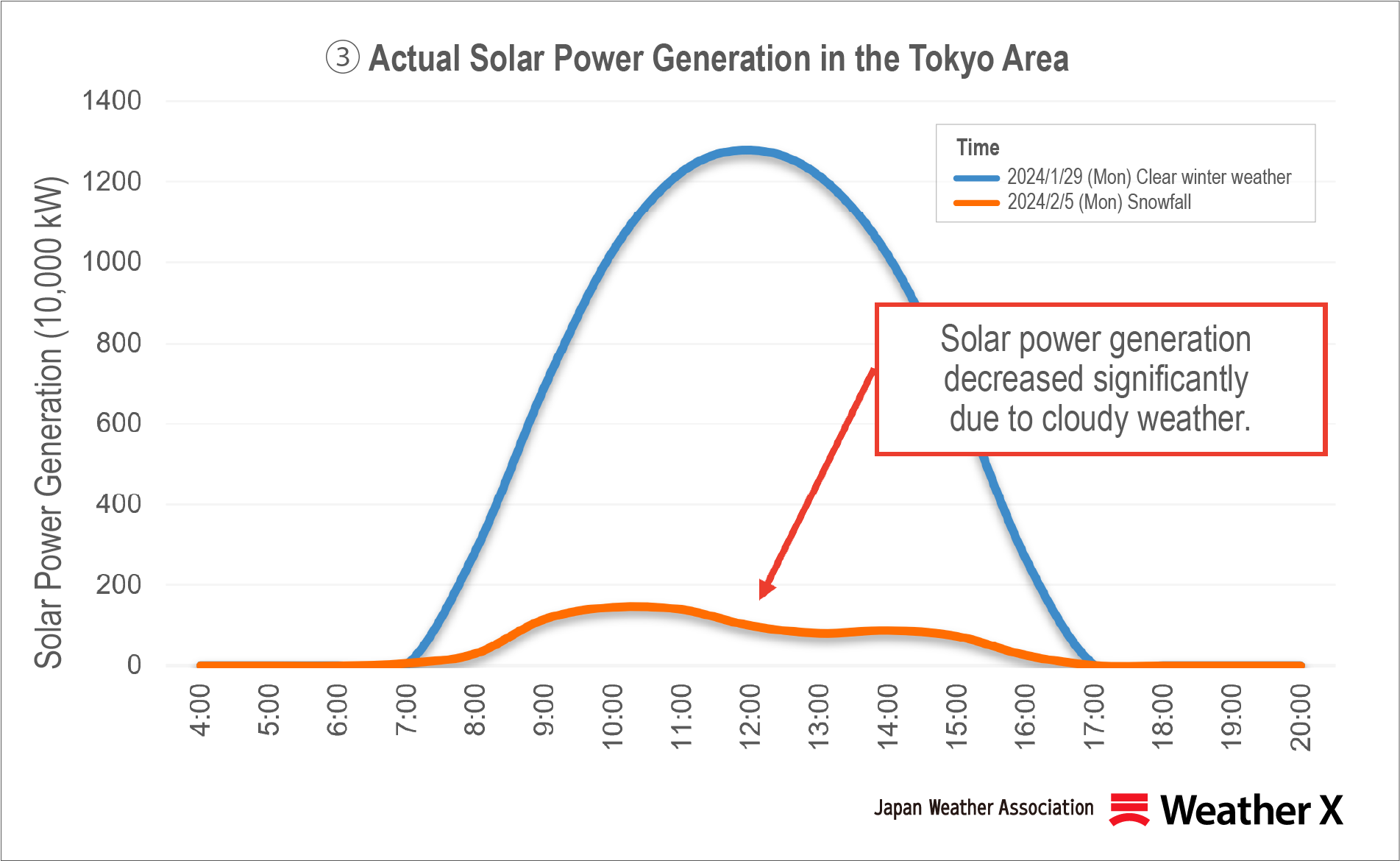
Meanwhile, at 2:00 p.m., solar power generation output was 10.16 million kW on January 29, compared with 0.87 million kW on February 5 (Figure 3). In this example, an increase in daytime demand coincided with a decrease in solar power generation output. In addition, electricity demand also peaked at 2:00 p.m. on February 5, indicating that winter operations need to account not only for morning and evening demand peaks but also for higher-than-expected daytime demand.
Spot market prices were also higher on February 5 than on January 29, particularly during the daytime (Figure 4). The simple average over the 48 trading periods in each day was 9.86 yen/kWh on January 29 and 13.04 yen/kWh on February 5.
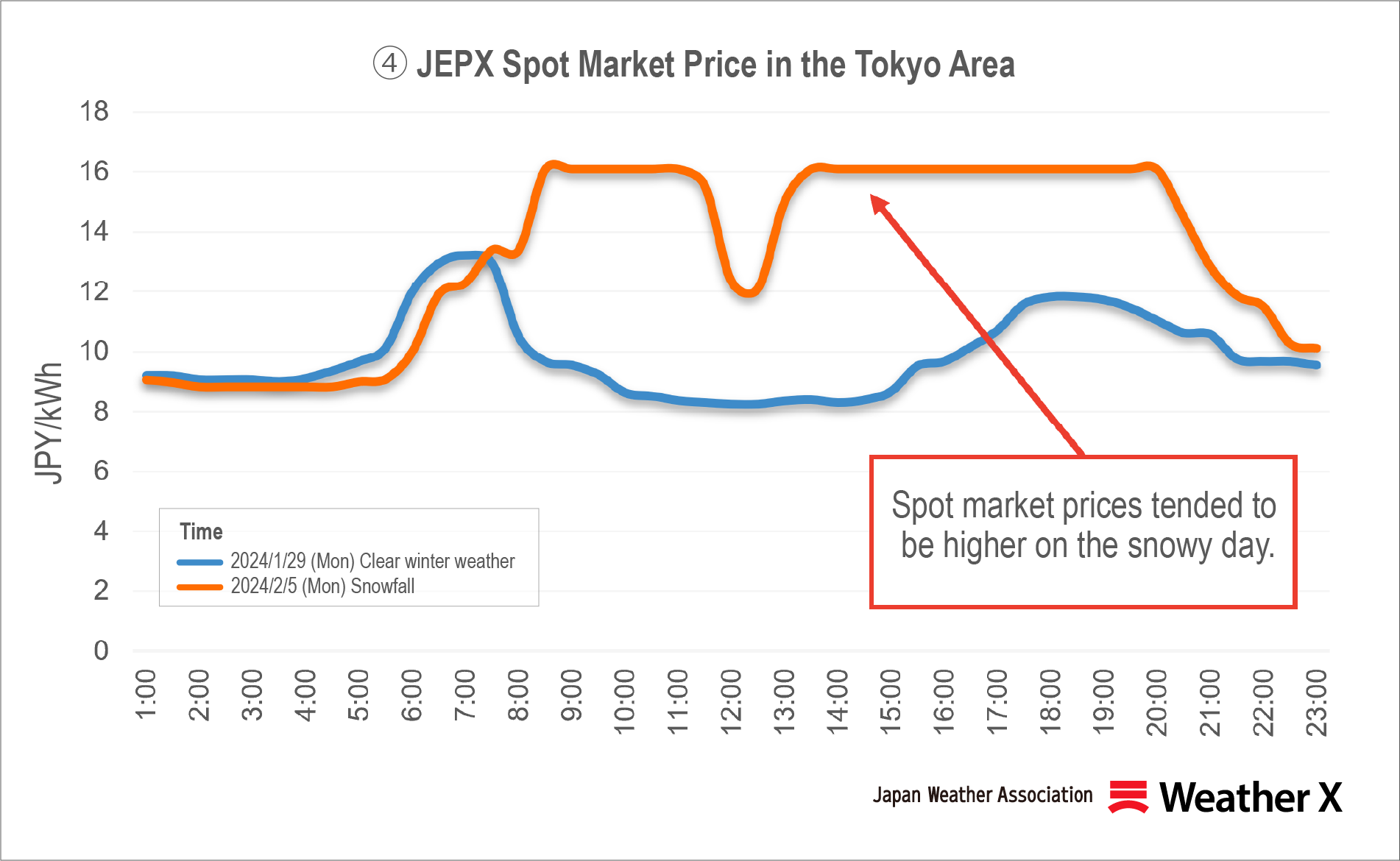
However, electricity market prices fluctuate in response to multiple factors, including the operating status of power generation facilities, fuel prices, and other supply–demand conditions, as well as weather. This example should therefore be regarded as one illustration of the relationship between weather conditions, electricity supply and demand, and market prices.
After Snowfall, Check Both Solar Radiation and Actual Solar Power Generation Output
Even if the skies clear after snowfall, solar power generation output may take longer to recover if snow remains on solar panels. Therefore, after snowfall, it is important to check not only solar radiation but also snow accumulation on the panels and actual solar power generation output.
How Does Winter Weather Affect Electricity Market Prices?
Because a mild winter reduces heating demand, a decrease in electricity demand tends to put downward pressure on wholesale electricity market prices, all else being equal.
However, electricity market prices are not determined by temperature alone. They fluctuate due to a range of factors, including solar and wind power generation, the operating status of power generation facilities, and fuel prices.
Watch for Price Increases During Cold Waves, Cloudy Weather, and Snowfall
When electricity demand increases due to a temporary nationwide cold wave, or when cloudy weather or snowfall keeps temperatures low and also reduces solar power generation, electricity supply and demand may tighten and market prices may rise.
Furthermore, if fuel prices, including LNG and natural gas, are high, increased thermal power generation costs can also be one factor driving market prices upward.
*For examples of electricity market price fluctuations in past winters, see “A Review of Electricity Market Prices in Winter 2025–26.”
Key Information to Check and Points to Monitor in Winter Supply–Demand Operations
Even when seasonal forecasts predict a mild winter, temperatures will not necessarily remain high throughout the season. A strong cold air mass may temporarily move into the country, or snow may fall on the Pacific side when low-pressure systems pass along the southern coast.
Therefore, winter supply–demand operations require monitoring not only the overall seasonal trend but also the movements of cold air masses and low-pressure systems, which become clearer as forecast lead times shorten, as well as hourly changes in temperature and solar radiation. The following table summarizes the main information to check and the points to monitor at each time horizon.
| Timing | Main Information to Check | Points to Monitor |
|---|---|---|
| Several months in advance | Seasonal forecasts | Mild or cold winter outlook; temperature trends throughout the winter season |
| Two weeks to one month in advance | One-month forecasts and two-week temperature forecasts | Changes in temperature trends; possibility of stronger inflows of cold air |
| One week in advance | Weekly forecasts | Intensification of cold air; passage of low-pressure systems along the southern coast of Japan; possibility of snowfall |
| Previous day | Temperature, solar radiation, snowfall, and demand forecasts | Hourly temperature changes; decrease in solar radiation; timing of snowfall; demand peaks and hourly demand changes |
| Same day | Latest weather forecasts and observations; actual demand and generation | Deviations from forecasts; changes in temperature, solar radiation, and snowfall; differences between forecasts and actual demand and generation |
Several months in advance, seasonal forecasts can be used to understand overall temperature trends over the winter season. One-month forecasts, two-week temperature forecasts, and weekly forecasts can then be used to assess the impacts of cold air and the possibility of snowfall. On the day before and on the day itself, it becomes important to check detailed forecasts and observed conditions for temperature, solar radiation, and snowfall, and to identify deviations from electricity demand and solar power generation forecasts.
The latest weather and supply–demand information can support electricity businesses in updating demand and generation forecasts, conducting intraday market trading, and reducing imbalances.
*In actual supply–demand operations, multiple types of weather and supply–demand information are checked, including information not shown here.
*Related articles
- How Should Weather Data Be Used for Different Purposes? Differences Between Short-, Medium-, Long-, and Extended-Long-Range Forecasts and Their Business Applications
- What Is Weather Risk in Renewable Energy Businesses? Data Utilization and Decision-Making by Time Scale
Using JWA Services for Winter Supply–Demand Operations
Electric Power Demand Forecasting
Japan Weather Association (JWA) analyzes historical electricity demand patterns based on variable factors such as weather conditions and social activity, and provides electricity demand forecasts combining data analysis techniques, including AI.
The forecasts reflect lower electricity demand during mild winters and higher demand during cold waves, supporting daily supply–demand planning and market trading decisions. Through consulting by weather forecasters, JWA also supports supply–demand operations that take anticipated temperature changes and snowfall risks into account.
-> Learn more about Electric Power Demand Forecasting
(ENeAPI provides electricity demand forecasts in WebAPI format.)
ENeAPI
ENeAPI provides forecast information in WebAPI format, including electricity demand, solar radiation and solar power generation output, wind direction and speed and wind power generation output, and electricity trading prices. Energy businesses can incorporate the forecast information they need into their own supply–demand management systems and other systems, and use it to review daily plans and make market trading decisions.
-> Learn more about “ENeAPI,” which provides demand, power generation, and price forecasts for supply–demand operations
Solar Radiation and Solar Power Generation Output Forecasting: SYNFOS-solar
When low-pressure systems bring cloudy weather, rain, or snow in winter, reduced solar radiation leads to lower solar power generation. If low temperatures coincide with these conditions, heating demand may also increase, making highly accurate forecasts of solar radiation and solar power generation important for supply–demand operations.
SYNFOS-solar forecasts solar radiation and solar power generation output at 30-minute intervals up to 78 hours ahead. Spatial statistical correction of forecast values also enables the provision of solar radiation distribution forecasts (grid forecasts) for each electricity supply area. By combining improvements in weather models with statistical correction of forecast values, the service supports power generation planning and supply–demand operations during cloudy weather and snowfall in winter.
-> Learn more about “SYNFOS-solar,” Solar Radiation and Solar Power Generation Output Forecasting
Price Forecasting (Electricity Trading Price Forecasting)
This winter, market prices may fluctuate due to factors such as lower-than-expected demand during a mild winter, increased demand during temporary cold spells or cloudy and snowy conditions, and reduced solar power generation associated with cloudy weather and snowfall. In particular, in the spot market, where transactions for the next day are conducted on the previous day, it is important to accurately understand weather conditions such as temperature and solar radiation.
JWA offers “Price Forecasting (Electricity Trading Price Forecasting),” which uses weather big data and AI-based analytical technology. Its spot market price forecasting service predicts prices for delivery periods ranging from the next day up to a maximum of 31 days ahead. It supports energy businesses in market trading and stable business operations, including power generation, procurement, and charging/discharging plans that take account of lower-than-expected demand during a mild winter and price fluctuations caused by temporary cold waves or adverse weather.
-> Learn more about “Price Forecasting,” which supports winter procurement and electricity sales decisions
2-Year Long-Term Weather Forecast
When examining supply plans and fuel procurement plans for the following fiscal year and beyond, the “2-Year Long-Term Weather Forecast” can also be used as a basis for decisions, as it provides insight into long-term trends in temperature, precipitation, snowfall, and other conditions up to two years ahead.
-> Learn more about the 2-Year Long-Term Weather Forecast
Related information: Japan Weather Association Launches the “2-Year Area Electricity Demand Forecast”
Conclusion
Winter 2026/27 is expected to be mild across Japan, and heating demand may be less likely to increase over the season as a whole. However, even during a mild winter, attention should be paid to temporary cold waves and cloudy weather or snowfall associated with passing low-pressure systems.
In particular, when low temperatures coincide with reduced solar radiation on the Pacific side, an increase in heating demand and a decline in solar power generation may occur simultaneously, changing electricity supply and demand conditions over a short period.
In winter supply–demand operations, rather than making decisions based only on seasonal forecasts, it is important to progressively update information using one-month forecasts, two-week temperature forecasts, weekly forecasts, and day-ahead and same-day weather forecasts, and to reflect this information in electricity demand forecasts, generation forecasts, and market trading.
FAQ | Frequently Asked Questions
Q. How does electricity demand change during a mild winter?
A. During a mild winter, heating use decreases, so electricity demand may be less likely to increase as much as normal over the season as a whole. In particular, on days with relatively mild early-morning temperatures, the rise in heating demand may be weaker, and morning and evening demand peaks may also be lower.
Q. Can electricity supply and demand become tight even when a mild winter is forecast?
A. Yes. Even if the winter is mild overall, a temporary cold wave that causes temperatures to fall sharply may lead to a rapid increase in heating demand. In addition, if low temperatures coincide with a decrease in solar power generation caused by cloudy weather or snowfall, electricity supply–demand may become tight.
Q. How do snow and cloudy weather on the Pacific side affect electricity demand and solar power generation?
A. If cloudy weather or snowfall prevents daytime temperatures from rising, heating demand may increase. At the same time, reduced solar radiation causes solar power generation to decline. It is therefore important to watch for situations in which electricity demand increases while solar power generation decreases.
Even if skies clear after snowfall, recovery in solar power generation may be delayed if snow remains on solar panels. Therefore, after snowfall, it is important to monitor not only solar radiation but also snow accumulation on the panels.
Q. How do temporary cold waves affect spot market prices and imbalance charges?
A. If a cold wave causes electricity demand to rise more than expected, electricity supply and demand may tighten and spot market prices may increase. In addition, if the gap between forecast and actual demand becomes large, imbalance volumes may increase. Spot market prices and imbalance charge rates are affected by multiple factors, including supply–demand conditions and the availability of balancing capacity, as well as weather conditions.
Q. What should electricity businesses pay attention to when a mild winter is forecast?
A. It is important to update demand outlooks on the assumption that heating demand will be lower over the season as a whole, while also preparing for higher-than-expected demand during temporary cold waves or snowfall. Rather than assuming that “demand will be low because it is a mild winter,” demand estimates need to be updated regularly by checking the latest forecast trends.
Q. How can winter weather forecasts be used for electricity demand forecasting and market trading?
A. Seasonal forecasts can be used to understand overall winter demand trends. One-month forecasts, two-week temperature forecasts, and weekly forecasts are useful for identifying changes in demand due to cold waves and snowfall at an early stage. Furthermore, forecasts of temperature and solar radiation for the day-ahead and same day can be used to update electricity demand and solar power generation forecasts, and to support procurement and electricity sales decisions in the day-ahead and intraday markets.