News
2025 Japan Weather Association’s Forecast Accuracy Verification Results
2026.05.13
Japan Weather Association (JWA) developed its proprietary weather forecasting system, the “JWA Blend of Models,” in 2023. Through its various weather services, JWA provides highly accurate, high-frequency, and high-resolution forecasts using the “JWA Blend of Models.”
*For more information, please see: 【Japan Weather Association】JWA Blend of Models (Only Available in Japanese)
To improve forecast accuracy, JWA regularly conducts forecast accuracy verification.
In this latest verification, we included evaluation results for October through December 2025 for the “accuracy rate of precipitation forecasts on the day” and the “accuracy rate of hourly weather forecasts for the following day,” and calculated the annual accuracy rates for each indicator.
For the period October through December 2025, JWA forecasts outperformed Japan Meteorological Agency (JMA) forecasts for both indicators.
Weather forecasts consist of various elements, and there are multiple indicators used to measure forecast accuracy.
At JWA, we continuously evaluate forecast accuracy using accuracy rates, examining whether we can accurately predict “whether it will rain today” and “when and what the weather will be like tomorrow.”
In 2025, we also evaluated the accuracy rates of weather forecasts for specific locations and dates where events were held.
*For more information, please see: 2025 Japan Weather Association’s Forecast Accuracy Verification Results (Only Available in Japanese)
In addition, the nationwide average temperature in summer (June–August) 2025 was the highest on record. On August 5, Isesaki City, Gunma Prefecture recorded a maximum temperature of 41.8°C, setting a new national record.
We also conducted verification of maximum temperature forecasts during the extreme heat of August 2025, and confirmed that the “JWA Blend of Models” showed smaller temperature forecast errors and higher accuracy than JMA forecasts.
JWA will continue working to improve forecast accuracy to better meet users’ needs.
Table of Contents
- Verification Results of the Accuracy Rate of Precipitation Forecasts on the Day (January–December 2025)
- Verification Results for the Accuracy Rate of Hourly Weather Forecasts for the Following Day (January–December 2025)
- Verification of Maximum Temperature Forecasts During the Extreme Heat of Summer 2025
- Weather Forecast Services by JWA
Verification Results of the Accuracy Rate of Precipitation Forecasts on the Day (January–December 2025)
From October through December 2025, we evaluated the “accuracy rate of precipitation forecasts on the day” using nationwide forecasts issued daily at 5 AM, by focusing on whether rain actually occurred on days when rain was forecast.
As a result of the verification, the accuracy rate of the “JWA Blend of Models” ranged from 88% to 92%, confirming that it exceeded the accuracy rates published by the JMA for the same metric.
(Results are presented together with those from the previous verification period, January–September 2025.)
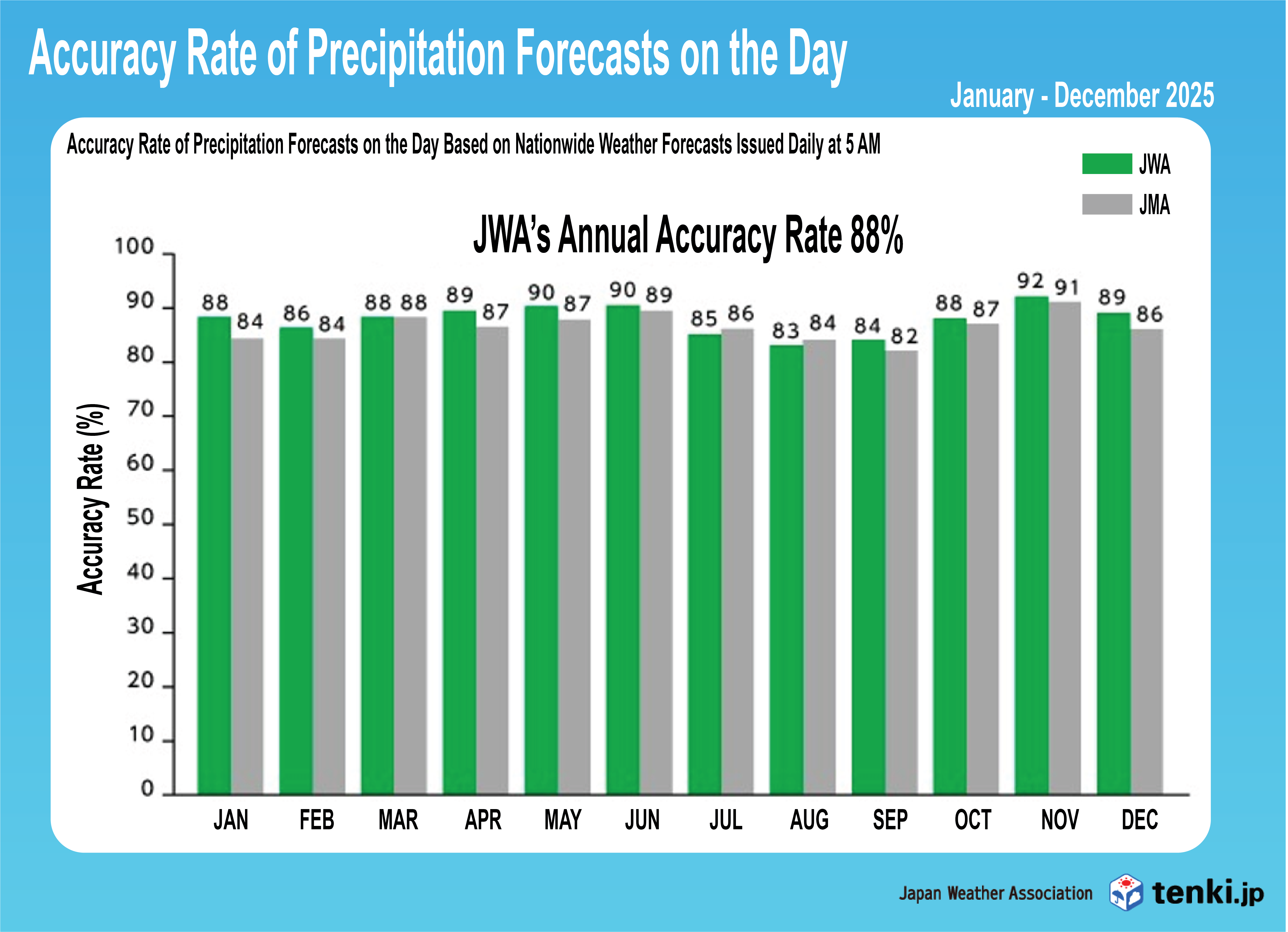
Calculation Method for the Accuracy Rate of Precipitation Forecasts on the Day
Key Points of the Evaluation Method
- Evaluated based on forecasts issued at 5 AM on the day
- Determined by whether total precipitation between 5 AM and midnight (24:00) reaches 1 mm or more (0.5 mm or more for snow)
- Timing differences are not considered; evaluation is based solely on the presence or absence of precipitation
The “accuracy rate of precipitation forecasts on the day” evaluates whether total precipitation of 1 mm or more (or 0.5 mm or more in the case of snow) occurred between 5 AM and midnight (24:00), based on the forecast issued at 5 AM that morning.
Therefore, even if the timing of rainfall at a specific location differs between the forecast and the actual observation, the forecast is considered accurate as long as precipitation occurs (or does not occur) at some point during the day.
*Detailed Calculation Method for the “Accuracy Rate of Precipitation Forecasts on the Day”
JWA also considers it important to accurately forecast hourly weather conditions.
This is because forecasts that not only indicate whether it will rain during the day at a given location, but also predict the timing of rainfall —such as rain beginning at 2 PM on that day—enable people to prepare and respond in advance, making them useful for both daily life and business.
For this reason, JWA conducts verification not only of the “accuracy rate of precipitation forecasts on the day,” but also of the “accuracy rate of hourly weather forecasts for the following day,” with the aim of improving the accuracy of hourly forecasts.
Verification Results for the Accuracy Rate of Hourly Weather Forecasts for the Following Day (January–December 2025)
We evaluated hourly weather forecasts for the following day issued at 5 PM for 141 locations in representative cities across Japan, verifying whether the forecasted conditions—clear, cloudy, rain, sleet (rain or snow), and snow—matched the actual weather.
As a result of verification for October through December 2025, the accuracy rate of the “JWA Blend of Models” was 69% in October, 71% in November, and 70% in December, exceeding the accuracy rates of JMA in each month.
(Results are presented together with those from the previous verification period, January–September 2025.)
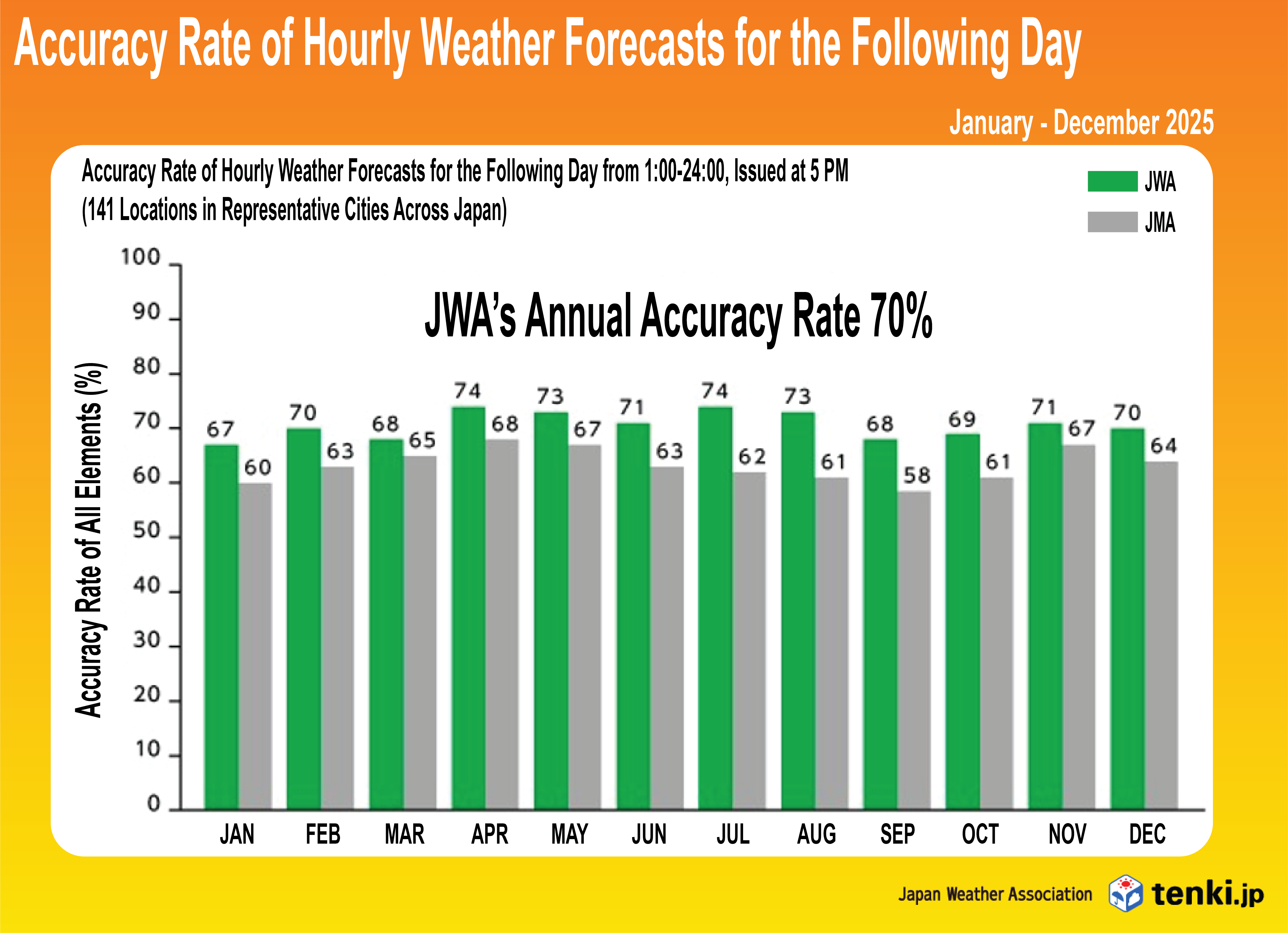
Across the three months from October through December, the accuracy rate of the “JWA Blend of Models” exceeded that of the JMA by an average of 6 percentage points.
In addition, the annual accuracy rate of the “JWA Blend of Models” for the “hourly weather forecasts for the following day” in 2025 was 70%, which was approximately the same as in 2024.
Calculation Method for the Accuracy Rate of Hourly Weather Forecasts for the Following Day
Key Points of the Evaluation Method
- Evaluated based on the forecasts issued at 5 PM on the previous day
- Verified whether hourly weather conditions were accurately forecast
- Evaluated including the specific timing (e.g., “It will rain at 2 PM tomorrow”)
The “accuracy rate of hourly weather forecasts for the following day” uses weather forecasts for the following day from JWA’s “JWA Blend of Models” and the JMA’s “Area Distribution Forecasts.”
Actual weather conditions are based on JMA’s weather analysis map. Forecasts and actual weather are compared hour by hour, and each forecast is classified as either accurate or inaccurate.
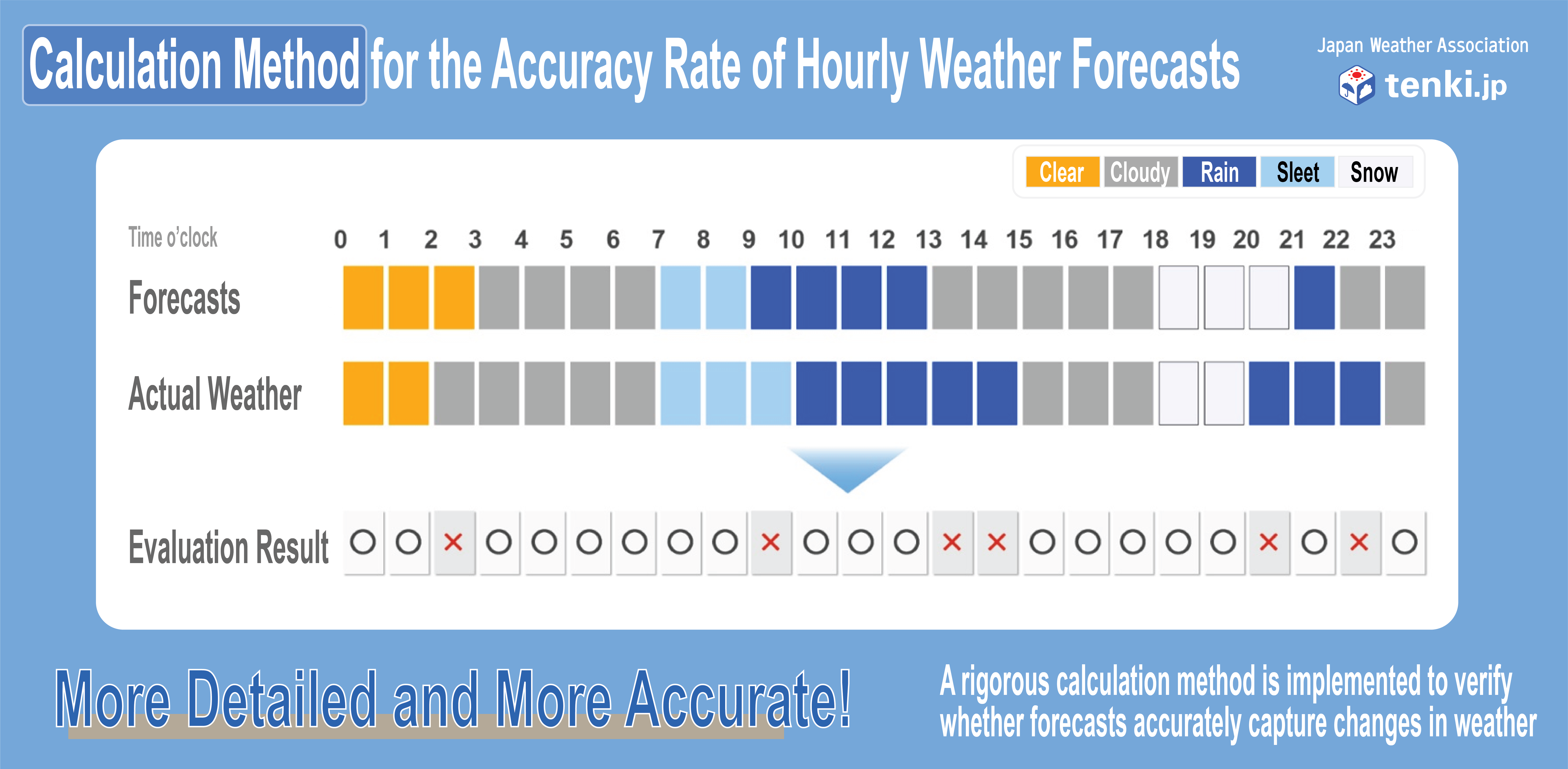
*Detailed Calculation Method for the “Accuracy Rate of Hourly Weather Forecasts for the Following Day” (Only Available in Japanese).
Key Focus Areas
- Improving not only the accuracy of precipitation occurrence forecasts on the day, but also the accuracy of hourly weather forecasts
- Providing forecast information that is useful for daily life and business
Under complex and rapidly changing weather conditions, accurately forecasting both the timing and type of weather is extremely challenging.
Verification of Maximum Temperature Forecasts During the Extreme Heat of Summer 2025
In summer 2025 (June–August), the nationwide average temperature was the highest on record, and on August 5, Isesaki City, Gunma Prefecture recorded a maximum temperature of 41.8°C, setting a new national record.
In this verification, we evaluated the accuracy of maximum temperature forecasts in August 2025, a month marked by extreme heat.
We compared maximum temperature forecasts from the “JWA Blend of Models” with those from JMA.
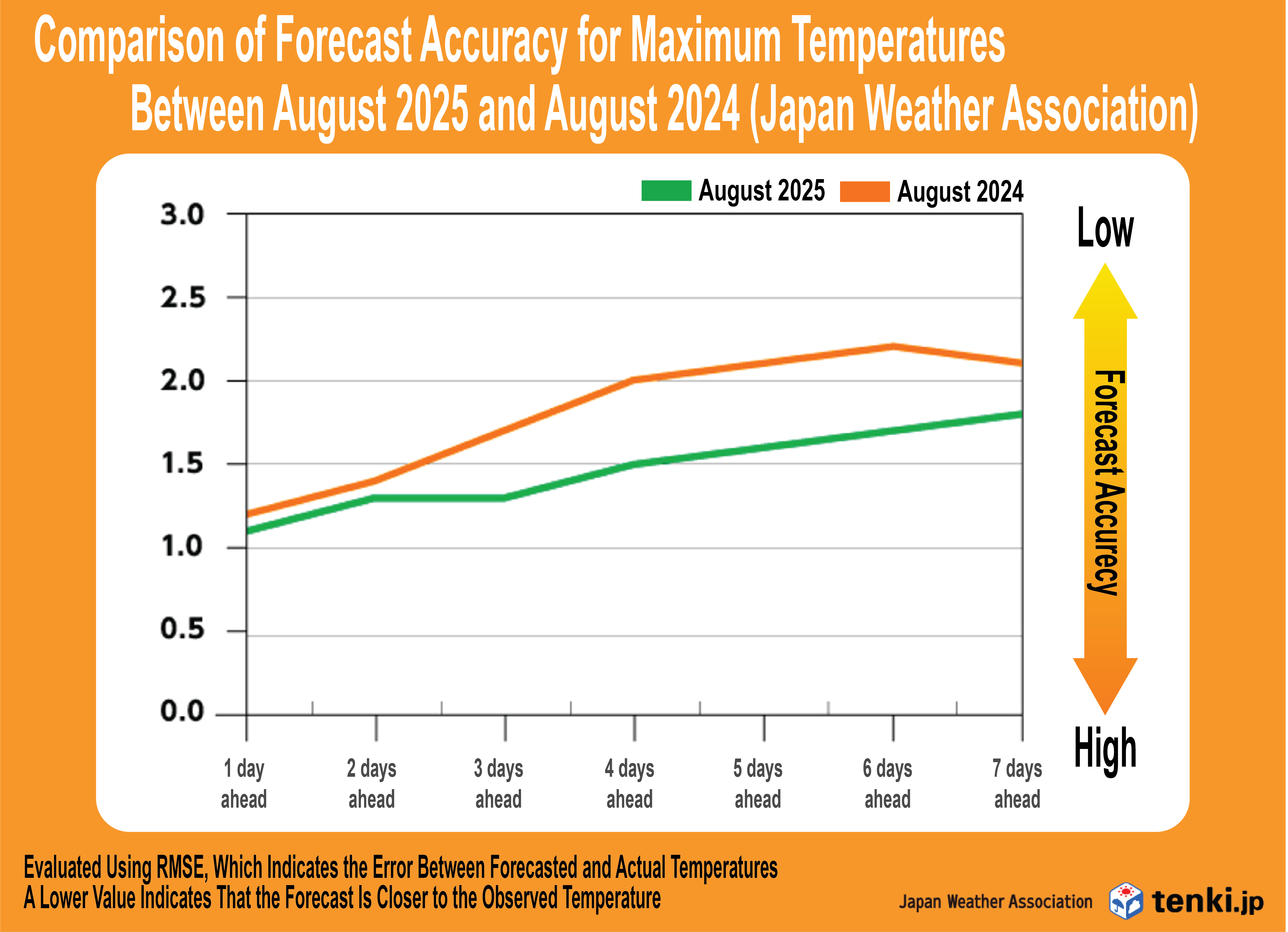
As a result, for all forecast periods from the following day up to seven days ahead, the temperature forecast error (RMSE: Root Mean Squared Error) of the “JWA Blend of Models” was smaller than that of JMA forecasts. Since RMSE represents the magnitude of errors between forecasted and observed temperatures, a lower RMSE indicates a forecast closer to the observed temperature.
For the “JWA Blend of Models,” the forecast error (RMSE) generally remained within approximately 2°C, maintaining stable accuracy even in August 2025, when extreme high temperatures were recorded.
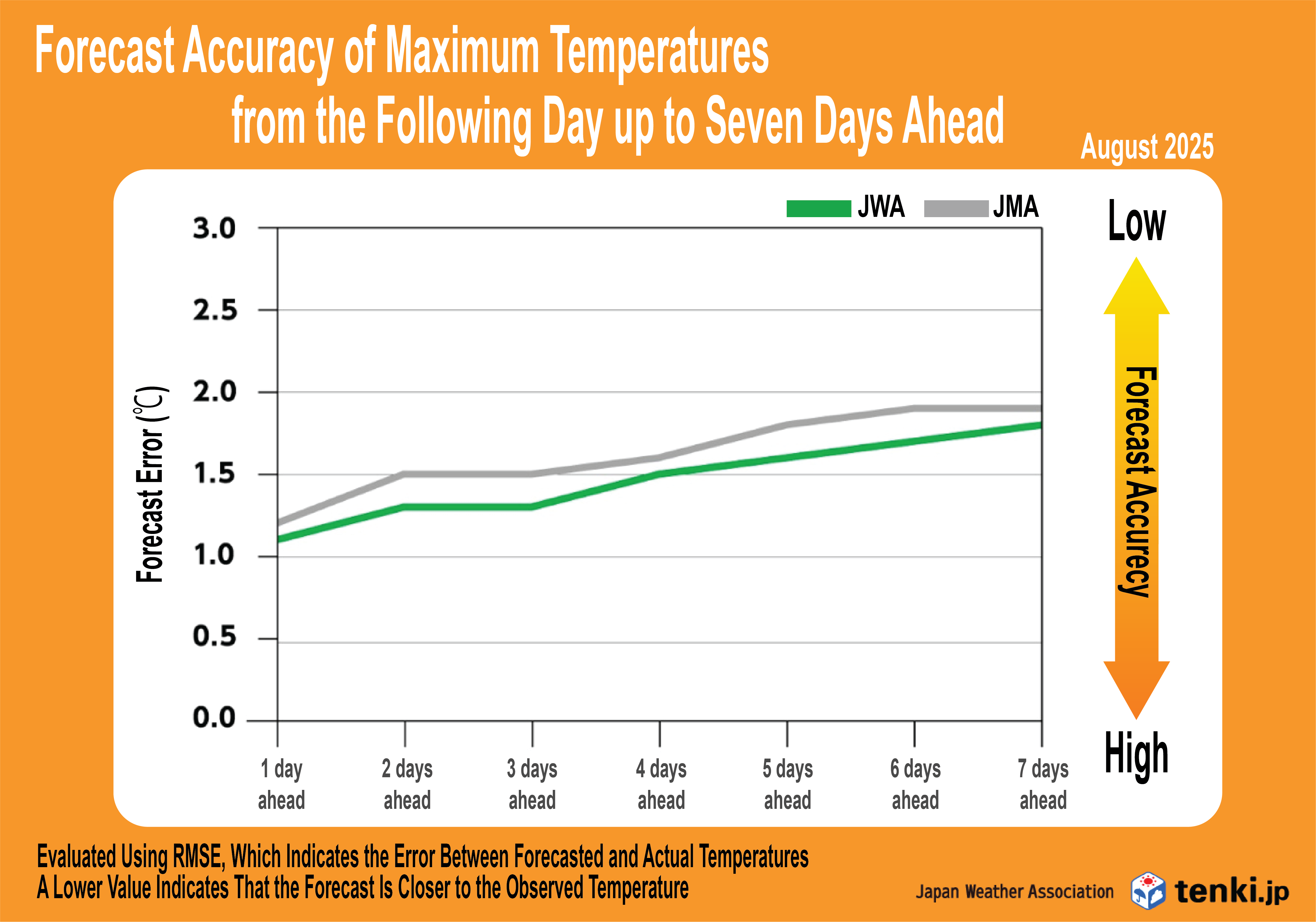
Compared with August 2024, forecast errors in August 2025 were generally smaller overall.
This improvement is attributed to the accumulation of observational data, which enhanced both key processes—the correction process, one of the key features of the “JWA Blend of Models,” and the integration of forecast models from multiple meteorological agencies—resulting in higher accuracy.
Comparison of forecast accuracy for maximum temperatures between August 2025 and August 2024 (Japan Weather Association)
Verification Method for Maximum Temperature Forecast Accuracy
Details of the Verification Method for Maximum Temperature Forecast Accuracy
- Period: August 1–31, 2024, and August 1–31, 2025
- Forecast Period: From the following day up to seven days ahead
- Element: Daily maximum temperature
- Locations: 56 meteorological stations
- Forecasts
Japan Weather Association: “JWA Blend of Models” (maximum and minimum temperatures), issued at 11 AM
Japan Meteorological Agency (JMA): Weather forecasts (maximum and minimum temperatures), issued at 11 AM - Observed Temperature
Observed temperature values from JMA’s AMeDAS (daily maximum and minimum temperatures) - Verification Method
The Root Mean Squared Error (RMSE), one of the indicators representing the magnitude of forecast errors, was calculated from the forecast values and observed values, and the results were compared.
On August 5, when a new national record for maximum temperature was set, forecasts had indicated as early as nine days in advance that temperatures in northern Kanto could exceed 40°C, and three days in advance that some areas could reach around 42°C. This enabled the potential for dangerous heat conditions to be identified ahead of time.
Maintaining the reliability of forecasts even during extreme weather events is an important factor for both daily life and business activities.
Being able to forecast extreme temperatures—such as maximum temperatures of 40°C—in advance can support a wide range of decisions, including power supply-demand planning, heatstroke prevention measures, demand forecasting for beverages and ice cream products, and apparel inventory adjustments in business. It is also useful in daily life for planning events and classes, scheduling outings, and preparing necessary items in advance.
JWA will continue working to improve its forecasting so that more accurate weather forecasts can be utilized in daily life and business activities.
Weather Forecast Services by JWA
Weather and business are closely related, and it is often said that one-third of all industries worldwide are exposed to weather-related risks.
JWA’s highly accurate weather data can help reduce various types of losses in business operations, including waste loss and opportunity loss, while also supporting labor saving, operational efficiency, and cost reduction.
Weather Data API
Weather Data API is a weather service (Web API / JSON format) that allows users to obtain meteorological data for any location on a 1 km mesh, including historical observation data and weather forecasts up to eight weeks ahead.
Users can retrieve data such as temperature, humidity, precipitation, snowfall, wind direction and speed, and weather conditions in a single request through a user-friendly API.
The Weather Data API is available in two versions: the Japan version, which covers Japan, and the Global version, which covers locations both within Japan and internationally.
For an overview, please see: Weather API Overview
2-Year Long-Term Weather Forecast (Only Available in Japanese)
JWA has developed an industry-first forecasting method that offers higher accuracy and longer forecast periods than the conventional approach.
As weather-related risks such as sudden extreme heat, prolonged late-summer heat, heavy rainfall, and heavy snowfall increase, highly accurate long-term forecasts play an important role in enabling well-informed decision-making in key business areas such as annual planning, procurement and ordering of materials, production and sales planning, advertising planning, and new product development.
* For details on 2-Year Long-Term Weather Forecast, please click: What are Long-Term Forecasts? JWA’s Proprietary “2-Year Long-Term Weather Forecast” and Its Business Applications Part 1 / Part 2
* Accuracy and use cases of the 2-Year Long-Term Weather Forecast (Only Available in Japanese)
* Case study: Reducing fashion loss at Adastria Co., Ltd. using the Two-Year Long-Term Weather Forecast (Only Available in Japanese)
Product Demand Forecasting
JWA analyzes product sales data together with weather data to forecast product demand and customer traffic. This enables businesses to adjust production volumes and optimize inventory management.