News
Heat-Related Illness and Business Risk: How Should Workplaces Prepare for Japan’s Summer Heat?
2026.09.11
Japan’s summers are characterized not only by high temperatures but also by high humidity, making precautions against heat-related illness essential in everyday life, outdoor activities, and the workplace. In recent years, temperatures of 35°C or higher have become increasingly common, making heat preparedness an indispensable part of every summer.
Heat is not only a personal health issue. It is also a significant business risk that can affect work safety, outdoor operations, logistics, event management and other business activities.
Weather-related risks to human health, including heat-related illness, cannot always be assessed by temperature alone.
In Japan, Wet Bulb Globe Temperature (WBGT), which takes into account not only air temperature but also humidity, solar and radiant heat, wind, and other factors, is widely used as an indicator of heat stress risk.
This article explains the key measures for preventing heat-related illness during Japan’s summer and introduces WBGT, an indicator used to assess and manage heat stress risk in the workplace.
Table of Contents
- What Is Heat-Related Illness?
- Why Does Summer in Japan Pose a Heat Stress Risk (High Temperature + High Humidity)?
- How Can Heat Stress Risk in Japan Be Assessed?
- Measures to Prevent Heat-Related Illness in Japan
- How Heat Stress Affects Business Operations
- JWA’s 2025 Assessment: Can Temperature Forecasts Help Identify Heat Stress Risk Earlier?
- JWA Information Can Support Heat Stress Risk Management in Workplaces
- Conclusion: Advance Preparation Is Important for Both Individuals and Workplaces Facing Summer Heat in Japan
- FAQ | Frequently Asked Questions
What Is Heat-Related Illness?
Heat-related illness is a general term for a range of symptoms and health conditions that occur when the body is unable to adapt to hot and humid environments.
When heat is generated within the body, body temperature is regulated by releasing heat from the skin and by evaporating sweat, both of which help remove heat to the surrounding air. When environmental conditions such as high temperatures and humidity, strong sunlight, and weak wind combine with physical and behavioral factors such as strenuous exercise or work, the body may become unable to cope with the heat, resulting in heat-related illness. Heat-related illness is not limited to outdoor settings. Hot, humid, and poorly ventilated indoor environments can also pose a risk.
In Japan, WBGT is widely used as an indicator for assessing the risk of heat-related illness.
To stay safe during the summer in Japan, it is important not to wait until you feel hot before taking action. Instead, check forecasts and other information in advance to understand expected heat conditions and adjust your activities accordingly.
Why Does Summer in Japan Pose a Heat Stress Risk (High Temperature + High Humidity)?
Summers in Japan are not only hot but also highly humid. Because sweat evaporation is reduced and heat dissipation from the body becomes less effective, these conditions increase the risk of heat-related illness.
Characteristics of Summer in Japan: Extreme Heat and Humidity, High Perceived Temperature
One of the most distinctive features of Japan’s summer is its high temperature and high humidity. Daytime temperatures often exceed 30°C for several consecutive days, and in some regions, days with temperatures reaching 35°C or higher are common.
Humidity levels are also very high. In Tokyo, for example, the average relative humidity during summer is around 75%. High temperature and high humidity significantly raise the perceived (or “feels like”) temperature, making it feel even hotter than what the thermometer indicates.
* For details on temperatures and humidity in summer in Japan: Summer Weather in Japan
The strain that this kind of heat places on the body is not determined by temperature alone. High humidity makes it harder for sweat to evaporate, reducing the body’s ability to cool itself. Strong sunlight adds more heat to the body, and light winds make it difficult for heat to escape. Together, these conditions can increase the risk of heat-related illness.
In other words, when assessing heat stress risk in Japan’s summer, it is important to consider not only temperature but also other factors, including humidity, solar and radiant heat, and wind.
High Temperatures Are Becoming Commonplace in Japan
In Japan, days with maximum temperatures of 35°C or higher are no longer unusual. Nationwide, the number of days with maximum temperatures reaching 35°C or higher has increased over the long term, and in recent years many summers have experienced prolonged periods of intense heat.
*For more information on summer heat trends in Japan: Summer Weather in Japan
In recent years, extreme heat with maximum temperatures of 40°C or higher has also been recorded in various parts of the country.
Given these trends, it is increasingly important to view heat stress risk not as a “rare or exceptional event,” but as a recurring summer risk that requires preparation every year.
How Can Heat Stress Risk in Japan Be Assessed?
Identifying Periods of High Temperature and Humidity
For the prevention of heat-related illness, it is important not only to check temperatures on the day itself, but also to identify days and times when high temperatures and humidity are expected several days in advance.
For travel, outings, and outdoor activities, checking weather forecasts and weekly forecasts can help people prepare appropriate clothing and supplies or adjust the timing of their activities.
The same principle applies in the workplace. By identifying in advance the dates and times when high temperature and humidity are expected, workplaces can prepare and plan work schedules, break arrangements, staffing levels, and operational workflows accordingly.
What Is WBGT?
Wet Bulb Globe Temperature (WBGT), commonly referred to in Japan as the Heat Stress Index, is widely used to assess the risk of heat-related illness.
WBGT is a thermal index calculated using four environmental factors: air temperature, humidity, solar radiation and radiant heat, and wind. It is used to evaluate the level of heat stress that people are exposed to in their environment.
Even at the same temperature, the strain on the body can vary depending on factors such as humidity, exposure to strong sunlight, and wind conditions. For this reason, heat-related illness prevention requires a comprehensive assessment of the thermal environment using WBGT and other indicators, rather than relying solely on maximum temperature.
WBGT was first proposed in the United States in 1954 as a tool for preventing heat-related illness.
In Japan, WBGT is recommended by the Ministry of Health, Labour and Welfare, the Ministry of the Environment, and other government agencies as an important indicator for heat-related illness prevention. It is used not only for individual decisions related to outdoor activities and exercise, but also for managing heat-related illness risk in workplaces such as construction sites, factories, and logistics operations.
Information on Heat Stress Risk in Japan: Heat Stroke Alerts
In Japan, the Ministry of the Environment and the Japan Meteorological Agency issue Heat Stroke Alerts.
These alerts are issued when the risk of heat-related illness is forecast to become extremely high based on predicted WBGT values. Japan is divided into 58 alert regions, and an alert is issued when a WBGT value of 33 or higher is forecast within a region. In addition, a Special Heat Stroke Alert is issued when exceptionally dangerous and unprecedented heat is forecast over a wide area, based on a predicted WBGT value of 35 or higher.
The Ministry of the Environment’s English website, Heat Illness Prevention Information, provides current alert information and updates.
For travelers and for use in daily life, the Heat Stroke Alerts are extremely useful as a source of information on heat stress risk across Japan.
However, when making operational decisions in the workplace, more detailed information may be required, including:
- Conditions at specific company sites or work locations
- The times of day when risk is expected to peak
- How conditions may change over the coming days or weeks
Measures to Prevent Heat-Related Illness in Japan
Preventing heat-related illness involves more than simply responding once temperatures rise. Effective prevention begins with preparing in advance by understanding when hot conditions are expected, adjusting plans accordingly, avoiding excessive heat exposure during the day, staying hydrated and replenishing electrolytes regularly, taking frequent breaks, and maintaining good physical health.
Use Forecasts to Identify When Heat Stress Risk is Expected to Increase
If you are planning to travel, go on an outing, or participate in outdoor activities, check weather forecasts and Heat Stroke Alerts in advance to understand when heat conditions are expected to become severe, both in terms of the day and the time of day. Checking WBGT forecasts is particularly useful, both on a daily basis and, for the short term, on an hourly basis.
By knowing in advance when WBGT levels are expected to be high, you can prepare appropriate clothing and supplies, adjust your schedule, and reconsider the timing of outdoor activities.
Adjust Schedules and Plans According to the Expected Heat Stress Risk
When extreme heat is forecast, modifying schedules and activities can be an effective way to reduce the risk of heat-related illness. For example, outdoor activities that involve prolonged exposure to the heat can be rescheduled to cooler days or times of day, time spent in direct sunlight can be reduced, and outdoor activities can be combined with time in air-conditioned indoor facilities.
The same principle applies in the workplace. When heat stress risk can be anticipated in advance, organizations can consider adjusting the timing of outdoor work, modifying work processes, and planning staffing arrangements before conditions become severe. Because forecast information such as WBGT is available both on a daily basis and, for the short term, on an hourly basis, it can be used not only for same-day operational decisions but also for planning work activities several days in advance.
When Heat Stress Risk Is High, Avoid Heat Exposure and Prioritize Rest, Hydration, and Personal Wellbeing
On hot days, seek out shaded areas or air-conditioned environments and take regular breaks without overexerting yourself. It is important to drink fluids frequently, even if you do not feel thirsty. If you are sweating heavily, be sure to replenish electrolytes as well as fluids.
Maintaining good health on a daily basis is also essential. This includes getting adequate quality sleep, avoiding excessive alcohol consumption, and following a balanced diet.
Particular care is required during periods when the body has not yet adapted to hot conditions. One effective preventive measure is heat acclimatization, which involves gradually helping the body adapt to heat through moderate exercise and other activities before the onset of hot weather.
The Heatstroke Zero Project promoted by Japan Weather Association (JWA) also provides information and practical guidance on preventing and managing heat-related illness.
How Heat Stress Affects Business Operations
Heat-related illness is not only a personal health issue for workers but also a business risk that can affect workplace safety, productivity, and business continuity.
Risks Exist Not Only Outdoors but Also in Factories, Warehouses, and Other Indoor Work Environments
Extra caution is required in locations that are prone to high temperatures and humidity, areas exposed to direct sunlight, and workplaces involving physically demanding tasks.
In addition to assessing thermal conditions using WBGT, effective heat-related illness prevention measures should consider factors such as workload intensity, clothing and personal protective equipment requirements, and the duration of continuous work.
According to the Ministry of Health, Labour and Welfare’s Status of Occupational Accidents Due to Heatstroke in the Workplace in 2025 (Final Figures), the industries with the highest combined number of heatstroke-related injuries and fatalities between 2021 and 2025 were manufacturing, construction, and transportation. Looking at fatalities alone, construction recorded the highest number of deaths, followed by security services and manufacturing, highlighting the elevated risks faced by workers in outdoor and high-heat environments.
High Temperatures Also Affect Work Planning, Production, and Logistics
The impacts of extreme heat extend beyond worker health and can influence a wide range of operational decisions, including:
- Adjusting or suspending outdoor work schedules
- Modifying work processes or project timelines
- Adjusting staffing levels and break schedules
- Revising delivery and logistics plans
- Modifying event operations
- Responding to changes in customer footfall and product demand
In other words, managing heat stress risk requires both day-to-day heat-related illness prevention measures and proactive business planning. JWA provides examples of how WBGT data and weather forecasts can support decisions on work scheduling, break arrangements, staffing, and other operational activities.
Related articles (only available in Japanese)
- How Should Workplaces Use WBGT to Make Heat-Related Illness Prevention Decisions? Choosing Between On-Site Measurements, Alerts, and Data Integration
- Heat-Related Illness Prevention in Factories and Warehouses: Key Considerations for Managing Heat Stress Risk Using Forecasts, Observations, and Site-Specific Analysis
Heat-Related Illness Prevention Measures Become Mandatory in Workplaces in Japan
As of June 1, 2025, amendments to Japan’s Ordinance on Industrial Safety and Health require companies to implement heat-related illness prevention measures when work is conducted for a certain period of time in environments where the WBGT is 28°C or higher or the temperature is 31°C or higher.
This regulation mandates that businesses take concrete steps to protect workers from heat-related risks, particularly during Japan’s increasingly hot and humid summers.
Details: “From June 1, Heatstroke Prevention Measures Become Mandatory in Workplaces – Required Actions and Use of WBGT” (only available in Japanese)
JWA’s 2025 Assessment: Can Temperature Forecasts Help Identify Heat Stress Risk Earlier?
When responding to heat stress risk, relying solely on same-day WBGT conditions may make it difficult for organizations to make significant adjustments to work schedules, staffing arrangements, production activities, or shipment plans.
If periods of unusually high temperatures can be identified several days in advance, businesses can evaluate work schedules, staffing requirements, break arrangements, and other operational measures before conditions become severe. The ability to forecast high temperatures and humidity accurately and as early as possible is therefore critical for effective planning and risk management.
JWA Forecast Accuracy Assessment: Verification of Maximum Temperature Forecasts for Summer 2025
In summer 2025 (June–August), Japan’s nationwide average temperature was the highest on record.
JWA evaluated the accuracy of maximum temperature forecasts for August 2025, a month marked by particularly severe heat.
To assess forecast accuracy, JWA compared maximum temperature forecasts generated using the JWA Blend of Models with those issued by the Japan Meteorological Agency (JMA).
As a result, JWA forecasts recorded lower forecast errors (RMSE: Root Mean Squared Error) than JMA forecasts across all forecast lead times, from the following day up to seven days ahead. A lower RMSE indicates smaller overall forecast errors.
For the “JWA Blend of Models,” the forecast errors (RMSE) generally remained within approximately 2°C, maintaining stable accuracy even in August 2025, when extreme high temperatures were recorded.
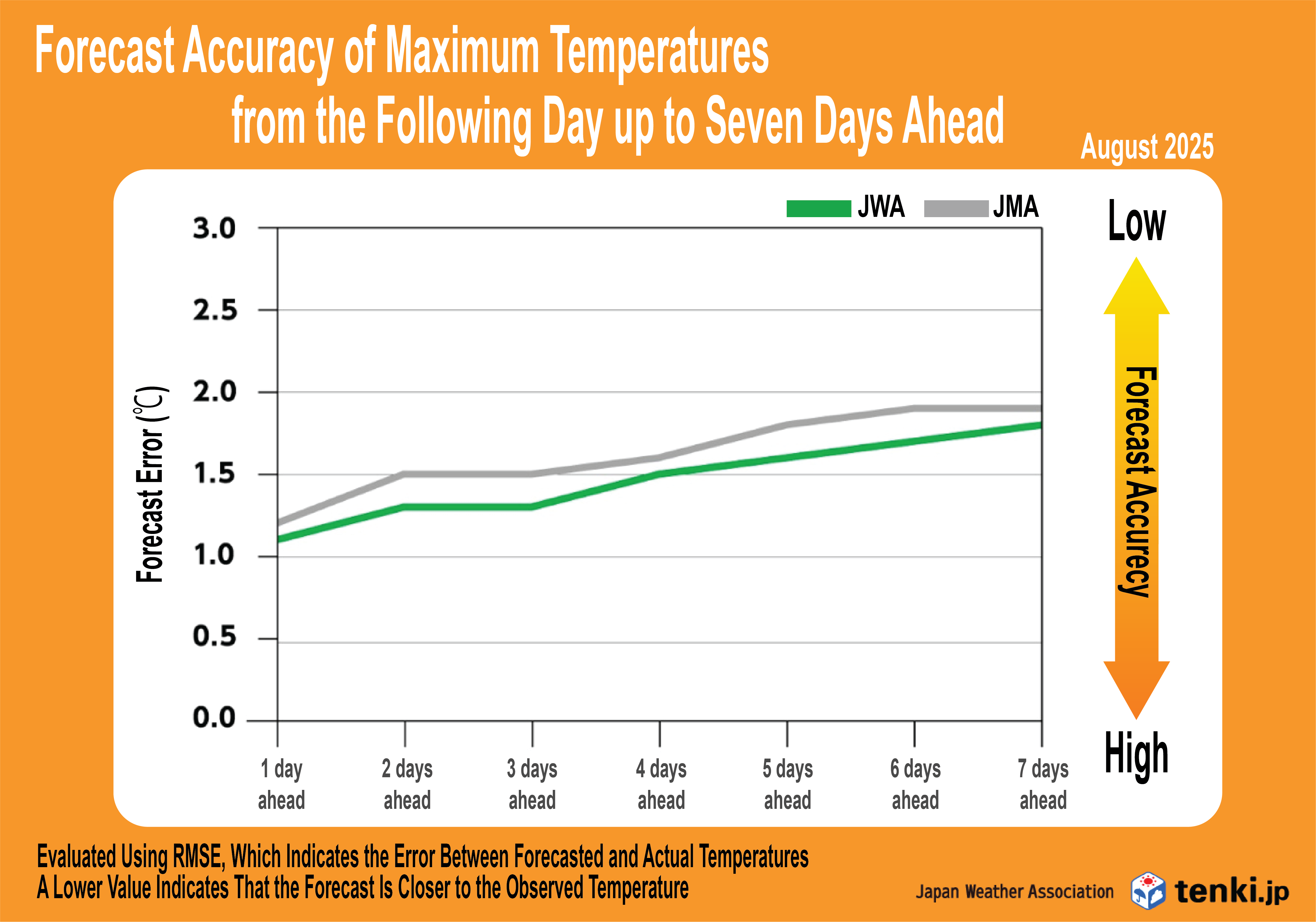
Details of the verification of maximum temperature forecasts for summer 2025: 2025 Japan Weather Association’s Forecast Accuracy Verification Results
JWA Forecast Accuracy Assessment: Verification of Daily Maximum Temperatures of 40°C or Higher in 2025
In the summer of 2025, daily maximum temperatures of 40°C or higher were recorded in 30 cases across 25 of the 914 locations comprising meteorological observatories and AMeDAS stations nationwide.
JWA examined the day-ahead forecasts for these 30 cases from its proprietary weather forecasting system, the “JWA Blend of Models.” The verification found that the errors between the forecast and observed maximum temperatures were within 1.0°C in 18 cases (60%) and within 2.0°C in 26 cases (87%).
When evaluated solely against the threshold of whether 40°C or higher was successfully forecast, cases in which temperatures were forecast to reach the upper 39°C range but ultimately exceeded 40°C would be counted as missed events. However, from an operational decision-making perspective, a forecast in the upper 39°C range still indicates dangerously high temperatures and should prompt appropriate preparation.
In heat stress risk management, it is important not only to assess whether a specific temperature threshold will be reached, but also to identify the possibility of dangerous high temperatures at an early stage and begin preparations accordingly.
Details of the forecast accuracy verification results: How Accurately Were Days with Daily Maximum Temperatures of 40°C or Higher Forecasted? Verification of Maximum Temperature Forecasts of 40°C or Higher (only available in Japanese)
JWA Information Can Support Heat Stress Risk Management in Workplaces
Effective heat stress risk management in workplaces requires understanding when, where, and how severe heat conditions are likely to become and translating that information into specific operational decisions.
JWA provides WBGT and a range of weather forecast data tailored to workplace applications.
Assess Heat Stress Risk in Advance
The Weather Data API enables weather information to be integrated into workplace systems and services, allowing location-specific weather forecasts and WBGT data to be incorporated into operational decision-making. JWA also provides WBGT data at 1-km grid resolution, enabling workplaces to assess heat stress risk at business sites and work locations at a finer spatial scale than official alerts.
In addition to API services, JWA offers a variety of data delivery options and weather risk information tailored to business needs. This supports the development of a structured heat stress risk management process: forecasting extreme heat, assessing risks, and adjusting work schedules, staffing arrangements, and other operational activities in advance.
Heat-related Illness Prevention Measures for Extreme Heat
The Heatstroke Zero Project, promoted by JWA, aims to reduce the number of people affected by heat-related illness, including heatstroke, and ultimately eliminate heat-related deaths.
The Project provides information on heat-related illness symptoms, prevention measures and the use of WBGT, offering practical guidance that can be applied in both daily life and workplaces.
These resources can also support workplace safety initiatives, including employee education and heat-related illness awareness campaigns.
Addressing Heat Stress Risk Specific to Each Workplace
Even under the same thermal conditions, heat stress risks vary depending on the region, facility, and type of work being done.
JWA also supervises the use of black globe thermometers for heat-related illness prevention, which can be used to monitor WBGT, temperature, and humidity in indoor facilities and support decisions on break arrangements, work adjustments, and heat-related alerts on the day.
In addition, JWA also provides services such as analysis of past cases using open data and consulting tailored to specific workplace challenges.
Whether you want to understand heat stress risks across different locations in Japan, integrate WBGT data into operational systems, or incorporate weather forecasts into work planning, please feel free to contact us to discuss heat stress risk measures tailored to your workplace.
Conclusion: Advance Preparation Is Important for Both Individuals and Workplaces Facing Summer Heat in Japan
Summers in Japan are hot and humid, and temperatures of 35°C or higher are no longer unusual. To prevent heat-related illness, it is important not to wait until conditions become hot, but rather to assess heat stress risk in advance using forecasts and other available information, and take appropriate action such as changing activity schedules, increasing break frequency, and avoiding excessive heat exposure.
The same principle applies to managing heat stress risk in the workplace. To maintain business operations while protecting workers’ safety, heat should be viewed not only as a “matter of day-to-day health management” but also as a business risk that needs to be identified in advance and incorporated into operational planning.
JWA provides forecast information such as WBGT and temperature forecasts, Weather Data API services, and 1-km resolution WBGT data. Please feel free to contact us.
FAQ | Frequently Asked Questions
Q. Why is it necessary to take precautions against heat-related illness during summer in Japan?
A. Summers in Japan are not only hot but also humid, making it difficult for sweat to evaporate and reducing heat loss from the skin, which limits the body’s ability to cool itself effectively. Strong solar radiation and low wind speeds can further increase the risk of heat-related illness.
Q. What is WBGT, and how is it used in Japan to assess heat-related illness risk?
A. Wet Bulb Globe Temperature (WBGT) is an index calculated based on four environmental elements: air temperature, humidity, solar radiation/radiant heat, and wind. It is used to assess heat stress on the human body under hot and humid environments and is widely utilized in evaluating the risk of heat-related illness.
Q. What measures are needed to prevent heat-related illness during summer in Japan?
A. It is important to check weather forecasts and other sources of heat-related information in advance and review activity schedules when high temperatures are expected. On hot days, avoid excessive heat exposure, take frequent breaks, and regularly replenish fluids and electrolytes. Maintaining good health through adequate sleep and proper nutrition is also important.
Q. How do extreme heat and high temperatures affect workplaces such as businesses in Japan?
A. High temperatures affect not only the risk of heat-related illness among workers, but also work schedules, operational processes, staffing, logistics, event management and other business activities. Workplaces therefore need both same-day safety measures and advance operational planning that anticipates heat-related risks.
Q. How can workplaces use weather forecasts and WBGT data to prepare for heat stress risk?
A. By using weather forecasts and WBGT data to understand “when, where, and how severe heat conditions are likely to become,” workplaces can adjust work schedules, break arrangements, staffing, and operational processes in advance. It is important to assess heat stress risk and translate that information into specific operational decisions.